Pacific Sacred Art: Easter Island, Maori, and the Oceanic Imagination
The Pacific Ocean covers more than a third of the Earth's surface — the largest geographic feature on the planet. The peoples who navigated it, settled its islands, and built civilizations from Hawaii to New Zealand to Easter Island were among the most extraordinary navigators and cultural creators in human history. Their sacred art traditions reflect the specific spiritual challenges of ocean existence: the world as water and islands, ancestors as the source of all power and identity, the body as the primary medium of sacred marking, and the community as the primary vehicle of spiritual practice. The moai of Easter Island (Rapa Nui), the carved meeting houses (wharenui) of the Maori, the tattoo traditions of Polynesia — all encode a worldview in which the boundary between the living and the dead is permeable, in which the ancestors are continuously present, and in which art is the primary technology for maintaining that presence.
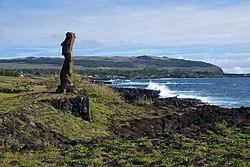 [Unavailable: ❌ https://upload.wikimedia.org/wikipedia/commons/thumb/8/8e/Easter_Island_5.jpg/250px-Easter_Island_5.jpg ❌]
Moai at Ahu Tongariki, Easter Island (Rapa Nui) — the largest ahu (stone platform) on the island, with 15 restored moai; the moai are not idols but ancestor figures — each one represents a deified chief or ancestor whose mana (spiritual power) was activated by the pukao (red topknot) placed on the head and by the coral eyes that were inserted during ceremonies
 [Unavailable: ❌ https://upload.wikimedia.org/wikipedia/commons/thumb/a/a2/Moai_Rano_raraku.jpg/250px-Moai_Rano_raraku.jpg ❌]
Moai at Rano Raraku quarry, Easter Island — nearly 400 moai remain in various stages of completion at the volcano quarry where they were carved; the largest moai ever attempted would have been 21 meters tall; the island's population collapsed before it could be moved; the unfinished giants stand in the quarry as testimony to an ambition that outran the civilization's capacity to fulfill it
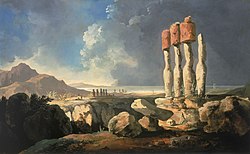 [Unavailable: ❌ https://upload.wikimedia.org/wikipedia/commons/thumb/a/a8/Hodges_easter-island.jpg/250px-Hodges_easter-island.jpg ❌]
Easter Island by William Hodges (1776) — the official artist on Cook's second voyage drew the moai as a Romantic encounter with the mysterious past; the 18th-century Western imagination saw in the moai the evidence of a civilization now fallen, the sublime of ruined grandeur that Europe associated with ancient Egypt and Greece
 [Unavailable: ❌ https://upload.wikimedia.org/wikipedia/commons/thumb/a/a5/Habitans_de_L%27ile_de_Pasques_by_Louis_Choris_%28British_Museum%2C_Oc2006%2CPrt.62%29.jpg/250px-Habitans_de_L%27ile_de_Pasques_by_Louis_Choris_%28British_Museum%2C_Oc2006%2CPrt.62%29.jpg ❌]
Inhabitants of Easter Island by Louis Choris (1816) — the Rapa Nui people as recorded by European explorers; by this time, the island's population had been reduced by epidemic disease, slave raids, and ecological collapse from a peak of perhaps 15,000 to a few hundred; the moai builders' descendants were barely surviving
 [Unavailable: ❌ https://upload.wikimedia.org/wikipedia/commons/thumb/d/d1/TamatekapuaMeetingHouse.jpg/330px-TamatekapuaMeetingHouse.jpg ❌]
Tamatekapua Meeting House (Wharenui), Rotorua, New Zealand — the Maori meeting house (wharenui) is a sacred space whose architectural form represents an ancestor: the ridgepole is the backbone, the rafters are the ribs, the bargeboards are the arms; to enter a wharenui is to enter the body of the ancestor
 [Unavailable: ❌ https://upload.wikimedia.org/wikipedia/commons/thumb/d/d4/Tohunga_under_Tapu.jpg/250px-Tohunga_under_Tapu.jpg ❌]
Tohunga under Tapu — a Maori expert practitioner (tohunga) in a state of sacred restriction (tapu); the concept of tapu (from which the English word 'taboo' derives) is fundamental to Maori spiritual life: certain people, objects, and places are charged with so much mana that they must be kept separate from ordinary life to prevent spiritual damage
 [Unavailable: ❌ https://upload.wikimedia.org/wikipedia/commons/thumb/5/53/KupeWheke.jpg/250px-KupeWheke.jpg ❌]
Kupe and the Wheke (octopus), New Zealand — the legendary navigator Kupe is credited with the discovery of Aotearoa (New Zealand); his encounter with the great wheke (octopus) Te Wheke-a-Muturangi is one of the central narratives of Maori origin mythology; the sea, in Pacific tradition, is not a barrier but a highway, a medium through which ancestors travel
 [Unavailable: ❌ https://upload.wikimedia.org/wikipedia/commons/thumb/1/19/Pataka.jpg/250px-Pataka.jpg ❌]
Pataka (raised storehouse), Maori — the ornate carved storehouse, raised on a single post to keep food safe from rats; every surface is carved with interlocking koru (spiral forms representing new growth) and manaia (bird-human-fish spirit figures) that encode the genealogical and spiritual connections of the owning family
 [Unavailable: ❌ https://upload.wikimedia.org/wikipedia/commons/thumb/e/e7/Maori-rafter1.svg/250px-Maori-rafter1.svg.png ❌]
Maori rafter pattern — the characteristic kōwhaiwhai painted patterns on wharenui rafters; each pattern belongs to a specific iwi (tribe) and encodes genealogical information; the geometric spirals are not decorative — they are records, the visual equivalent of the whakapapa (genealogy) recited at formal occasions
Related Esoteric Inquiries:
- The Legend of the Easter Island Moai: The Giant Stone Heads of Rapa Nui, the Platforms of Ahu, and the Mystery of the Walking Statues
- Rongorongo: The Lost Writing of Easter Island That No Living Soul Can Read
- Día de los Muertos: Mexico's Sacred Conversation with the Dead
Lux Esoterica.
2026.


Comments