Feng Shui: The Ancient Art of Living in Harmony with the Flow of the Universe
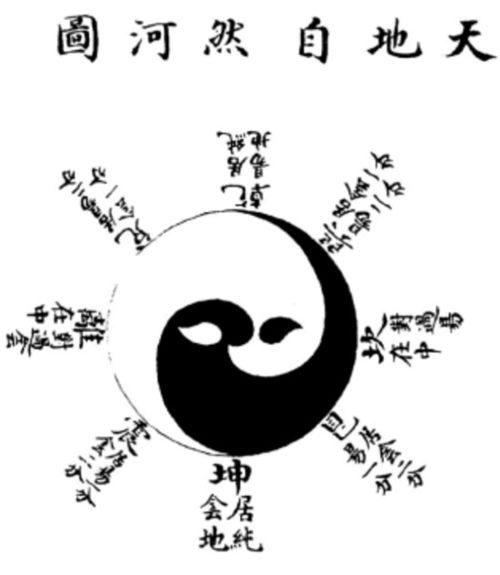
The Bagua — the eight trigrams of the I Ching arranged in their traditional octagonal configuration — is the foundational map of Feng Shui: each of the eight sections corresponds to a direction, an element, a quality of life, and a aspect of human experience
The name means wind and water (fēng shuǐ, 風水). These are the two most fluid, most pervasive, most essential of the natural forces — the medium through which the invisible current of cosmic energy, called qi (氣), flows through the landscape and through the spaces that human beings inhabit. To practice Feng Shui is to study how that flow moves, where it pools, where it stagnates, and how the arrangement of the built environment can align with it or work against it.
Feng Shui is among the oldest continuous intellectual traditions in human civilization. Its roots reach back more than three thousand years into Chinese cosmology, geomancy, and the observation of natural landscapes. It is both a science — a systematic body of knowledge about the relationship between space, energy, and human wellbeing — and a spiritual practice: a way of bringing the arrangement of daily life into alignment with the forces that move through the cosmos.
In its most simplified Western commercial form, Feng Shui has been reduced to furniture placement tips and lucky bamboo plants. But the tradition that underlies these popularizations is far more profound: a complete cosmological framework that draws on the same sources as Chinese medicine, martial arts, and the I Ching, and that addresses the fundamental question of how a human life can be lived in harmony with the natural world rather than in unconscious resistance to it.
The Philosophical Foundation: Qi, Tao, and the Living Universe
Feng Shui rests on three foundational concepts drawn from the deepest currents of Chinese philosophy.
The first is Qi (also written ch'i, pronounced "chee"): the universal life energy that flows through all things. Qi is not simply "energy" in the Western scientific sense — it is something closer to the animating principle of the universe, the force that makes a living organism alive rather than merely matter, that gives a landscape its felt quality of vitality or deadness, that moves through the body in the channels described by Chinese medicine as meridians. Everything that exists has Qi; everything is in relationship with everything else through the medium of Qi's flow.
The second is the Tao (道): the fundamental principle underlying all existence, the Way that cannot be named, the source from which all things arise and to which all things return. The Tao is not a god in the Western sense — it is more like the deep structure of reality, the pattern of patterns, the ground of being. To live in harmony with the Tao is to move with the grain of the universe rather than against it. Feng Shui is, at its root, a technology for aligning the arrangements of human life with the Tao's expression in space.
The third is the polarity of Yin and Yang (陰陽): the two fundamental forces whose interaction generates all the phenomena of the manifest world. Yang is active, bright, warm, ascending, masculine, solar. Yin is receptive, dark, cool, descending, feminine, lunar. Neither is superior to the other; neither can exist without the other; the interplay between them is the engine of change and life. A space, like a body or a season, can be too yang (overly active, stimulating, depleting) or too yin (stagnant, cold, draining). Feng Shui practice includes the diagnosis and correction of imbalances in the yin-yang quality of a space.
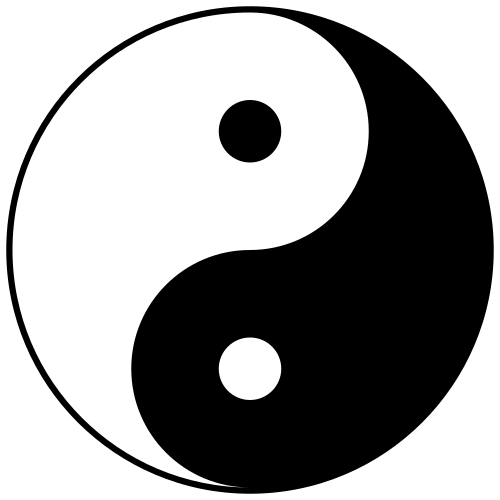
The taijitu — the yin-yang symbol — represents the dynamic balance of opposing forces that underlies all of Chinese cosmology. In Feng Shui, every space, direction, time, and element is analyzed in terms of its yin-yang quality and its position within the cycle of continuous change
The Five Elements: A Map of Transformation
Central to Feng Shui practice is the Chinese doctrine of the Five Elements (Wǔ Xíng, 五行): Wood, Fire, Earth, Metal, and Water. These are not simply materials but phases of energy — dynamic qualities of transformation that cycle through each other in two fundamental sequences.
In the Generating Cycle (Sheng cycle), each element feeds and strengthens the next: Wood feeds Fire; Fire creates Earth (ash); Earth produces Metal (ore); Metal collects Water (condensation); Water nourishes Wood. This is the cycle of creative support: when elements follow this sequence in a space, energy flows and builds naturally.
In the Controlling Cycle (Ke cycle), each element restrains and balances another: Wood parts Earth (roots); Earth absorbs Water; Water extinguishes Fire; Fire melts Metal; Metal cuts Wood. This is the cycle of check and balance: when elements interact in this sequence, they create regulation and prevent excess.
In Feng Shui, every direction, every area of the home, every material, color, and shape has a Five Element correspondence. The practitioner uses this map to diagnose imbalances and introduce corrective elements. A space that feels lifeless might need more Wood (plants, green, tall vertical shapes). A space that feels draining might need more Metal (white, round shapes, metal objects). A space that feels chaotic might need more Earth (yellow and terracotta tones, square shapes, ceramics, low heavy furniture).
The Five Elements doctrine is not symbolic decoration. It is a systematic vocabulary for describing the qualitative energy of spaces and materials — a language for conversations between the human environment and the natural world.
The Bagua: The Map of Life Areas
The Bagua (八卦, "eight trigrams") is the octagonal map that divides the energy of a space into eight sectors, each corresponding to an area of life, a direction, an element, a quality, and a set of I Ching trigrams. There are two primary Bagua systems used in Feng Shui practice: the Later Heaven Bagua (the more common in Form School and Black Hat sect Feng Shui) and the Earlier Heaven Bagua (used primarily in compass calculations).
The eight life areas of the standard Bagua:
Zhen (震) — Family and Ancestors / Thunder: The area associated with lineage, health inheritance, and the living support of the family unit. Element: Wood. Colors: green and teal.
Xun (巽) — Wealth and Abundance / Wind: The area associated with material prosperity, gratitude, and the flow of resources into one's life. Element: Wood. Colors: purple and green.
Li (離) — Fame and Reputation / Fire: The area associated with visibility, recognition, and how one is seen in the world. Element: Fire. Colors: red.
Kun (坤) — Relationships and Love / Earth: The area associated with partnership, marriage, and all significant relationships. Element: Earth. Colors: pink, red, and white.
Dui (兌) — Children and Creativity / Lake: The area associated with creative expression, projects, and the joy of bringing new things into the world. Element: Metal. Colors: white and pastels.
Qian (乾) — Helpful People and Travel / Heaven: The area associated with mentors, supporters, and the synchronistic arrival of help when needed. Element: Metal. Colors: gray and white.
Kan (坎) — Career and Life Path / Water: The area associated with one's work in the world and the flow of life purpose. Element: Water. Colors: black and very dark tones.
Gen (艮) — Knowledge and Self-Cultivation / Mountain: The area associated with study, self-knowledge, and spiritual practice. Element: Earth. Colors: blues and greens.
The center of the Bagua — the ninth area — represents health and well-being: the fulcrum around which all other life areas turn.
The Luopan: Reading the Energy of the Land

The Luopan — the traditional Chinese geomantic compass used in Classical Feng Shui — contains multiple concentric rings encoding directions, I Ching hexagrams, Five Elements correspondences, and the positions of stars. A skilled practitioner reads this instrument the way a physician reads a patient's pulse
Classical Compass School Feng Shui uses the Luopan (羅盤) — the geomantic compass — as its primary instrument. The Luopan is not merely a magnetic compass: it contains multiple concentric rings that encode the full complexity of classical Chinese cosmology. The innermost rings show the eight directions and their I Ching trigram correspondences. Further rings encode the Twenty-Four Mountains (the sub-divisions of the compass into 15-degree segments), the Sixty-Four Hexagrams, the positions of the five planets and their Five Element correspondences, and complex timing formulas.
A Compass School practitioner taking measurements at a site is performing something closer to what a physician does when reading a pulse than what an interior decorator does when selecting furniture. They are reading the qualitative energy flowing through a space at a particular moment, relative to the specific configuration of that site's relationship to the surrounding landscape, the orientation of its main entrance, and the timing of the inhabitants' births.
Classical Feng Shui was primarily a geomantic practice — concerned with the siting of buildings, villages, and especially tombs in relation to the landscape. The shape of the surrounding hills (the Four Animals: the Black Tortoise to the north, the Azure Dragon to the east, the White Tiger to the west, the Red Phoenix to the south), the direction and flow of waterways, the presence of sha qi (negative energy, often associated with sharp angles or cutting lines) — all of these were analyzed with great care.
The traditional understanding is that a well-sited building and burial place allows the Qi of the landscape to nourish the inhabitants and their descendants. A poorly sited one allows sha qi to accumulate or beneficial Qi to escape. The consequences, in the traditional framework, are played out not only in the lives of the current inhabitants but across generations.
Form School: Reading the Landscape
The Form School (Xíng Shì Pài) is the oldest tradition within Feng Shui, predating the development of the Luopan. It focuses on the shapes, heights, and positions of landforms and structures, reading them as expressions of the Five Animals — the protective presences that ideally surround an auspicious site.
The ideal site in Form School Feng Shui has:
- A Black Tortoise hill at the back (to the north or behind the site): tall, protective, sheltering.
- An Azure Dragon ridge to the left: slightly lower than the Tortoise, longer, gently curving.
- A White Tiger ridge to the right: shorter than the Dragon, more compact, deferential.
- A Red Phoenix formation in front: a lower hill or rise that provides a visual boundary and draws the eye without blocking the view.
- A meandering water feature — river, stream, or natural water — flowing across the front of the site in a gentle curve.
This configuration creates a natural armchair shape that shelters the site, allows Qi to accumulate rather than scatter, and provides the feeling of being supported from behind and embraced on both sides. The principle is both energetically precise and aesthetically resonant: the best sites for human habitation tend to be protected from wind, oriented toward light and water, with gradual slopes that allow drainage without erosion.
Form School Feng Shui is in many ways the meeting point between geomancy and landscape ecology — a systematic traditional knowledge of how natural environments function and how human settlements can be positioned within them for maximum vitality.
Feng Shui in Daily Practice
Contemporary Feng Shui practice, as practiced in homes and offices, draws primarily on the Black Hat Sect tradition (developed by Grandmaster Lin Yun in California in the 1970s and 1980s, synthesizing classical Chinese Feng Shui with Western needs and aesthetics) and on simplified Classical Compass School applications.
Some consistent principles that appear across traditions:
Clear the clutter: stagnant objects create stagnant Qi. Clutter represents unfinished business, delayed decisions, and energy that is neither used nor released. Regular clearing of objects that are no longer needed is among the most consistently effective and cross-traditional Feng Shui recommendations.
Attend to the entrance: the front door is the mouth of Qi — the primary portal through which energy enters the home. It should be clean, well-lit, easily openable, and welcoming. A door that sticks, a pathway obscured by overgrown plants, a poorly lit entrance — all of these impede the flow of beneficial energy into the space.
Support the command position: the most auspicious position in any room is the one from which the door can be seen without being directly in line with it — with a solid wall behind you and a wide view of the room in front. In a bedroom, this is the ideal position for the bed; in an office, for the desk. This position activates a sense of security and command that affects both sleep quality and productive capacity.
Balance yin and yang: bedrooms should be more yin (calming, dark, quiet, conducive to rest); offices and kitchens more yang (bright, active, stimulating). Applying yang energy to a bedroom (televisions, exercise equipment, chaotic color) disrupts rest. Applying yin energy to a workspace (excessive darkness, clutter, stagnant air) drains productivity.
Work with the Five Elements: notice whether a space feels deficient in any element. A kitchen dominated by metal and white may feel cold and need the warmth of wood and fire tones. A bedroom saturated with red may need the calming of water (dark blues, flowing shapes, mirrors placed appropriately).
Feng Shui and the Inner Landscape
The most profound understanding within the Feng Shui tradition — one that contemporary practice sometimes overlooks in its focus on furniture placement and color schemes — is that the outer landscape reflects the inner landscape. The state of a person's home is a mirror of their state of consciousness. The clutter that cannot be cleared, the repairs that are never made, the darkened rooms that are never entered — these are not merely aesthetic failures. They are expressions of something in the psyche.
This is the dimension of Feng Shui that connects it to the broader esoteric tradition: the recognition that environment and consciousness are not separate. To tend one is to tend the other. The person who clears their physical space often finds that something in their inner space clears as well. The person who brings more light and life into their home often finds that their own sense of possibility expands.
"As within, so without; as without, so within." The Hermetic formula and the Taoist understanding point at the same truth: that the world we inhabit — built and natural, inner and outer — is a continuous fabric, and that the attention we bring to any part of it affects the whole.
Wind and water. Qi and Tao. The universe flowing through the spaces we inhabit, shaped by the way we inhabit them. Feng Shui is, in the end, the practice of paying attention — of listening to the spaces we live in, and arranging them so that the invisible force that sustains life can move freely through them.
— Lux Esoterica
Related Esoteric Inquiries:
- The I Ching: The Book of Changes and the Oracle That Discovered Binary Code
- I Ching: The Book of Changes — Philosophy, Structure, and the 64 Hexagrams
- Feng Shui: The Art of Harmonizing Your Space for Energetic Flow
Lux Esoterica.
2026.


Comments