Greek and Roman Sculpture: The Gods in Marble and Bronze
The gods of ancient Greece and Rome were not abstract theological principles. They were presences — beings whose nature could be known through the exercise of reason, whose character could be studied in myth, and whose physical form could be given definitive expression in stone and bronze. The great sculptors of Athens, Corinth, and Rhodes — working in the 5th through 1st centuries BCE — understood their task as theological as much as artistic: to find the perfect visual form for a divine quality, the precise shape of courage or wisdom or beauty as it would manifest if the divine became flesh. The results transformed Western aesthetics permanently. Every ideal of physical beauty in the Western tradition — every later Renaissance figure, every Baroque sculpture, every neoclassical statue — is haunted by the achievement of the Greek sculptors who first showed what the perfect human form looks like when it embodies a divine idea.
 [Unavailable: ❌ https://upload.wikimedia.org/wikipedia/commons/thumb/3/3a/Cavalcade_south_frieze_Parthenon_BM.jpg/500px-Cavalcade_south_frieze_Parthenon_BM.jpg ❌]
Parthenon frieze — South cavalcade (c. 438-432 BCE), British Museum; the Panathenaic procession carved in shallow relief across the 160-meter frieze of the Parthenon is the largest continuous narrative sculpture in the ancient world, depicting Athenian citizens in the moment of their greatest civic act
 [Unavailable: ❌ https://upload.wikimedia.org/wikipedia/commons/thumb/1/1b/Ac.nike.jpg/250px-Ac.nike.jpg ❌]
Winged Victory of Samothrace (c. 190 BCE), Louvre — Nike alighting on the prow of a ship, her wings still beating, her robes still moving from flight; one of the supreme achievements of Hellenistic sculpture; the missing head does not diminish but intensifies the figure's power
 [Unavailable: ❌ https://upload.wikimedia.org/wikipedia/commons/thumb/a/a6/Laoco%C3%B6n_and_his_sons_group.jpg/250px-Laoco%C3%B6n_and_his_sons_group.jpg ❌]
Laocoön and His Sons (c. 200-150 BCE or 40-30 BCE), Vatican Museums — the Trojan priest and his sons crushed by serpents, the anguish of the father helpless to save his children encoded in every muscle; Michelangelo studied it obsessively; it influenced the entire subsequent tradition of depicting suffering
 [Unavailable: ❌ https://upload.wikimedia.org/wikipedia/commons/thumb/0/02/Athena_Parthenos_LeQuire.jpg/250px-Athena_Parthenos_LeQuire.jpg ❌]
Athena Parthenos — modern reconstruction of the lost chryselephantine (gold and ivory) cult statue by Pheidias (c. 438 BCE); the original stood 12 meters tall in the Parthenon, gold-sheathed, the shield of Medusa at her side; it was the most famous artwork of the ancient world for centuries
 [Unavailable: ❌ https://upload.wikimedia.org/wikipedia/commons/thumb/1/1a/Netuno19b.jpg/250px-Netuno19b.jpg ❌]
The Artemision Bronze (c. 460 BCE), National Archaeological Museum, Athens — Zeus or Poseidon in the act of hurling his weapon; the perfect balance of the figure — arms extended, one foot forward, the entire body organized around a single gesture of divine power — is the synthesis of the Early Classical style
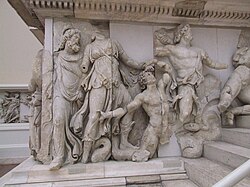 [Unavailable: ❌ https://upload.wikimedia.org/wikipedia/commons/thumb/5/5b/Nereus%2C_Doris%2C_Okeanos_Pergamonaltar.JPG/250px-Nereus%2C_Doris%2C_Okeanos_Pergamonaltar.JPG ❌]
Nereus, Doris, and Oceanus — Pergamon Altar gigantomachy frieze (c. 180-160 BCE), Berlin; the battle between the Olympian gods and the Giants is carved in a register 2.3 meters high that runs around the entire altar; the Hellenistic relief achieves a density of interlocking figures and spatial complexity unmatched in ancient art
 [Unavailable: ❌ https://upload.wikimedia.org/wikipedia/commons/thumb/a/a1/Arte_greca%2C_giovane_vittorioso%2C_300-100_ac._02.JPG/250px-Arte_greca%2C_giovane_vittorioso%2C_300-100_ac._02.JPG ❌]
Victorious Youth (c. 300-100 BCE), Getty Museum — a young athlete binding his head with the fillet of victory; the slightly asymmetrical, weight-shifted pose (contrapposto) that Polykleitos codified in the 5th century as the mathematical ideal of the human body in action
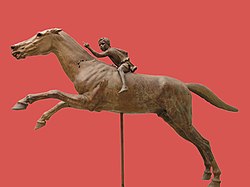 [Unavailable: ❌ https://upload.wikimedia.org/wikipedia/commons/thumb/3/32/NAMA_Jockey_Art%C3%A9mision.jpg/250px-NAMA_Jockey_Art%C3%A9mision.jpg ❌]
The Jockey of Artemision (c. 150-100 BCE), National Archaeological Museum, Athens — a boy jockey leaning forward in the urgency of the race, his entire body expressing the extremity of effort; the lost horse beneath him must be imagined, and the imagination is not disappointed
 [Unavailable: ❌ https://upload.wikimedia.org/wikipedia/commons/thumb/b/bd/NAMABG-Aphaia_Trojan_Archer_3.JPG/250px-NAMABG-Aphaia_Trojan_Archer_3.JPG ❌]
Trojan archer — Temple of Aphaia, Aegina (c. 490-480 BCE), Glyptothek Munich; the transition from Archaic smile to Classical naturalism is visible in this figure: the body still somewhat rigid, but the focused concentration of the archer's expression points toward the psychological depth the Classical style was about to achieve
 [Unavailable: ❌ https://upload.wikimedia.org/wikipedia/commons/thumb/b/bb/British_Museum%2C_London_%282014%29_-_07.JPG/330px-British_Museum%2C_London_%282014%29_-_07.JPG ❌]
Parthenon Elgin Marbles, British Museum — the metopes, frieze, and pediment sculptures removed by Lord Elgin between 1801-1812; the center of the most enduring controversy in the history of cultural heritage; Greece has requested their return since 1983
Related Esoteric Inquiries:
- Ancient Greek Coins: Gods and Heroes in Miniature
- The Parthenon: Mathematics, Beauty, and the Divine Proportion
- The Bronze Guardians of Benin: Alchemical Sovereignty and Ancestral Power
Lux Esoterica.
2026.


Comments