Ancient Greek Coins: Gods and Heroes in Miniature
The ancient Greek coin was not merely money. It was a political statement, a theological declaration, a miniature sculpture, and a medium of propaganda that traveled farther and reached more people than any other art form of the ancient world. The city-state's choice of divine patron — Athena for Athens, Apollo for Delphi and Corinth, Zeus for Olympia, Demeter for Syracuse — was encoded permanently in the silver or gold of every coin it struck, spreading its divine identity along every trade route in the Mediterranean. The engravers of Greek coins (celators) were among the most skilled artists of antiquity, working in reverse on hardened iron dies no larger than a thumbnail, creating portraits of gods, heroes, and mythological scenes of such technical mastery that they have never been surpassed in the entire history of coinage. The great issues of Syracuse in the 5th and 4th centuries BCE — particularly the dekadrachms signed by celators Kimon and Euainetos — are considered the finest coins ever struck by any civilization.
 [Unavailable: ❌ https://upload.wikimedia.org/wikipedia/commons/thumb/c/cd/ATTICA%2C_Athens._Circa_545-525-15_BC.jpg/250px-ATTICA%2C_Athens._Circa_545-525-15_BC.jpg ❌]
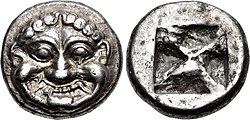
Attic tetradrachm, Athens (c. 545-525 BCE) — the Athenian owl tetradrachm became the dominant trade currency of the ancient Mediterranean; the obverse shows Athena's helmeted head, the reverse her sacred owl (symbol of wisdom) with an olive sprig and the letters ΑΘΕ (Athena's city); the design was so trusted that it was copied unchanged for centuries, making it the dollar of antiquity
 [Unavailable: ❌ https://upload.wikimedia.org/wikipedia/commons/thumb/5/5f/ATTICA%2C_Athens._Circa_510_to_500-490_BC.jpg/250px-ATTICA%2C_Athens._Circa_510_to_500-490_BC.jpg ❌]
Athenian tetradrachm (c. 510-490 BCE) — the transition from the Archaic to the Classical style is visible in the increasingly refined rendering of Athena's profile; the coin's consistency of design over three centuries was a deliberate commercial strategy: international merchants who had learned to trust Athenian silver needed to recognize it instantly
 [Unavailable: ❌ https://upload.wikimedia.org/wikipedia/commons/thumb/4/4d/001-athens-dekadrachm-1.jpg/250px-001-athens-dekadrachm-1.jpg ❌]
Athenian dekadrachm (c. 467 BCE) — ten times the value of a tetradrachm, struck to commemorate the victory over Persia; the finest Athenian coinage of the Classical period, combining the Archaic owl reverse with a new level of formal sophistication; these rare coins were status objects as much as currency
 [Unavailable: ❌ https://upload.wikimedia.org/wikipedia/commons/thumb/9/92/Kyme-01.jpg/250px-Kyme-01.jpg ❌]
Kyme stater (c. 480-450 BCE) — the eagle of Zeus over a skyphos (wine cup); the sacred eagle, messenger of the supreme god, rendered with such controlled power that the small scale of the coin seems insufficient for the energy it contains; Kyme (in modern Turkey) was one of many Ionian cities that produced coinage of extraordinary quality in the 5th century BCE
 [Unavailable: ❌ https://upload.wikimedia.org/wikipedia/commons/thumb/f/f2/AR_Didrachm_90001284.jpg/250px-AR_Didrachm_90001284.jpg ❌]
Silver didrachm — the horse and rider symbol of a cavalry-dependent city-state; Greek coins encode the specific identity of their issuing city with remarkable economy: the dolphin of Syracuse, the bull of Sybaris, the lion of Miletus, the tortoise of Aegina — each symbol identifying the city as precisely as a flag identifies a nation
 [Unavailable: ❌ https://upload.wikimedia.org/wikipedia/commons/thumb/9/98/Aegina_Stater_achaic.jpg/250px-Aegina_Stater_achaic.jpg ❌]
Aegina stater (c. 600-550 BCE) — the famous Aeginetan tortoise, one of the first coins struck in Greece; Aegina was the earliest major minting city in the Greek world; the tortoise (sacred to Hermes, patron of travelers and commerce) on the obverse became so associated with Aeginetan trade that the coins themselves were called 'tortoises'
 [Unavailable: ❌ https://upload.wikimedia.org/wikipedia/commons/thumb/4/46/BMC_193.jpg/250px-BMC_193.jpg ❌]
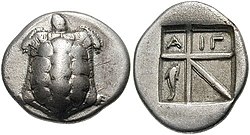
Corinthian stater with Pegasus and Athena — Corinth's iconic coin type: the winged horse Pegasus on the obverse, Athena's helmeted head on the reverse; the Pegasus stater (called 'colts' in antiquity) circulated throughout the western Mediterranean and into Sicily, carried by Corinthian colonists and traders; the coin type's beauty and consistency made Corinthian silver among the most trusted in the ancient world
 [Unavailable: ❌ https://upload.wikimedia.org/wikipedia/commons/thumb/b/be/SNGCop_039.jpg/250px-SNGCop_039.jpg ❌]
Tetradrachm with Apollo — the god of light, music, and prophecy rendered in profile with the formal perfection of High Classical sculpture; the coin celators who worked in the 5th-4th centuries BCE understood their medium as sculpture at the smallest possible scale, applying the same aesthetic standards as the sculptors of the Parthenon frieze to a surface measurable in millimeters
 [Unavailable: ❌ https://upload.wikimedia.org/wikipedia/commons/thumb/4/40/EucratidesStatere.jpg/250px-EucratidesStatere.jpg ❌]
Eucratides I stater, Bactria (c. 170-145 BCE) — the largest gold coin struck in antiquity, 58 grams; the Bactrian Greek kings who ruled in modern Afghanistan after Alexander's conquests produced some of the most psychologically powerful royal portraits in ancient coinage; the coin traveled so far along the Silk Road that examples have been found in southern India and Central Asia
Related Esoteric Inquiries:
- Greek Vase Painting: The Gods in Red and Black
- Nymphs: The Nature Spirits of the Ancient World, Daughters of Gods and Wild Places
- Greek and Roman Sculpture: The Gods in Marble and Bronze
Lux Esoterica.
2026.


Comments