Greek Vase Painting: The Gods in Red and Black
For nearly four centuries (c. 700-300 BCE), the potters and painters of Athens produced a body of decorated ceramic art that constitutes one of the richest visual archives of Greek mythology and daily life that survives. Working in two successive techniques — black-figure (figures painted in black silhouette on red clay) and red-figure (figures left in red clay against a black background, allowing greater detail in musculature and expression) — they depicted the full range of the Greek mythological universe: the labors of Heracles, the Trojan War, the loves of the gods, the underworld, the Dionysiac mysteries, the athletic festivals. These were not luxury objects for aristocratic display alone; they were functional vessels — amphorae for wine and oil, kraters for mixing wine at symposia, cups for drinking — whose images accompanied the rituals of daily life, making the mythological universe present at every meal, every libation, every athletic competition.
 [Unavailable: ❌ https://upload.wikimedia.org/wikipedia/commons/thumb/e/e6/Akhilleus_Aias_MGEt_16757.jpg/330px-Akhilleus_Aias_MGEt_16757.jpg ❌]
Achilles and Ajax playing dice, black-figure amphora by Exekias (c. 540 BCE) — one of the greatest achievements of ancient vase painting; Exekias gives the two heroes complete psychological presence within the rigid conventions of the black-figure technique: their postures tense, their attention fixed on the game, their armor left to one side in a moment of false peace before Troy
 [Unavailable: ❌ https://upload.wikimedia.org/wikipedia/commons/thumb/b/ba/Akhilleus_Patroklos_Antikensammlung_Berlin_F2278.jpg/250px-Akhilleus_Patroklos_Antikensammlung_Berlin_F2278.jpg ❌]
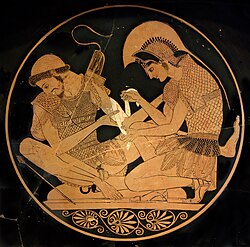
Achilles bandaging Patroclus, red-figure cup attributed to the Sosias Painter (c. 500 BCE) — one of the most tender images in ancient art; the greatest warrior of the Greek world concentrating entirely on the wound of his beloved companion, who turns his face away in pain; the Iliad's emotional core condensed into a single circular image
 [Unavailable: ❌ https://upload.wikimedia.org/wikipedia/commons/thumb/8/86/Achilles_Penthesileia_BM_B209.jpg/250px-Achilles_Penthesileia_BM_B209.jpg ❌]
Achilles and Penthesilea, black-figure amphora by Exekias (c. 525 BCE) — the moment Achilles kills the Amazon queen and, meeting her eyes as she dies, falls instantly in love with her; tragedy as erotic vision, the Greek myth's insistence on finding beauty at the exact intersection of desire and death
 [Unavailable: ❌ https://upload.wikimedia.org/wikipedia/commons/thumb/9/98/Apollo_black_bird_AM_Delphi_8140.jpg/250px-Apollo_black_bird_AM_Delphi_8140.jpg ❌]
Apollo with a raven and a lyre, red-figure cup from Delphi (c. 480 BCE) — the god pours a libation at his sanctuary; the raven is Apollo's prophetic bird; the white cup (kylix) from which he pours mirrors the cup in the viewer's hands, collapsing the distance between the worshipper and the god
 [Unavailable: ❌ https://upload.wikimedia.org/wikipedia/commons/thumb/2/29/Andokides_Painter_ARV_4_9_Herakles_reclining_with_Athena_%2801%29.jpg/250px-Andokides_Painter_ARV_4_9_Herakles_reclining_with_Athena_%2801%29.jpg ❌]
Heracles reclining with Athena, red-figure amphora by the Andokides Painter (c. 520 BCE) — Heracles, after completing his labors, reclines in the company of his divine patron; the red-figure technique allowed the Andokides Painter to capture the relaxation of divine companionship, the hero finally at rest in the presence of the goddess who guided him
 [Unavailable: ❌ https://upload.wikimedia.org/wikipedia/commons/thumb/0/0e/Niobid_Painter_-_Red-Figure_Amphora_with_Musical_Scene_-_Walters_482712_-_Side_A.jpg/250px-Niobid_Painter_-_Red-Figure_Amphora_with_Musical_Scene_-_Walters_482712_-_Side_A.jpg ❌]
Musical scene, red-figure amphora by the Niobid Painter (c. 460 BCE) — figures performing music and poetry; the symposium (drinking party) was the primary context for both vase display and lyric poetry performance; the images on the vessels were continuous with the performances enacted around them
 [Unavailable: ❌ https://upload.wikimedia.org/wikipedia/commons/thumb/3/39/Dypilon_vase_1.jpg/250px-Dypilon_vase_1.jpg ❌]
Dipylon vase, Athens (c. 750 BCE) — a monumental geometric-period krater used as a grave marker; the horizontal registers of geometric pattern alternate with figured scenes of funeral procession and mourning; the earliest large-scale Athenian painted pottery, from the period when Greek figural art was still learning to walk
 [Unavailable: ❌ https://upload.wikimedia.org/wikipedia/commons/thumb/7/77/Amphorae_stacking.jpg/330px-Amphorae_stacking.jpg ❌]
Stacked transport amphorae — the amphora was the universal shipping container of the ancient Mediterranean, carrying wine, oil, and grain from port to port; the same vessel form that carried sacred images of the gods on its walls was the backbone of ancient trade, making Greek mythology mobile across the entire ancient world
 [Unavailable: ❌ https://upload.wikimedia.org/wikipedia/commons/thumb/a/a1/Reveller_courtesan_BM_E44.jpg/250px-Reveller_courtesan_BM_E44.jpg ❌]
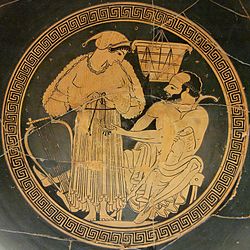
Reveller and courtesan, red-figure cup (c. 490 BCE) — Greek vase painting depicts the full range of human life without the separation of sacred and profane; the same vessels that carried images of Achilles and Apollo also carried images of symposium revelers, athletes, and erotic scenes; in the Greek world, the divine was not confined to the temple
Related Esoteric Inquiries:
- Ancient Greek Coins: Gods and Heroes in Miniature
- Nymphs: The Nature Spirits of the Ancient World, Daughters of Gods and Wild Places
- Centaurs: Between Two Worlds — Chiron, the Wounded Healer
Lux Esoterica.
2026.


Comments