Gurdjieff and the Fourth Way: The Teaching That Ordinary Life Is a Dream

Students performing the Gurdjieff Movements -- choreographed sacred dances combining precise physical coordination with active inner attention -- a central practice of the Fourth Way
In the cafes and drawing rooms of early twentieth-century Moscow, a remarkable man appeared. He was stocky, dark-eyed, with a shaved head and an enormous moustache, and he spoke with an accent no one could quite place. He said he had been to Egypt, Tibet, Afghanistan, and the monasteries of Central Asia.
He said he had found what the world's sacred traditions had been protecting for millennia. And he said something that his interlocutors could not forget, no matter how much they wanted to disagree with it:
You are asleep. You only believe you are awake.
His name was George Ivanovich Gurdjieff (c. 1866-1949), and the teaching he brought to Europe was unlike anything the West had encountered before -- not because it was mystical (the West already had mysticism in abundance) but because it was ruthlessly practical, intensely demanding, and built on a premise that is as disturbing today as it was in 1915: that ordinary human beings are not conscious.
Not truly. The thoughts we think, the emotions we feel, the actions we take -- these are, in the Gurdjieffian view, the mechanical responses of a sleeping machine, not the expressions of a genuinely awake human being.
The question the Fourth Way poses to every person who encounters it is not "How can I become more spiritual?" It is: "Am I awake right now?" And if you look carefully enough, honestly enough, you will discover that the answer is almost always: not quite.
A Man From Nowhere: The Life of G. I. Gurdjieff
Gurdjieff was born -- probably in 1866, though he was deliberately vague about dates -- in Alexandropol (now Gyumri), a city on what was then the Armenian-Russian border. He grew up in a world where the old world of the East met the encroaching West, where Armenian Christianity, Greek Orthodox tradition, and Sufi Islam all overlapped, and where the folk wisdom of ancient cultures was still alive in living practitioners.
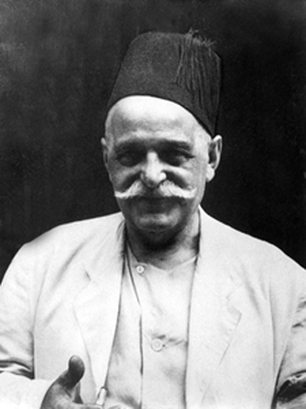
George Ivanovich Gurdjieff (c. 1866-1949), the Greek-Armenian teacher who brought the Fourth Way teaching to Europe and America
What Gurdjieff did between his youth and his appearance in Moscow around 1912 is mostly a matter of his own account -- which is where the scholarly debates begin. In Meetings with Remarkable Men (written in the 1920s but published posthumously in 1963), he described decades of travel through Egypt, Persia, Afghanistan, India, and Tibet, seeking out hidden communities and teachers who preserved knowledge he believed had been lost from the mainstream traditions.
Whether these travels occurred precisely as described, whether they were allegorical, or whether they were a deliberate mystification to prevent lazy readers from short-circuiting the teaching is a question the Fourth Way tradition itself cultivates rather than resolves.
What is documented is his extraordinary impact on the people who knew him. In Moscow and later Petrograd (1912-1917), he gathered a circle of disciples including the journalist and philosopher P. D. Ouspensky, who would become the most systematic expositor of his ideas.
After the Russian Revolution, Gurdjieff led his students through the chaos of the Caucasus and eventually arrived in France, where in 1922 he established the Institute for the Harmonious Development of Man at the Prieure des Basses Loges, a former monastery near Fontainebleau.
The Prieure became one of the strangest establishments in European history. Gurdjieff's students -- intellectuals, artists, seekers from across the West -- were put to work building fountains, cooking elaborate meals, tending livestock, and performing practices at all hours. The New Zealand writer Katherine Mansfield, dying of tuberculosis, spent her last months there and died in January 1923. The whole enterprise combined something of a monastery, a training ground, an artist's colony, and a deliberate school of psychological shock.
In 1924, Gurdjieff nearly died in an automobile accident. He recovered, dissolved the Institute's residential program, and devoted the remaining years of his life to writing his vast and extraordinary literary trilogy, All and Everything, of which the first book -- Beelzebub's Tales to His Grandson (1950) -- is a 1,200-page satirical cosmological novel told from the perspective of an alien observing humanity's spiritual condition across six thousand years.
He died in Paris in 1949. His teaching continues, through Gurdjieff groups operating worldwide, through the work of his students and their descendants, and through an ever-growing body of literature about his ideas.
The Fundamental Teaching: Man Is a Machine
The first and most shocking element of Gurdjieff's teaching is his assessment of the ordinary human condition.
"Man is a machine," he told Ouspensky. "All his deeds, actions, words, thoughts, feelings, convictions, opinions, and habits are the results of external influences, external impressions. Out of himself man cannot produce a single thought, a single action. Everything he says, does, thinks, feels -- all this happens. Man cannot discover anything, cannot create anything, cannot do anything. It all happens."
This is not a comfortable claim. Gurdjieff was not offering it as metaphysics. He was offering it as something to be verified, personally, through observation. Watch your own thoughts for five minutes without being pulled into them. Watch how your mood changes depending on who you meet, what you eat, what news you read.
Watch how you react -- not respond, but react -- to every circumstance with patterns laid down before you were old enough to choose them.
If you watch carefully, Gurdjieff argued, you will see that most of what you call "I" -- your opinions, your personality, your characteristic emotions -- is not a unified self at all. It is a collection of "I"s, each generated by a different part of the machine, each believing itself to be the whole.
The person who resolves to change in the morning is not the person who cannot resist in the evening. They are different "I"s, and neither is the real "I" -- because there is, as yet, no real "I." There is only the machine.
The aim of the Fourth Way is to create, through a specific process of sustained inner work, a genuine, permanent, unified consciousness -- what Gurdjieff called a Real I -- that can actually do rather than merely happening.
The Fourth Way: In the Conditions of Ordinary Life
Traditional spiritual paths, Gurdjieff taught, addressed only one of the three fundamental dimensions of the human being:
- The way of the fakir works exclusively on the physical body: mastering pain, developing extraordinary endurance, but at the expense of feeling and thought.
- The way of the monk works on the emotional center: devotion, surrender, prayer -- but often at the cost of intellectual development and practical capacity.
- The way of the yogi works on the intellectual center: study, concentration, willpower -- but often leaves the body and emotions untransformed.
The Fourth Way works on all three simultaneously. More importantly, it works in the conditions of ordinary life. There is no need to withdraw to a monastery or an ashram. There is no requirement to renounce the world. The Fourth Way is practiced in the office, in the kitchen, in the traffic jam, in the conversation with the difficult colleague. The circumstances of daily life are not obstacles to the Work -- they are the material of the Work.
This is both its appeal and its difficulty. There is nowhere to hide. Every irritation, every vanity, every automatic comfort-seeking behavior becomes a mirror. The Fourth Way demands a kind of honesty that most spiritual paths, with their emphasis on uplift and consolation, quietly discourage.
The Enneagram: A Symbol of Universal Process
One of Gurdjieff's most lasting contributions to the Western esoteric tradition is the enneagram -- a nine-pointed figure that he presented as a universal symbol encoding the laws governing any process of transformation.

The Enneagram as Gurdjieff presented it: a nine-pointed figure encoding the Law of Three (inner triangle) and the Law of Seven (the hexad), representing the structure of any complete process of transformation
The enneagram combines two fundamental laws: the Law of Three (every complete phenomenon requires three forces: active, passive, and neutralizing) and the Law of Seven (every process unfolds through seven stages, with characteristic points of difficulty where additional energy is required to maintain the trajectory). The inner triangle of the enneagram represents the Law of Three; the hexagonal figure connecting the remaining points represents the Law of Seven.
Gurdjieff taught the enneagram primarily as a cosmic diagram -- a map of how any process from the growth of a seed to the transformation of a human soul actually proceeds. He used it in the sacred Movements (specific body positions and transitions correspond to different points of the enneagram) and as a framework for understanding the obstacles to awakening.
It should be noted that the Enneagram of Personality widely used in popular psychology and corporate training -- with its nine personality types -- is derived from Gurdjieff's symbol but represents a significant later development, associated primarily with the Bolivian teacher Oscar Ichazo and the Chilean psychiatrist Claudio Naranjo in the 1960s and 1970s.
The relationship between Gurdjieff's original enneagram and its popular derivative is a subject of considerable debate within the Fourth Way community.
Ouspensky and the Teaching in Words
The most systematic written account of Gurdjieff's teaching comes not from Gurdjieff himself but from his most famous student. P. D. Ouspensky (1878-1947), a Russian journalist and author of Tertium Organum (1912), met Gurdjieff in Moscow in 1915 and spent years recording their conversations with meticulous precision.
In Search of the Miraculous: Fragments of an Unknown Teaching (published posthumously in 1949) is the book that most readers encounter first. It lays out Gurdjieff's cosmology (the Ray of Creation, the food diagram, the hydrogen table), his psychology (the four states of consciousness, the five centers, the two lines of work), and his method with a clarity that Gurdjieff's own writings deliberately withheld.
Ouspensky eventually broke with Gurdjieff, finding his teacher's later behavior incomprehensible or even deliberately destructive -- a rupture that itself illustrates something important about the Work: Gurdjieff was not offering comfortable wisdom. He was offering the opportunity to be seen, which is not at all the same thing, and is considerably more difficult to bear.
Self-Remembering: The Core Practice
The central practical element of the Fourth Way is self-remembering -- a specific quality of attention in which the practitioner divides awareness between the external environment and themselves simultaneously. Not observation from outside oneself, and not self-absorption either -- but a binocular quality of attention in which "I am here, and I am aware that I am here."
Ordinary consciousness, in Gurdjieff's analysis, moves between two states: identification (absorbed in whatever is happening, completely lost in it, with no awareness of oneself as a separate observer) and daydreaming (lost in internal associations, cut off from the external world). What almost never happens, spontaneously, is the divided, inclusive attention of genuine self-awareness.
Self-remembering cannot be achieved by thinking about it. It requires a specific inner effort that is at once very simple and very difficult -- difficult precisely because the thinking mind immediately tries to capture and mechanize it, turning the living practice into another "I" performing a spiritual exercise. The moment you think "I am remembering myself," you almost certainly are not.
This paradox is characteristic of Gurdjieff's teaching at every level. The Work cannot be faked. The machine cannot self-remember. Only something more real can -- and that something more real can only emerge through genuine, sustained, sincere inner effort.
The Inner Meaning: Being vs. Knowing
Gurdjieff drew a persistent distinction between knowledge and being. Ordinary education gives knowledge without being. Religion gives aspiration without method. Philosophy gives concepts without transformation. What the Fourth Way offers -- what Gurdjieff himself seems to have considered its essential contribution -- is a technology for the development of being: for the gradual creation, out of the raw material of the mechanical personality, of a genuinely conscious human being.
Being is not a belief. It is not a feeling. It is not a spiritual experience, however elevated. It is the actual quality of presence that you bring to your life, moment to moment, verified not in meditation but in everything else.
Gurdjieff told his students that the universe needs conscious beings. That the process of cosmic evolution of which the human being is a part requires, at a certain level, individuals who are genuinely awake -- not asleep in the comfortable dreams of their own thoughts and habits. That the question of whether any individual wakes up or not matters, in a real sense, beyond that individual.
Whether you take that cosmically or personally, the question remains the same: Am I awake right now?
Look carefully. The honest answer is almost always "not quite." And that "not quite" -- that gap between where you are and where you could be -- is precisely where the Work begins.
- Lux Esoterica
Related Esoteric Inquiries:
- The Enneagram: The Nine-Pointed Map of the Soul and Its Shadows
- Sufism: The Mystical Heart of Islam, the Path of Divine Love
- Tarot as a Mirror of the Soul: The Cards as Tools for Self-Knowledge
Lux Esoterica.
2026.


Comments