Sufism: The Mystical Heart of Islam, the Path of Divine Love
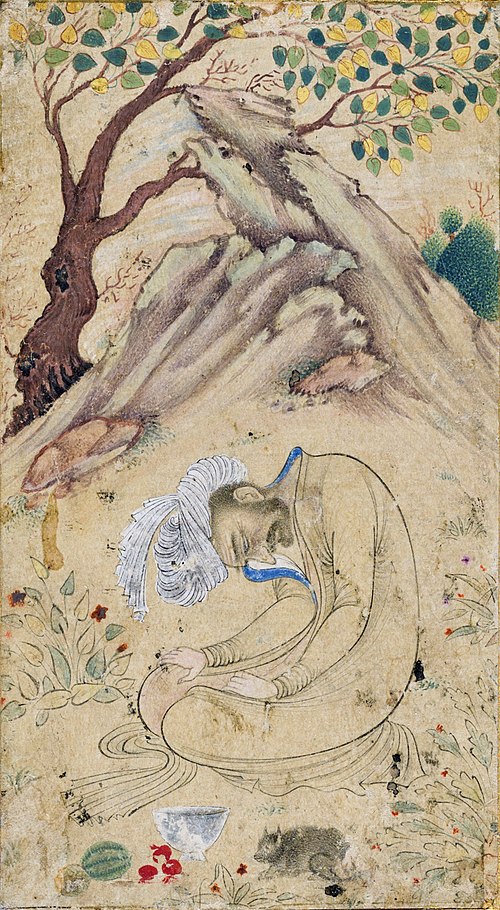
A Sufi in Ecstasy in a Landscape — Mughal period painting, c. 17th century, LACMA collection. The ecstatic state (hal) that overtakes the Sufi in moments of deep practice is understood in the tradition not as a loss of consciousness but as a gain: the dissolution of the limited ego into the ocean of divine presence
There is a verse in the Quran — 50:16 — that reads: "We are nearer to him than his jugular vein." It is among the most quoted in all of Islamic mysticism, and it expresses the foundational insight from which Sufism — the inner, mystical tradition within Islam — unfolds: that God is not distant, demanding, and separate from the human being, but intimate, present, and closer than the breath. The entire project of Sufism is to close the gap between the knowledge of this proximity and the direct experience of it.
Sufism (taṣawwuf in Arabic) is the esoteric dimension of Islam: the tradition of contemplative practice, poetry, sacred music, spiritual psychology, and philosophical theology that has developed within the Islamic world since the eighth and ninth centuries CE, seeking not only to follow the shariah (the outer law) but to travel the tariqah (the inner path) toward haqiqah (the ultimate reality). Where the theologian establishes what God commands, the mystic seeks to encounter God directly — to move from knowledge about the Beloved to knowledge of the Beloved, from ilm (learning) to ma'rifah (gnosis, direct knowing).
The paradox at the heart of Sufism is also its essential teaching: that the seeker and the sought are not ultimately separate. The soul that longs for God is already, in some dimension, in God. The journey is not from here to there but from illusion to reality — from the condition of forgetting that the human being is always already in the divine presence, to the condition of remembering and of living from that remembrance.
The Origins: From the Desert Companions to the Early Mystics
The roots of Sufism reach back to the companions of the Prophet Muhammad (d. 632 CE) who were noted for their exceptional piety, their intense contemplative lives, and their emphasis on the inner dimension of religious practice. Uwais al-Qarani, a Yemeni Muslim who never met the Prophet in person but was spoken of by him as one of the greatest of his followers, became a model of the hidden saint — the abdal — whose spiritual realization is known to God though invisible to the world.
The early Sufi women and men — Hasan al-Basri (642-728 CE), the Yemeni mystic; Rabia al-Adawiyya (714-801 CE), the freed slave and poet of Basra who articulated the doctrine of mahabbah (divine love) with a directness that still takes the breath away — were not creating something separate from Islam. They were exploring its interior dimension with unprecedented intensity.
Rabia is particularly significant: a woman who owned nothing and needed nothing, she is credited with the formulation of disinterested love for God — not love motivated by the hope of paradise or the fear of hell, but love offered for its own sake because God is worthy of love. Her prayer, reported in the sources: "O God, if I worship You for fear of Hell, burn me in Hell; and if I worship You in hope of Paradise, exclude me from Paradise. But if I worship You for Your own sake, grudge me not Your everlasting Beauty." This is a statement that would not be out of place in the mouth of any great mystic from any tradition.
The Sufi Path: Stations, States, and the Spiritual Teacher
The Sufi path is not a doctrine but a journey — a disciplined progression through levels of consciousness that the tradition has mapped with considerable precision. The classical literature distinguishes between maqamat (stations) — stable levels of spiritual attainment achieved through sustained effort — and ahwal (states) — transient conditions of grace that come and go beyond the practitioner's control.
The stations vary in their enumeration by school and tradition, but a representative sequence includes: tawbah (repentance, turning toward God), zuhd (renunciation of attachment to the world), wara (scrupulous piety), faqr (spiritual poverty, the recognition of one's absolute dependence on God), sabr (patient endurance), tawakkul (trust in God, surrender of anxious ego-control), rida (contentment with whatever God appoints), mahabbah (divine love), and — at the summit — ma'rifah (gnosis, direct knowing) and fana (annihilation).
Fana — literally "passing away" — is the experiential state in which the ordinary ego-self, with its claims to independent existence and its separation from God, temporarily ceases to be the center of experience. What remains is not nothing but divine presence. The great Sufi teachers are careful to distinguish fana from dissolution into nothingness: what dies is the illusion of separation, not the reality of the individual soul. The complementary concept is baqa (subsistence) — the return from fana to ordinary consciousness carrying the knowledge of what was experienced in the mystical union. The fully realized Sufi moves freely between the two conditions, grounded in the ordinary world while carrying the awareness of the divine ground beneath it.
The role of the spiritual teacher (shaykh or murshid) in Sufism is indispensable. The Sufi path, in the tradition's understanding, cannot be traveled alone: the student (murid, literally "one who desires") needs a guide who has walked the path before, who can recognize the stages of the journey and the traps along the way, who can transmit not only instruction but the baraka (spiritual blessing) that accelerates the student's progress. The relationship between teacher and student in Sufism is one of the most carefully considered in the world's contemplative traditions.

Sufi dervishes in the sema ceremony — the whirling meditation developed by Rumi and practiced in the Mevlevi order since the 13th century. The right hand is raised to receive divine grace; the left hand is turned down to transmit it to the earth. The spinning represents the soul's rotation around the axis of the divine, the same motion expressed by the planets around the sun and electrons around the nucleus
Dhikr: Remembrance as Meditation
The central practice of Sufism is dhikr (zikr) — literally "remembrance" — the repetition of divine names or phrases from the Quran as a form of meditation. The Quranic basis: "Truly, in the remembrance of God do hearts find rest" (13:28). Dhikr may be performed silently (khafi, hidden) or aloud (jali, manifest), alone or in group, with or without accompanying movement or breath work.
The most fundamental dhikr is the repetition of the shahada (the declaration of faith): "La ilaha illa'llah" — "There is no god but God." In the Sufi reading, this phrase is not merely a theological statement. It is a complete contemplative instruction: with each breath and each repetition, everything that presents itself as an object of ultimate concern — the ego, the world, desire, fear, status, security — is negated ("La ilaha"), and only the divine Reality is affirmed ("illa'llah"). Practiced deeply over years, this simple repetition is understood to progressively dissolve the layers of veiling that separate ordinary consciousness from the divine presence it has never actually left.
Different Sufi orders have developed distinctive forms of dhikr: the Naqshbandiyya practice a silent, interiorized dhikr synchronized with the heartbeat; the Qadiriyya practice a vigorous group dhikr with breath and movement; the Shadhiliyya emphasize the dhikr of divine presence in every activity of daily life. All share the understanding that dhikr is not merely a religious practice but a transformation of consciousness: the systematic replacement of the habitual egoic monologue with the awareness of divine presence.
Rumi: The Ocean of Divine Poetry
Jalal al-Din Muhammad Rumi (1207-1273 CE) — known in the Persian-speaking world as Maulana ("Our Master") and in the West simply as Rumi — is the most widely read poet in the world, and the figure who has done most to introduce Sufi teaching to the global audience. Born in Balkh (in present-day Afghanistan), educated in the Islamic sciences, and settled in Konya (in present-day Turkey), Rumi's life was transformed by his encounter with the wandering dervish Shams-i Tabrizi in 1244 — a meeting that unleashed in Rumi a torrent of mystical poetry that he composed for the rest of his life.
His principal work is the Masnavi-ye Ma'navi (The Spiritual Couplets) — six volumes and approximately 25,000 verses of poetry that constitute the most celebrated text in the Persian language after the Quran, and a comprehensive treatment of Sufi psychology, theology, and practice encoded in parables, stories, metaphors, and lyrical outbursts of mystical experience. It opens with one of the most famous lines in world literature: "Listen to the reed flute, how it tells a tale of separations. Longing for my origin, it complains of exile."
The reed (ney) is Rumi's central metaphor: cut from the reed bed (its origin in the divine), it cries for reunion — and its very cry is the music that draws hearts toward the source of all longing. Human existence, in Rumi's vision, is this condition of the cut reed: separated from the divine origin by the veil of individual existence, crying out in longing, and in that very longing already participating in the divine life that it seeks. The cry is the connection. The longing is the love. The exile is the beginning of the return.

Rumi's tomb at the Mevlana Museum in Konya, Turkey — the green dome over the mausoleum of Jalal al-Din Muhammad Rumi (1207-1273), the most widely read poet in the world. The Mevlana Museum (formerly the Mevlevi lodge) attracts approximately 2.5 million visitors per year, making it one of the most visited sites in Turkey
Al-Hallaj and Ibn Arabi: The Extremes of Mystical Experience
If Rumi represents Sufism at its most lyrical and accessible, Mansur al-Hallaj (858-922 CE) represents it at its most radical and dangerous. Al-Hallaj — poet, wandering mystic, and visionary — is most famous for his cry in a state of ecstatic union: "Ana'l-Haqq" — "I am the Truth" or "I am God." In the Islamic theological context, this was blasphemy. Al-Hallaj was accused of claiming divinity for himself, imprisoned for years, and finally executed in Baghdad in 922 by crucifixion and burning.
The Sufi tradition has struggled with al-Hallaj ever since — some accepting his utterance as a genuine expression of the mystical state of fana (where the individual ego has ceased to exist as a separate reality and only God speaks), others condemning it as an excess that should have been kept interior. What his life demonstrates is the ultimate danger and ultimate seriousness of the Sufi claim: that the path of divine love leads to a destination that leaves no room for the ordinary boundaries between the human and the divine.
Muhyiddin Ibn Arabi (1165-1240 CE) — the Andalusian Sufi philosopher known as the Shaykh al-Akbar (the Greatest Sheikh) — developed the most systematic philosophical framework of Sufi mysticism: the doctrine of wahdat al-wujud (the Unity of Being). In Ibn Arabi's metaphysics, there is ultimately only one reality: divine being, the self-disclosure of God to Himself through the infinite modes of created existence. The apparent multiplicity of the world is real, but it is real as a mode of the one divine Reality that underlies and pervades all things.
This is not pantheism in the simple sense (the claim that all things are God). It is more subtle: that God's self-disclosure in creation is real, that created beings have real existence, but that their existence is entirely dependent on and embedded in the divine existence that gives rise to them. To experience this directly — not merely to understand it intellectually — is the summit of the mystical path.
The Mevlevi Order and the Sema: Dance as Prayer
The Mevlevi order — the Sufi brotherhood founded by Rumi's son Sultan Walad after Rumi's death — developed the practice for which Sufism is most visually famous in the West: the sema, or whirling ceremony. The dervishes of the Mevlevi order dress in white robes (symbolizing the ego's death shroud), tall camel-hair hats (sikke, symbolizing the ego's tombstone), and black cloaks (which they remove at the beginning of the ceremony to symbolize emerging from the tomb). They spin counterclockwise, right arm raised to receive divine grace, left arm lowered to transmit it to the earth.
The sema is not performance. It is prayer — a practice of meditative motion designed to produce a state of receptivity in which the divine presence becomes directly accessible. The spinning creates a physiological state of altered awareness while maintaining a precise geometry: the dervish turns on the axis of his left foot, revolving around a fixed center the way the planets revolve around the sun and electrons around the nucleus. The motion is the teaching: in Sufi cosmology, everything that exists revolves around the divine center that is its source and sustainer.
The Mevlevi sema was inscribed on UNESCO's Representative List of the Intangible Cultural Heritage of Humanity in 2008. It continues to be performed in Konya and in Mevlevi lodges around the world — a living tradition more than seven centuries old, still carrying the transmission of Rumi's teaching through the universal language of movement, music, and silence.
The Sufi path begins and ends in love. "I searched for myself and found only God. I searched for God and found only myself." This paradox — not resolved but embraced, not explained but lived — is the axis around which all the traditions of Islamic mysticism turn, the secret teaching that eight centuries of poets, saints, and wandering dervishes have carried across the world in the basket of their ecstatic longing.
— Lux Esoterica


Comentarios