Powers: Celestial Guardians Against the Forces of Darkness

Luca Giordano, "The Fall of the Rebel Angels" (c. 1660–1665, Kunsthistorisches Museum, Vienna) — the celestial battle in which loyal angelic Powers drove the rebel angels from heaven. This cosmic conflict defines the Powers' essential identity as guardians of the divine order.
At the boundary between the heavenly and the earthly, between the ordered cosmos and the forces of chaos that would undo it, stand the Powers — the third order of the second angelic sphere, and among the most warlike and vigilant of all celestial intelligences. They are the defenders of the divine order: not merely administrators or conduits of grace, but active guardians whose perpetual work is to hold the structure of creation against the forces — fallen, disordered, chaotic — that would corrupt or dissolve it.
The Powers occupy a unique position in the celestial hierarchy. They have received from the Dominions the principles of divine governance and from the Virtues the concentrated energy of divine force. Their task is to use that energy defensively — to maintain the integrity of the cosmic order, to resist the incursions of everything that is opposed to the divine will, and to ensure that the grace flowing downward through the angelic hierarchy reaches its intended destinations without being intercepted or distorted.
They are, in the language of the tradition, the army of heaven — not in the sense of mere military force, but in the deeper sense of beings who have dedicated their entire existence to the protection of the good, the true, and the beautiful, and who face the reality of evil not with denial or despair but with clear-eyed, unflinching vigilance.
The Name: Exousiai and the Authority Over Evil
The Greek term for the Powers in Pseudo-Dionysius is Exousiai (Ἐξουσίαι) — a word meaning authorities or powers, specifically the power of authorized action. Exousia is the kind of authority that comes with a specific mandate — the power to act in a particular domain on behalf of a higher authority. The Powers are not free agents who happen to fight evil; they are beings authorized and commissioned by the divine to maintain the boundaries of the created order.
Paul uses the same term repeatedly in his discussion of spiritual forces. In Colossians 1:16, exousiai (authorities/powers) are listed among the cosmic orders created in and through Christ. But in Ephesians 6:12, the term appears in a more ominous context — referring to fallen or hostile powers that human beings must contend with: "For our struggle is not against flesh and blood, but against the rulers, against the authorities, against the powers of this dark world and against the spiritual forces of evil in the heavenly realms."
This double usage — Powers as divine guardians in one context, corrupted powers as adversaries in another — reflects a crucial theological point: the angelic orders can fall. The Powers who remained faithful to the divine are the guardians of the cosmic order. Those who fell away became, in the tradition of early Christian and Jewish thought, the source of the dark powers that oppose the divine plan. The faithful Powers are therefore defined partly by their contrast with and opposition to their fallen counterparts.
The Fall of the Rebel Angels
The tradition of fallen angels — angelic beings who, in the exercise of their created freedom, chose to turn away from the divine — is ancient and complex, appearing in various forms in the Book of Enoch, in the Qumran scrolls, in Patristic theology, and throughout medieval angelology. Whatever form the tradition takes, the faithful Powers are consistently represented as the angelic order that actively resisted this fall and that continues to guard against its consequences.
In the most dramatic version of the celestial conflict — the war in heaven described in Revelation 12 and elaborated in countless theological and artistic traditions — the loyal angels, led by Michael, cast the rebel angels from the heavens. The Powers are among the principal combatants in this battle: they are the ones who understand most clearly what is at stake in the rebellion, who recognize the true nature of the forces of disorder, and who bring the full weight of their commissioned authority to bear in the defense of the divine order.
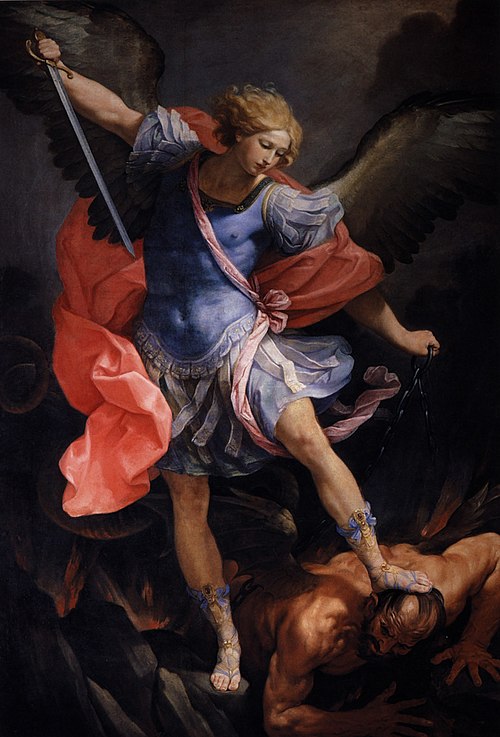
Guido Reni, "Saint Michael Archangel" (1635, Santa Maria della Concezione dei Cappuccini, Rome) — the archangel who leads the celestial host stands upon the defeated adversary. The Powers are the angelic order whose essential function is this constant guardianship against the forces of disorder.
Ephesians 6: The Armor of God
The most important New Testament text for understanding the Powers' cosmic role — and its implications for human spiritual life — is Ephesians 6:10–18, Paul's famous description of the "armor of God":
"Finally, be strong in the Lord and in his mighty power. Put on the full armor of God, so that you can take your stand against the devil's schemes. For our struggle is not against flesh and blood, but against the rulers, against the authorities, against the powers of this dark world and against the spiritual forces of evil in the heavenly realms. Therefore put on the full armor of God..."
Paul's passage is remarkable for several reasons. First, it directly acknowledges that human beings are caught up in a cosmic conflict that extends far beyond the human dimension — that the forces they wrestle with are not merely psychological or social but genuinely spiritual. Second, it implies a correspondence between the human interior and the cosmic battleground: the qualities Paul recommends as "armor" (truth, righteousness, faith, salvation, the Word of God) are precisely the qualities that the faithful Powers embody. To put on the armor of God is, in a sense, to align oneself with the Powers — to participate in their vigilance and share in their protection.
Augustine of Hippo, reflecting on this passage, argued that the Powers who remain faithful to God serve as the intermediaries through which divine protection reaches human beings engaged in spiritual struggle. They are not distant cosmic warriors fighting battles invisible to us; they are actively present at the points where the divine order meets its greatest resistance, which often means in the interior life of human beings seeking to live in accordance with their deepest nature.
Pseudo-Dionysius: The Order That Holds the Hierarchy Intact
For Pseudo-Dionysius, the Powers serve a function that is at once defensive and structural. They are the angelic order responsible for ensuring that the divine illumination flowing downward through the hierarchy is not corrupted or disrupted as it travels. Just as a power grid requires protection against interference and short circuits, the celestial transmission of divine light requires beings who actively maintain the integrity of the channels through which it flows.
In this sense, the Powers are less about dramatic battle and more about vigilant maintenance — a constant, quiet, unglamorous work of holding the structure of things together against the entropy that perpetually threatens it. They are the great sustainers: not creators, not healers, not messengers, but those who ensure that creation remains capable of receiving what is offered to it from above.
Pseudo-Dionysius notes that the Powers, like all angelic beings, are defined by their relationship to the divine light they serve. The Powers who have remained faithful are luminous, ordered, strong, and free. Those who have fallen are the opposite: darkened, disordered, weakened, and enslaved. The contrast is not between strong and weak, but between ordered and disordered — and the Powers' entire existence is oriented toward maintaining order in every domain entrusted to their care.

An illustration representing the concept of spiritual warfare — the ongoing conflict between ordered and disordered forces, in which the angelic Powers serve as the guardians of the divine structure of creation.
Thomas Aquinas: Coercive Power Over Evil Spirits
Thomas Aquinas offers a characteristically precise account of the Powers' specific function. For Aquinas, the Powers possess a kind of coercive authority over evil spirits — they are the angelic order empowered to restrain, limit, and ultimately overcome the activity of fallen angelic intelligences in the world.
This does not mean that the Powers neutralize evil entirely — the tradition is clear that evil retains a significant degree of freedom and activity in the created world. But the Powers set the limits within which that activity is permitted to operate. They are the cosmic boundaries: beyond them, disordered forces cannot go. Within the space the Powers maintain, human beings have the freedom to encounter temptation and to choose — but the encounter happens within a protected space, not in an unlimited darkness.
Aquinas also notes that the Powers' function extends to the governance of lower spiritual forces in general — not only the fallen, but also the ordering of various energies and intelligences that exist at the boundary between the celestial and the terrestrial. They are the last angelic order in the second sphere, and their work represents the conclusion of the process begun by the Dominions and continued by the Virtues: the divine order is now fully established, concentrated, and defended, ready to flow into the lowest sphere and through it into the world.
The Inner Guardians
For the contemplative and esoteric traditions, the Powers suggest an interior principle: the need for discernment and vigilance in the governance of one's own inner life. The human psyche is not a peaceful garden; it is a space where ordered and disordered impulses, genuine insights and distorted compulsions, divine grace and its counterfeits, all seek to establish themselves. The practice of discernment of spirits — learning to distinguish what truly comes from the divine from what merely mimics it — is, in this sense, a participation in the Powers' work.
The great spiritual directors and mystics of every tradition have emphasized this: that not every inner experience that feels profound is genuine, that not every compelling impulse comes from a good source, that the work of interior purification requires sustained vigilance as well as open receptivity. This is the inner work of the Powers: the ongoing, quiet, unglamorous maintenance of order in the space where the divine meets the human.
To develop something of the Powers' quality within oneself is to become, gradually, a being who can be genuinely present to both the light and the darkness within and around them — clearly seeing both, committed to the former, and neither seduced nor overwhelmed by the latter.
— Lux Esoterica
Related Esoteric Inquiries:
- Dominions: The Celestial Administrators of the Divine Order
- Principalities: The Angelic Princes of Nations, Cities, and Peoples
- Virtues: Angels of Grace, Miracles, and Cosmic Power
Lux Esoterica.
2026.


Comments