Principalities: The Angelic Princes of Nations and Cities

Stained glass depicting scenes from the Book of Daniel — it is in Daniel 10 that the Bible offers its most explicit glimpse of the Principalities, the angelic princes appointed over the great nations of the earth.
Nations have souls. Civilizations carry a spirit that is greater than the sum of their individual members — something that persists across generations, that shapes the character of a people, that rises and falls with the tides of history but maintains a recognizable identity across centuries. This is not merely a poetic metaphor; it is, according to the great traditions of angelology, a literal spiritual reality. Behind every nation, every people, every great human collective, stands an angelic Principality — one of the celestial beings whose particular vocation is the governance, protection, and spiritual guidance of collective human existence.
The Principalities (Archai in Greek, Principatus in Latin) are the first order of the third and lowest angelic sphere in Pseudo-Dionysius's celestial hierarchy. They stand at the boundary between the purely celestial realm and the world of human affairs — the first angelic order whose concern is directly and primarily with humanity in its collective dimension: nations, peoples, cities, institutions, cultures, and the great movements of history. They are, in a very precise sense, the guardian angels of civilizations.
The Prince of Persia: Daniel's Revelation
The most explicit and dramatic biblical reference to the Principalities is found in the Book of Daniel, chapter 10 — a passage that has exercised the imagination of angelologists and mystics for millennia.
Daniel has been fasting and praying for three weeks when a radiant angelic figure appears to him and delivers this extraordinary explanation:
"Do not be afraid, Daniel. Since the first day that you set your mind to gain understanding and to humble yourself before your God, your words were heard, and I have come in response to them. But the prince of the kingdom of Persia opposed me twenty-one days. Then Michael, one of the chief princes, came to help me, because I was detained there with the king of Persia." (Daniel 10:12–13)
The passage is remarkable. An angel — sent immediately in response to Daniel's prayer — was delayed for twenty-one days by a being called "the prince of the kingdom of Persia." Michael had to intervene to free the messenger. And later in the same passage, the angel mentions "the prince of Greece" who will come after.
These "princes" — the Prince of Persia and the Prince of Greece — are angelic beings assigned to oversee and, in some sense, embody the spiritual dimension of major world empires. They are not human rulers but celestial intelligences whose governance of the spiritual sphere of a nation directly influences that nation's earthly history. The conflict described is not a physical battle but a struggle in the spiritual realm — one angelic intelligence opposing another, with the destiny of nations hanging in the balance.
This passage introduced into Jewish and Christian angelology a concept of enormous significance: every great nation has its angel, and the conflicts of human history are partly the reflection of interactions — cooperative and adversarial — among these celestial princes.

The Prophet Daniel — whose vision in Daniel 10 provides the most vivid biblical account of the angelic Principalities, the celestial princes assigned to the great nations of the earth.
The Deuteronomy Tradition: Nations Assigned to the Angels
The Daniel passage does not stand alone. An ancient Hebrew textual tradition, preserved in the Septuagint (the Greek translation of the Hebrew Bible), offers a crucial verse from Deuteronomy (32:8) that provided the theological foundation for the entire angelology of nations:
"When the Most High gave the nations their inheritance, when he divided all mankind, he set up boundaries for the peoples according to the number of the angels of God."
The Masoretic (standard Hebrew) text reads "sons of Israel" rather than "angels of God" in this verse, but the Septuagint reading — confirmed by Dead Sea Scrolls fragments — suggests that the original tradition assigned each nation its own angelic overseer at the very moment of the division of humanity. The nations of the world are not merely human constructs; they correspond to an angelic structure that was established at the foundation of history.
The Book of Jubilees and various texts from the Qumran community develop this idea further: Israel received no angelic intermediary because God governs it directly, while all the other nations received angelic Principalities to govern and guide them. The quality of a nation's governance — divine or fallen, just or corrupt — depended in part on the faithfulness or unfaithfulness of its angelic prince.
Pseudo-Dionysius: First Heralds to Humanity
For Pseudo-Dionysius, the Principalities hold the first position in the third sphere — which makes them the highest of the "lower" orders, the angelic beings most elevated in the hierarchy who are nonetheless directly oriented toward human affairs rather than toward the purely celestial. They stand at the threshold between the worlds, receiving from the Powers the organized, protected divine order and beginning the work of transmitting it to the level of collective human existence.
Pseudo-Dionysius describes the Principalities as beings who turn both upward and downward simultaneously: upward toward the higher orders from which they receive the divine illumination, and downward toward the human communities whose spiritual welfare is their charge. They are, in his terminology, the first heralds of the divine governance to reach the human sphere — the angelic intelligences through whom the eternal divine order first becomes legible as a reality that operates in historical time, among actual peoples and civilizations.
The name Archai (Principalities, Beginnings, First Ones) is significant: they are not merely administrators but initiators. They initiate the processes through which the divine will enters human history — planting seeds of culture, civilization, law, and spiritual aspiration in the collective soul of nations, and tending those seeds through the long centuries of a people's development.
Thomas Aquinas: The Divine Ordering of Nations
Thomas Aquinas provides a careful account of the Principalities' distinctive role, distinguishing them from the Archangels and Angels below them. Where Archangels deal with the most important individual missions, and Angels deal with individual souls, the Principalities deal with the collective: nations, peoples, cities, and institutions.
Aquinas argues that the ordering of human society — the emergence of nations, the development of just laws, the rise of cultures that carry particular spiritual gifts — is not a purely human achievement but reflects the work of the Principalities, who act as what we might today call "collective spiritual directors." They do not override human freedom, but they influence the collective spiritual atmosphere of peoples in ways that make certain achievements possible, certain values accessible, certain forms of beauty and wisdom naturally arising from a particular cultural soil.
This is why, Aquinas observes, different nations have different spiritual gifts — different forms of religious expression, philosophical insight, artistic genius, or moral wisdom. These are not accidents of geography or climate alone. They reflect the particular spiritual orientation of the Principality assigned to that people, and the degree to which that people has responded to the guidance offered from above.
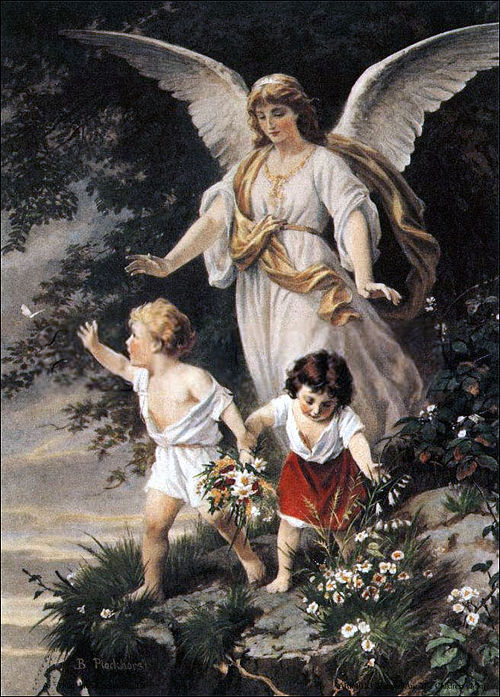
Bernhard Plockhorst, "Guardian Angel" (1886) — while this image traditionally illustrates the Guardian Angel of individuals, the same principle of angelic care and guidance operates at the collective level through the Principalities, the guardian angels of nations and peoples.
Fallen Principalities: The Dark Princes of the World
Just as the faithful Principalities guide nations toward the divine, fallen Principalities corrupt collective human existence from within. Paul's reference to "the god of this age" (2 Corinthians 4:4) and "the ruler of the kingdom of the air" (Ephesians 2:2) point to a fallen angelic intelligence of enormous scope — one that has inverted the Principality function, using its access to the collective human sphere not to guide peoples toward the sacred but to seduce them toward what is opposed to it.
The great ideologies that have enslaved nations — the cults of race, of class, of nation above all else, of pure power — can be understood in the Principality framework as the work of fallen celestial princes: beings who once served the divine order but have turned their governance of collective human life toward corruption and domination. The history of human evil is not only a history of individual moral failure; it is a history of collective spiritual captivity, of peoples enslaved to the inverted vision of their fallen angelic overlord.
This perspective does not diminish human responsibility — individuals remain morally accountable for their choices even within corrupted collective structures. But it adds a dimension that purely sociological or political analysis cannot provide: the spiritual roots of collective evil go deep, deeper than any human institution, into the angelic order itself. Liberation from those roots requires more than political reform; it requires a spiritual transformation of the collective soul, the re-alignment of a people's Principality with the divine order it was created to serve.
The Sacred Dimension of Collective Identity
The Principalities teach something deeply important for a world that has oscillated between the extremes of radical nationalism (the nation as ultimate value) and radical cosmopolitanism (the nation as irrelevant). The truth, in the Principality framework, is that collective identities — nations, peoples, cultures, traditions — are sacred realities: real communities with real angelic guides, real spiritual gifts, and real spiritual vocations in the history of the cosmos.
This sacredness is not exclusive or hierarchical — no nation is inherently superior to another. Every people has its Principality; every culture carries something irreplaceable. But sacredness also implies accountability: a people's history, culture, and institutions will be shaped by how faithfully it has received and embodied the guidance of its angelic Prince, and how courageously it has resisted the corruption of fallen powers seeking to subvert that guidance.
To take collective identity seriously — to honor one's cultural inheritance, to work for the genuine flourishing of one's community, to recognize the spiritual dimension of historical events — is to participate, in some small but real way, in the work of the Principalities: the patient, millennia-long effort to bring the divine order into the fabric of human civilization.
— Lux Esoterica
Related Esoteric Inquiries:
- Dominions: The Celestial Administrators of the Divine Order
- Thrones: The Living Seat of Divine Justice and Stability
- Powers: Celestial Guardians Against the Forces of Darkness
Lux Esoterica.
2026.


Comments