The Elder Futhark: Norse Runes as Oracle, Magic, and the Alphabet of the Cosmos

Carved Elder Futhark inscriptions — the 24-character alphabet used across Scandinavia and Germania from the 2nd to 8th centuries CE.
There is a story, told across a dozen variations in the Norse Eddas and their commentaries, of how a god hung himself from a tree for nine days and nine nights. He pierced himself with a spear. He refused food and water. He stared into the darkness below — into the Well of Urðr, the well from which the three Norns draw the water that shapes fate — and in the final moment of that ordeal, he screamed. And in that scream, something screamed back: the runes.
The god was Odin, the Allfather, the one-eyed wanderer, the lord of wisdom and war, of poetry and death. The tree was Yggdrasil, the World Tree that connects all nine realms of Norse cosmology. And the runes that rose to meet him were not merely letters or signs — they were forces, primordial patterns woven into the fabric of existence before the gods themselves came to be.
This is the founding myth of the Elder Futhark, the oldest known runic alphabet — 24 characters carved into stone, wood, bone, and metal across northern Europe from roughly the 2nd to the 8th centuries CE. But calling them an "alphabet" is like calling the Tarot a "card game." Technically accurate. Spiritually insufficient.
What Are Runes, Really?
The word rune comes from the Proto-Germanic *rūnō, meaning "secret" or "whisper." In Old Norse, rún can mean a secret message, a confidential consultation, or a mystery known only to the initiated. The Finnish cognate runo means a poem or song. Already, in the etymology, we are dealing with something layered: letters that are also secrets, signs that are also songs, marks that are also mysteries.
The Elder Futhark takes its name from its first six characters: F-U-Þ-A-R-K (Fehu, Uruz, Þurisaz, Ansuz, Raidho, Kenaz). This 24-letter system was used not only for everyday inscription — names on objects, memorial texts on runestones, property marks — but also for magical purposes: protection, cursing, healing, binding, and communication with unseen powers.
What distinguishes runes from ordinary alphabets is their status as cosmological symbols. Each rune has a name (e.g., Fehu, Uruz, Thurisaz), a corresponding sound value, a set of associated meanings (prosperity, force, giants), and a deeper mythological context linked to the Norse vision of reality. To draw or carve a rune is not merely to write — it is to invoke.
Odin's Sacrifice: The Mythological Origin
The Hávamál — "Sayings of the High One," one of the poems in the Poetic Edda — contains Odin's own account of the runic initiation:
I know that I hung on the windy tree / nine long nights / wounded with a spear / dedicated to Odin / myself to myself / on that tree of which no man knows / from where its roots run.
No bread did they give me, nor a drink from a horn / downwards I peered / I took up the runes / screaming I took them / then I fell back from there.
This is a shamanic initiation of the highest order. Odin does not receive the runes as a gift — he earns them through a near-death experience of self-sacrifice, hanging between worlds in a liminal state that dissolves the boundary between the living and the dead, the known and the unknown. The Well of Urðr beneath the World Tree is the source of fate itself, and it is by gazing into that source — by surrendering consciousness to the abyss — that the runic patterns become visible.
The mythological grammar here is precise: sacrifice creates access to hidden knowledge. This pattern repeats throughout Norse mythology. Odin sacrifices his eye to drink from Mímir's well of wisdom. He sacrifices warriors in battle to feed his pursuit of cosmic intelligence. He is, above all, a god of price paid — of transformation through loss.
For the esoteric student, Odin's runic initiation is a template: the encounter with primordial knowledge demands the surrender of the ordinary self. You cannot receive the runes while clinging to comfort and certainty.
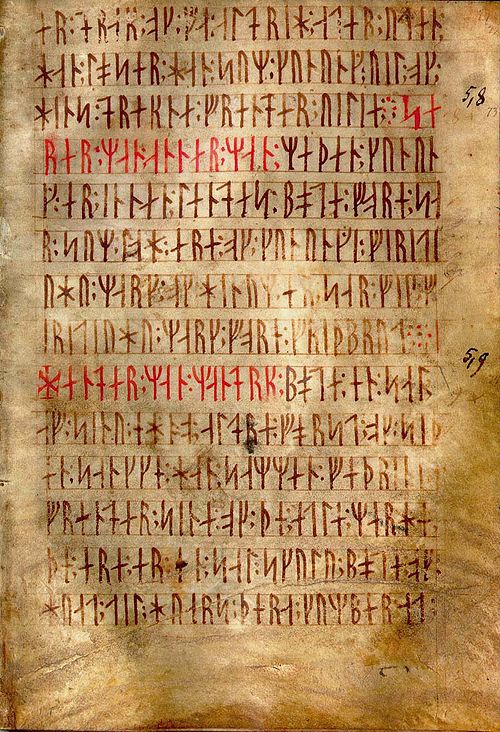
The Codex Runicus (c. 1300 CE) — one of the oldest surviving manuscripts written in runes, containing the Scanian Law and musical notation.
The 24 Runes: Three Aettir
The Elder Futhark is divided into three groups of eight runes, called aettir (singular: ætt), each named after a Norse deity:
Freyr's Ætt (Prosperity and the Natural World)
-
Fehu (F) — Cattle, wealth, abundance. The primal life force, the energy that circulates and must be shared to remain vital. A rune of prosperity but also of the responsibilities of abundance.
-
Uruz (U) — The aurochs (the wild ancestor of the cow). Raw force, physical strength, the untamed power of nature. A rune of health, vitality, and the courage to meet what is wild.
-
Þurisaz (Þ/Th) — Giants, thorns, Mjolnir. A rune of directed force, both protective and destructive. Associated with Thor and the threshold between chaos and order.
-
Ansuz (A) — The mouth, breath, divine speech. The rune of Odin, communication, wisdom, and the power of the word. Galdr — runic magic spoken aloud — operates through this rune's principle.
-
Raidho (R) — The wheel, the journey. Movement, rhythm, the turning of the solar wheel and the horse's canter. A rune of travel, ritual, and the right ordering of time.
-
Kenaz (K) — The torch. Light in darkness, craft, controlled fire. The smith's forge and the teacher's illumination. A rune of knowledge that must be tended, or it goes out.
-
Gebo (G) — The gift. Exchange, hospitality, the sacred contract between gods and humans. In Norse society, the gift binds giver and receiver in mutual obligation — a social and cosmic law.
-
Wunjo (W/V) — Joy, fellowship, the banner of kinship. When the community is whole and the individual finds their place within it, Wunjo describes that state of rightness.
Hagal's Ætt (Disruption, Transformation, and Hidden Forces)
-
Hagalaz (H) — Hail. The destructive storm that also fertilizes. Disruption that cannot be avoided, the seed of future growth within present destruction. The rune of the Norns and fate.
-
Naudiz (N) — Need, necessity. The friction of survival, the fire kindled from need. A rune of constraint but also of the power that awakens under pressure.
-
Isaz (I) — Ice. Stillness, contraction, the pause before transformation. Not death but suspension — the glacier that holds what it will eventually release.
-
Jera (J/Y) — The harvest year, the cycle of seasons. Patient work rewarded. The rune of right timing, of understanding that cosmic forces operate on their own schedule.
-
Eihwaz (Ei) — The yew tree. Yggdrasil, the axis mundi, the tree of life and death. The yew is both the hardest wood and the most poisonous tree — a rune of paradox, endurance, and shamanic passage between worlds.
-
Perthro (P) — The dice cup, fate, the unknown. What is hidden in the lap of the Norns. A rune of mystery, chance, and the fundamental unpredictability at the heart of existence.
-
Algiz (Z/R) — Elk sedge, protection. The raised hand, the antler's crown, the guardian at the threshold. A rune of warding, connection to higher powers, and the protection that comes from spiritual alignment.
-
Sowilō (S) — The sun. Victory, clarity, divine energy in motion. The sun rune was among the most powerful protective symbols in Germanic tradition, carved on shields and helmets.
Tyr's Ætt (Justice, Sacrifice, and the Deep Self)
-
Tiwaz (T) — Tyr, the one-handed god of justice. The rune of the north star, of law, sacrifice for the greater good, and the courage to stand by what is right regardless of cost. Tyr sacrificed his hand to bind Fenrir — a voluntary act of self-harm for cosmic order.
-
Berkano (B) — The birch tree, the goddess Berchta, the mother. Birth, regeneration, the feminine mysteries of growth and nurturing. The birch is the first tree to return after fire.
-
Ehwaz (E) — The horse. Partnership, the sacred bond between rider and mount, the shamanic vehicle for journeying between worlds. In Norse myth, Sleipnir carries Odin between the nine realms.
-
Mannaz (M) — Humankind, the self in relation to others. The rune of the human being as a social and spiritual creature. Intelligence, memory, the gift of consciousness.
-
Laguz (L) — Water, the lake, the leek plant. The flow of the unconscious, the tidal pull of emotion, the hidden currents beneath the surface of awareness. A rune of initiation into depth.
-
Ingwaz (Ng) — Ing, the earth god, seed potential. Gestation, the hero's journey into the earth before returning transformed. The rune of what is held in readiness, not yet manifest.
-
Dagaz (D) — Dawn, the breakthrough moment. The threshold between night and day, the paradoxical point of transformation where opposites meet and something new becomes possible.
-
Othala (O) — The ancestral homeland, inherited land, the family estate. Birthright, genetic inheritance, the wisdom passed down through blood and tradition.

The Rök Runestone in Östergötland, Sweden (c. 800 CE) — containing the longest known runic inscription, with nearly 800 runes covering complex mythological and cosmological themes.
Runes as a Divinatory System
The earliest written account of Germanic divination comes from the Roman historian Tacitus, writing around 98 CE in his Germania. He describes a practice of cutting branches from a nut-bearing tree, marking them with signs (notae), and casting them randomly onto a white cloth. A priest or the head of the family would then pick up three pieces without looking, read their signs, and interpret them in light of the question asked.
Whether Tacitus was describing runic divination or a precursor system remains debated by scholars. What is clear is that divination by carved symbols was central to Germanic religious practice long before Christianity replaced it — and that the symbolic system eventually known as the Elder Futhark was deeply intertwined with these practices.
Modern runic divination typically works as follows: the querent (the person seeking guidance) focuses on a question or life situation. Rune stones or carved tiles are drawn from a pouch without looking, and the runes that come up — their faces, their positions, their combinations — are interpreted as reflecting the energetic forces at work in the situation.
Unlike Tarot, which uses a fixed spread of many cards, runic readings often work with just one to three runes — a quality of counsel rather than quantity of information. The rune drawn does not "predict" the future in a mechanical sense; it names the underlying force at work, the mythological pattern being played out, and leaves the querent to find their own navigation.
This is deeply consistent with the Norse worldview: fate (wyrd, örlög) is real and binding, but wisdom and courage (megin) allow the hero to meet it with dignity rather than being crushed by it.
Runic Magic: Galdr and Bind Runes
Beyond divination, runes were used for active magical working in three primary modes:
Carving (rista): The physical act of cutting runes into a surface — stone, wood, bone, metal, or even flesh — was understood as releasing the rune's power into the material. Runestones memorializing the dead often include protective runic formulae. Helmets and weapons were inscribed with runes of victory (Sowilō, Tiwaz). The act of carving was accompanied by focused intent and spoken invocation.
Coloring (fá): Once carved, runes were often colored — traditionally with red pigment, and in ritual contexts possibly with blood. The rune Ansuz specifically governs the magic of the spoken word and colored inscription. The color activated the carving, linking the physical mark to the mythological force it named.
Chanting (galdr): The word galdr comes from the same root as the English "yell" and relates to the cry of birds (Odin's ravens Huginn and Muninn were his messengers). Galdr was the practice of chanting or singing the rune's name — sometimes in extended tones, sometimes in complex formulae — to raise and direct its power. This is runic magic as pure vibration: the voice as a tool of cosmic manipulation.
Bind runes (bindrunes) combined multiple runic characters into a single composite symbol, merging their powers for a specific purpose. A bind rune for protection might combine Algiz (warding) and Tiwaz (courage and justice). Bind runes were carved onto talismans, amulets, and weapons, and their creation was considered an art requiring both runic knowledge and magical skill.
The Runestones: Where Myth Meets Stone
Across Sweden, Denmark, Norway, and Iceland, over 3,000 runestones survive — carved monuments that range from simple memorial stones to complex mythological compositions. The Rök Runestone in Östergötland, Sweden (c. 800 CE), is among the most extraordinary: with nearly 800 runes covering five different runic systems, it contains references to the heroes Theodoric and Wemod, to Odin, and to cosmic questions about the nature of fate that scholars are still debating.
These stones are not merely historical curiosities. They represent the integration of runic knowledge into daily Norse life — the meeting point of the sacred and the social, where private grief for the dead was expressed through cosmological symbols that connected the bereaved family to the forces governing all existence.
For the esoteric student, runestones offer something precious: evidence that in pre-Christian northern Europe, the magical and the mundane were not separated. To commemorate your father was also to invoke the protection of Odin. To mark your property was also to carve a ward against misfortune. Language was sacred, and every word had weight.
The Historical Journey: Suppression and Revival
With the Christianization of Scandinavia (roughly 9th–12th centuries CE), runic practice entered a long period of suppression. Church authorities viewed runic divination and magic as demonic and issued prohibitions against their practice. Yet runes did not disappear — they survived in folk tradition, in carved wooden objects, in the isolated communities of rural Sweden and Norway, and in the scholarly preservation of the Eddas by medieval Icelandic monks who recognized their cultural value.
The modern revival of runic study began in the 19th century with the Romantic rediscovery of Norse mythology — the same movement that inspired Wagner's Ring Cycle and the nationalism of Scandinavian countries asserting cultural identity. Unfortunately, the 20th century saw a dark chapter: the Nazi regime appropriated runic symbols (particularly Sowilō/SS and Odal/Othala) for its ideology, creating an association that legitimate scholars and practitioners have spent decades working to contextualize and correct.
Contemporary runic practice — through figures like Ralph Blum (who popularized rune cards in the 1980s), Edred Thorsson (who developed the academic and magical system known as Runology), and the broader Ásatrú and Heathen movements — has worked to restore the runes to their authentic mythological and spiritual context: as a living wisdom tradition belonging to the full spiritual heritage of humanity, not to any racial or political ideology.
Working with Runes Today
For the contemporary esoteric practitioner, runes offer a distinctive quality of counsel: earthy, direct, and mythologically dense. Where Tarot speaks in psychological archetypes accessible to anyone, runes speak from within a specific cosmological framework — the Norse understanding of fate, sacrifice, and the warrior's relationship to death and destiny.
To work with runes is to enter into relationship with a particular version of the cosmos: one in which the world hangs on a tree that is forever threatened by the serpent Níðhöggr gnawing at its roots; in which three women at the base of that tree weave, measure, and cut the threads of fate; in which the gods themselves are mortal, aware that Ragnarök is coming, and fighting anyway.
This is not an optimistic cosmology in the comfortable sense — it does not promise that everything will work out. But it is a profoundly courageous one. In the Norse worldview, knowing that doom is inevitable does not lead to despair: it leads to nobility. To act rightly, to face what comes with clear eyes and a full heart, to honor your word and your kin even when the odds are against you — this is the runic ethic at its deepest level.
The runes are not a shortcut to certainty. They are an invitation into depth — into the mystery at the heart of language, fate, and the cosmos. They ask you to hang, however briefly, on your own inner Yggdrasil; to stare into your own Well of Urðr; and to receive whatever screams back.
— Lux Esoterica
Related Esoteric Inquiries:
- Runes: The Viking Alphabet and Its Use in Divination and Magic (2026)
- Norse Runes: The Elder Futhark, Their Meanings, and How to Use Them for Divination
- The Secret Language of the Cosmos: Study and Mystical Symbolism of the 24 Runes of the Elder Futhark
Lux Esoterica.
2026.


Comments