The Pantheon: Rome's Temple to All the Gods
The Pantheon of Rome — completed in its current form around 125 CE under the Emperor Hadrian — is the best-preserved ancient Roman building and one of the most influential architectural achievements in the history of Western civilization. Its name means "temple of all the gods" and its plan is a perfect cosmological instrument: a circular drum surmounted by a hemisphere whose diameter (43.3 meters) exactly equals its height above the floor — a perfect sphere inscribed within the building. At the summit of the dome, the oculus (the eye of heaven) — a circular opening 9 meters in diameter — is the building's only light source. The beam of light that enters through the oculus moves across the interior as the sun moves, transforming the entire building into a sundial, a calendar, and a continuously changing meditation on the relationship between the divine light and the human space it illuminates. Every architect in the Western tradition has studied the Pantheon. Brunelleschi, Michelangelo, Palladio, Wren — all began there.

The Pantheon exterior — the eight-column Corinthian porch (pronaos) fronts the cylindrical rotunda; the transition between the rectangular porch and the circular drum behind it is one of the most audacious architectural moves in antiquity; the inscription reads M·AGRIPPA·L·F·COS·TERTIVM·FECIT (Marcus Agrippa, son of Lucius, made this in his third consulship) — a fiction, since the current building is Hadrianic

The Pantheon dome interior — the coffered ceiling, 28 rows of 5 coffers each (140 total), reduces the weight of the concrete dome while creating a visual rhythm that draws the eye upward toward the oculus; the coffers were originally decorated with bronze rosettes; the concrete dome remains the largest unreinforced concrete dome in the world, 1,900 years after construction

The oculus — the 9-meter circular opening at the dome's apex; open to the sky, it admits rain (a drain in the floor handles it), birds, and the beam of light that constitutes the building's only illumination; on April 21 (the traditional founding date of Rome), the oculus beam falls directly on the main entrance, aligning the building with its most sacred civic moment

The Pantheon by Giovanni Battista Piranesi (c. 1756) — Piranesi's cross-section reveals the geometric secret of the building: the interior sphere, whose diameter equals the full height from floor to oculus; the perfect sphere inscribed in the rotunda was understood by Renaissance and Baroque architects as a symbol of the cosmos — the divine totality contained within a human space

The Pantheon in its urban context, Piazza della Rotonda — the building has been in continuous use since its construction; consecrated as a Christian church (Santa Maria ad Martyres) in 609 CE, which is the principal reason for its extraordinary preservation; it contains the tombs of Raphael (1483-1520) and two Italian kings
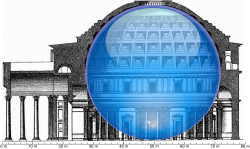
The Pantheon sphere diagram — the inscribed sphere whose diameter equals the total interior height (43.3 meters) was Hadrian's geometric idea; it is the most elegant single idea in ancient Roman architecture; every subsequent domed building in the Western tradition — from Brunelleschi's Florentine dome to St. Peter's Basilica to the US Capitol — responds to this precedent

The Pantheon's portico columns — sixteen monolithic columns of Egyptian granite (eight in the front row, four on each side), each 12 meters high and 1.5 meters in diameter, shipped from the quarries of Mons Claudianus in the Eastern Desert; the logistical achievement of transporting, finishing, and erecting them was as impressive as the architectural achievement they support

Raphael's tomb in the Pantheon — the painter who fused Neoplatonic philosophy with Catholic theology in the Vatican Stanze chose to be buried in the Pantheon; his epitaph reads: 'Here lies Raphael, by whom the mother of all things feared to be overcome while he lived, and while he was dying, feared herself to die.' The greatest painting mind of the Renaissance chose as his resting place the building that had most profoundly shaped his understanding of form


Comentarios