Hildegard von Bingen: The Scivias and the Living Light
In a famous medieval miniature, a woman sits with a wax tablet on her knees while tongues of fire descend from the sky onto her head. Beside her, a monk peers through a small opening in the wall, pen in hand, ready to copy what she says.
The woman is Hildegard of Bingen, and the picture shows the moment when, in her own words, the heavens opened and the light of a vision poured into her mind. The book she dictated was called Scivias, and it made her one of the most extraordinary voices of the Middle Ages.
Abbess, composer, healer, preacher and visionary, Hildegard (1098–1179) refused to separate the study of nature from the contemplation of God. For her, the whole creation was a single living body, and she described it with images so vivid that readers still return to them nine centuries later.
A Child Who Saw Light
Hildegard was born in the Rhineland and was given to the Church as a young girl, to be raised in the care of a woman named Jutta, who lived as an anchoress attached to a monastery. She later recalled that since childhood she had perceived a radiance that she could not explain.
She called its source the "Shadow of the Living Light," a phrase that tells us she thought of her visions as a reflection of a greater brightness, not the brightness itself.
For decades she kept silent about these experiences. Only in her early forties, according to her own account, did a voice command her to write down what she saw. Hesitant and ill, she eventually obeyed, and she began to work with her secretary, the monk Volmar, who helped to polish her Latin.
Scivias: "Know the Ways"
The title Scivias is usually understood as a shortening of Scito vias Domini, "Know the ways of the Lord." The book took about ten years to finish and records twenty-six visions in three parts. They describe the creation of the world, the story of salvation, the Church, the struggle between good and evil and the final restoration of all things.
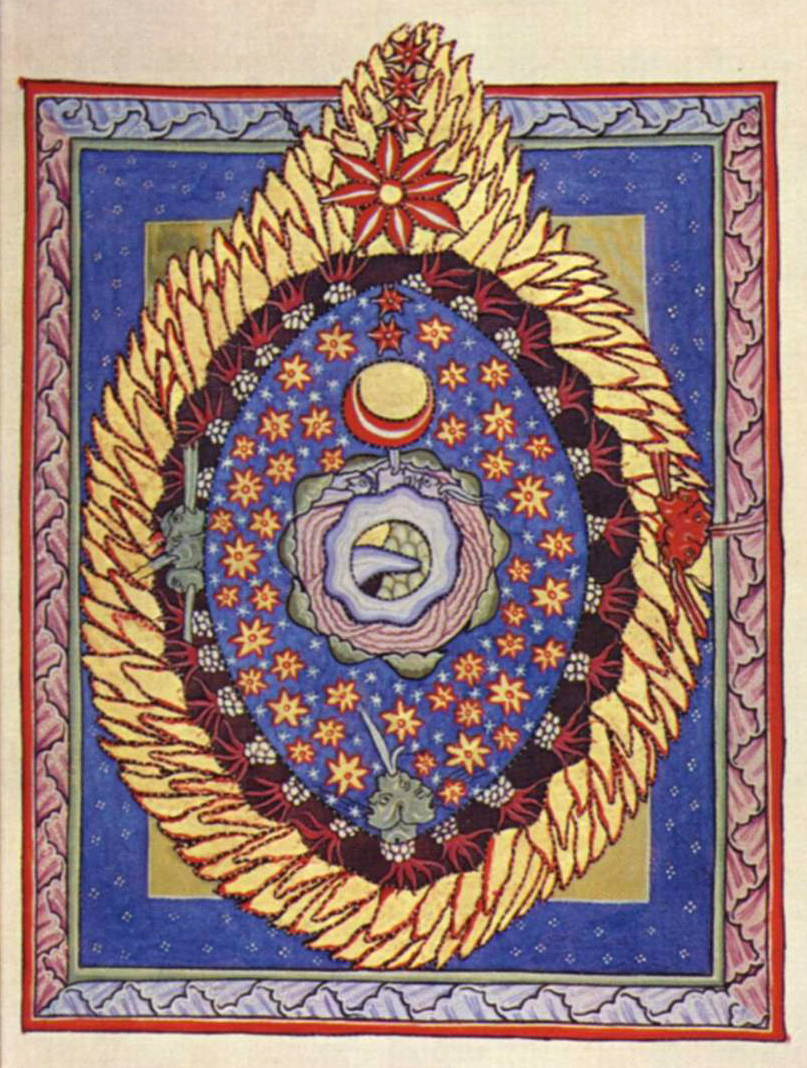
Each vision is followed by an explanation, which Hildegard says she received together with the image. The pictures are strange and precise: a mountain with a figure seated on it, a luminous figure covered in eyes, a great egg-shaped cosmos with fire, air and water arranged in layers.
The manuscripts made under her supervision illustrated these scenes with brilliant colors, and they remain among the great treasures of medieval art.
Viriditas: The Greening Power
Hildegard's most beloved idea is viriditas, a Latin word meaning "greenness" or "freshness." For her it was far more than a color. It was the life force that moves through plants, animals and human beings alike, the sap that makes a tree bloom and the grace that makes a soul fruitful.
She also named its opposite, dryness. A person who falls into bitterness, laziness or despair, she suggested, dries up inside, like a field in a drought. The remedy was to turn back toward the sources of life: prayer, music, honest work, the herbs and stones of the earth.
In her medical writings she describes the properties of plants and minerals, always within the frame of a world that God has made good.
The Cosmos and the Human Being
In her later work on the divine works, Hildegard drew a great vision in which a human figure stands at the center of the universe, linked to the planets, the winds and the elements. Centuries before the Renaissance made the man inside a circle famous, she was already teaching that the human body is a small world mirroring the large one.
In this view, health is harmony. The four elements and the four temperaments should be balanced, just as the voices in a choir are balanced, and illness appears when one voice grows too loud or too weak. This is why music held such a high place in her thought: she composed a cycle of chants for her nuns, and she believed that song could recall the soul to its original perfection.
What Her Life Teaches
Hildegard lived in a time when women rarely held public authority, yet she wrote to popes, kings and emperors, and she traveled to preach. She founded a community of nuns on the Rupertsberg, near Bingen, and later a second house across the river.
She was not a rebel against the Church. She stood inside it and spoke with the confidence of someone who believed she had been given a message.
Her example is useful to anyone who feels called to something larger than the role assigned to them. Obedience and boldness, she shows, can live in the same person.
Closing
Hildegard of Bingen offers a gentle but demanding vision: the world is alive, the soul is meant to be green, and the divine light shines through every leaf and every note of music. When she looked at the sky, she did not see an empty vault but a living shape full of meaning.
Those who read her today can ask a simple question from her teaching: where in my life has the greenness dried, and what would bring it back?
Related Esoteric Inquiries
- The Hereford Mappa Mundi: Esoteric Cartography of the Middle Ages
- The Ogdoad: The Octave and Universal Harmony
- The Triad: The First Equilibrium and Harmony
Lux Esoterica.
2026.


Comments