Atalanta Fugiens, Emblem 33: The Hermaphrodite Lying Like the Dead
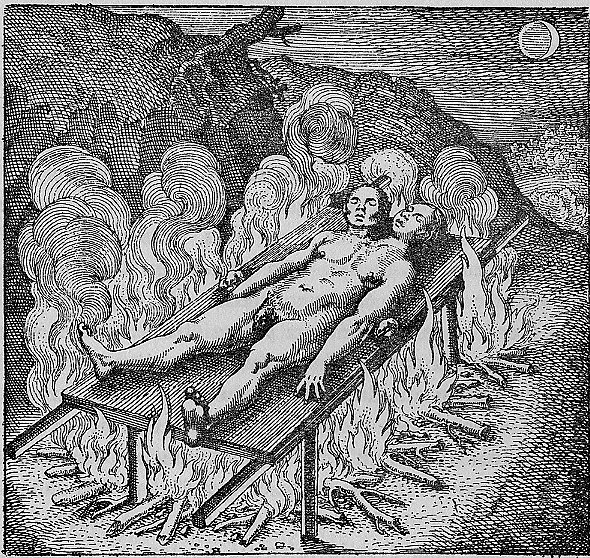
Two bodies lie side by side on a long wooden bench, joined into one figure with two heads, a man's and a woman's. Fires burn under the bench and all around it, and curls of smoke rise in the dark.
A thin crescent moon hangs in the upper right corner over a rough hillside. This is the thirty-third emblem of Michael Maier's Atalanta Fugiens, and its motto says: the hermaphrodite, like a dead man lying in darkness, needs fire.
The book was printed in 1617 at Oppenheim. It has fifty emblems, and each one joins an engraving, a Latin verse, a prose discourse and a fugue for three voices. The engravings are attributed to the workshop of Matthäus Merian. Maier, a physician at the court of Emperor Rudolf II, never shied from strange pictures.
The Motto
The Latin line gives three facts. The being is double, male and female. It is as still as a corpse. It lies in darkness, and what it needs is fire.
The engraving obeys the line. The figure is pale and motionless, and the fire waits all around it.
The Hermaphrodite
The name comes from Greek myth. Hermaphroditus was the son of Hermes and Aphrodite. In Ovid's telling, a water nymph named Salmacis fell in love with him and prayed that they might never be parted. The gods granted the prayer, and the two bodies became one.
Alchemists took the myth as a symbol. The union of Hermes, or mercury, and Aphrodite, or the copper of Venus, gave a double being. They named the result the rebis, a Latin word that means two-thing, the matter that holds both principles at once.
The Dead One in the Dark
The figure lies as if dead because, in the tradition, the Work comes to a still point after the union of opposites. The two principles have joined, and the new body has not yet begun to move. The old authors called this stage black, the night of the Work.
It is not an ending. The dark is a waiting room. The emblem says that the double being is not dead, but needs a certain kind of help to rise.
Why Fire?
A corpse cannot warm itself. The heat must come from outside, and it must be carefully managed. In the old language, fire was the agent that awakened the sleeping matter and drove it to the next stage.
The picture shows many small fires, set at intervals around the bench, and not one great blaze. The tradition valued a patient and even heat, which dried and fixed the matter without scorching it.
A Reading for Today
The emblem speaks to a hard moment in any change. A person has brought together two parts of the self, and for a while nothing seems to happen. The old way of life has ended, and the new one has not begun.
The image advises against alarm. Stillness may be a stage and not a failure. What is needed is warmth, regular attention and time.
The Engraving
The two heads rest at the end of the bench, their eyes closed, and the bodies lie so close that they seem to be one. The bench is made of two long planks set on short legs, and flames rise between them and on every side.
The smoke curls in neat spirals, drawn with fine parallel lines. A bare tree leans from the hill at the upper left. The moon is a thin sliver, and the whole scene has a hush about it.
The Fugue
The fugue that goes with this emblem is written for three voices. The voices enter one after another and repeat the same line, as if each chased the one before. That is the sense of the title. In the myth, Atalanta was a swift runner, and Hippomenes won her by dropping golden apples to make her stop. Maier turned that chase into music and into a series of images. Modern recordings let us hear it today.
Contemplating the Emblem
For those who wish to work with this image:
- Look at the double figure and the ring of fires around it.
- Ask which two parts of you have lately come together.
- Think of what warmth, steady and not harsh, could help them wake.
- Give yourself one quiet hour without demanding progress.
A Word of Care
The emblem is a symbol of union and waiting, and it offers no instruction for the body. Real fire is dangerous, and a person who feels lost in a long dark stretch of life should seek the company of friends or a qualified counselor. The tradition's claims about the rebis cannot be confirmed.
Closing
Two heads on one body, a bench among flames, a thin moon. Maier painted the stillest moment of the Work. For the seeker, the teaching is steady: what has been joined may lie as if dead, and it will rise when the fire is kept with care.
Related Esoteric Inquiries
- Atalanta Fugiens, Emblem 38: The Rebis and the Absolute Union
- Atalanta Fugiens, Emblem 40: The Union of the Two Waters
- Atalanta Fugiens, Emblem 30: The Sun and the Moon
Lux Esoterica.
2026.


Comments