Atalanta Fugiens, Emblem 38: The Rebis and the Absolute Union
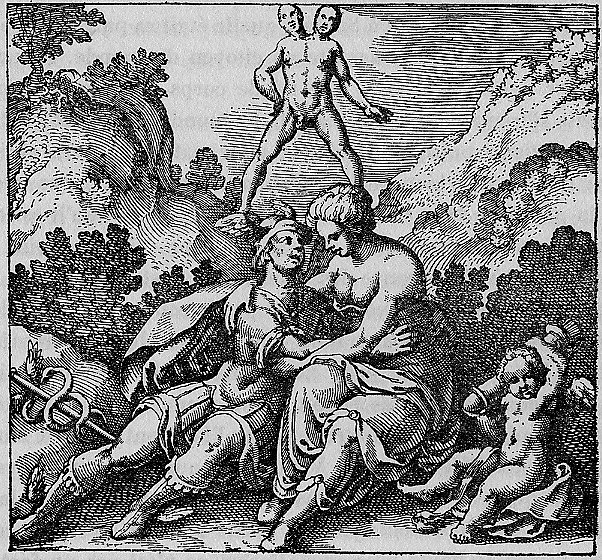
Two mountains stand on opposite sides, one named for Mercury and one for Venus, and between them a single child is born with a double nature. So runs the motto of the thirty-eighth emblem in Michael Maier's Atalanta Fugiens: Rebis, ut Hermaphroditus, nascitur ex duobus montibus, Mercurii et Veneris, "The Rebis, like a Hermaphrodite, is born from two mountains, of Mercury and of Venus."
The picture has everything a puzzle-loving reader of 1618 could want: a mystery, a pair of gods and a creature that belongs to neither side alone.
What the Word Means
Rebis is an alchemical term, usually explained as coming from the Latin res bina, "double thing." It names the product of the union of the two principles in the Great Work, a being with both a male and a female aspect. Many alchemical books show it as a figure with two heads, or as a body half male and half female.
The term does not appear in ancient sources. It belongs to the late medieval and Renaissance tradition, and it was already well known by Maier's day. Its closest ancestor in myth is Hermaphroditus, the child of Hermes and Aphrodite, whom Ovid says was joined with a nymph, Salmacis, in a single body.
The Two Mountains
The motto gives the parents as two mountains, Mercury and Venus. These are the planets and their gods. Mercury, in alchemy, is also the metal quicksilver and the spirit of change. Venus corresponds to copper and to love and beauty. A mountain, in the language of emblems, is a high and solid place, a picture of something that has grown over a long time.
The Hermaphroditus of the old myth was likewise a child of Hermes, the Roman Mercury, and Aphrodite, the Roman Venus. Maier's motto plays directly on this: the alchemical child has the same parents as the mythical one. The classical story lent the alchemist a respectable ancestry for his symbol.
A Book for Eye and Ear
Atalanta Fugiens was printed in Oppenheim in 1618 by Johann Theodor de Bry, with copper engravings by Matthäus Merian. It has fifty emblems, each with a motto, a picture, an epigram and a discourse, and each is paired with a musical fugue for three voices.
The thirty-eighth has its own fugue, number thirty-eight. Maier's hope was that a reader could study the work with the eye, the mind and the ear at once.
Recent scholarship has argued that some of the music was borrowed from earlier English composers. If so, Maier chose existing tunes and fitted them to his emblems, as an editor and compiler as much as a composer.
How Alchemists Read It
For the laboratory alchemist, the Rebis stood for the result of joining sulphur and mercury, the two chief principles of the metals, into a stable compound. For a more spiritual reader, it was a picture of wholeness, in which male and female, active and receptive, body and spirit are not at war.
These two readings were not separated in the period. The books speak in a double language, and a phrase might refer to a flask on the furnace or to the inner life. Modern readers can enjoy both without having to prove either.
The Old Story Behind the Symbol
Ovid tells the tale in the fourth book of the Metamorphoses. A handsome boy, Hermaphroditus, bathes in a pool, and the water nymph Salmacis, who loves him, clings to him and prays that the gods never part them. The gods hear her, and their two bodies merge into one that is both man and woman.
Before the boy leaves the pool, he asks that anyone who bathes there afterward be changed in the same way.
Alchemists took the story as a ready-made picture of union by water, and the pool became the bath of the vessel. The myth is about loss as much as joining, and Ovid's tone is sad, which sits well with the alchemical idea that two must give up something to become one.
A Note on the Image
The hermaphrodite in alchemical art is a symbol and does not describe real human bodies. Reading it as a comment on actual people would be a mistake. It belongs to a tradition of symbolic pairings, like the king and queen or the sun and moon, in which one body stands for a union of principles.
Closing
The thirty-eighth emblem sets two mountains side by side and lets a single figure grow between them. It is a small riddle about how opposites can make something that neither could make alone. Four centuries later, the Rebis remains one of the most memorable pictures in alchemy, and the Latin motto still carries it: a double thing, born of two, and more than both.
Related Esoteric Inquiries
- Atalanta Fugiens, Emblem 33: The Alchemical Hermaphrodite
- Atalanta Fugiens, Emblem 40: The Union of the Two Waters
- Atalanta Fugiens, Emblem 47: The Wolf and the Dog
Lux Esoterica.
2026.


Comments