Atalanta Fugiens, Emblem 3: The Alchemy of the Laundress
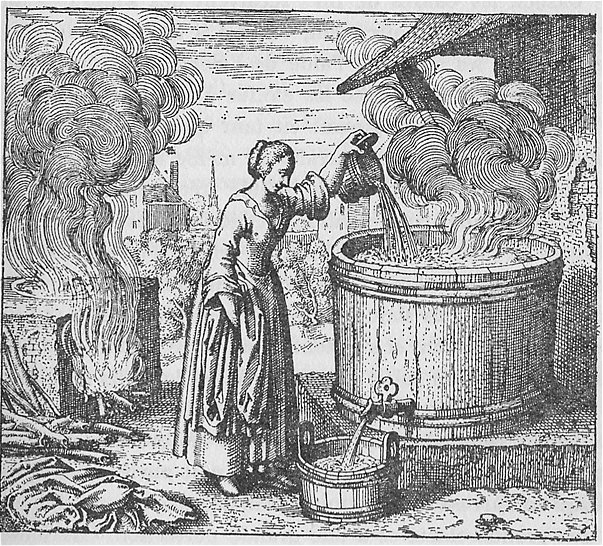
A woman in a long dress stands beside a huge wooden tub, tilting a jug so that water falls into it. Steam rolls from the tub, a fire burns under a pot on the left, and a pile of cloth lies on the ground.
A small pail below the tub catches what drips from a tap. This is the third emblem of Michael Maier's Atalanta Fugiens, and its motto gives an order: go to the woman washing clothes, and do the same.
The book was printed in 1617 at Oppenheim. It has fifty emblems, and each one joins an engraving, a Latin verse, a prose discourse and a fugue for three voices. The engravings are attributed to the workshop of Matthäus Merian. Maier, a physician at the court of Emperor Rudolf II, often found his teachers in ordinary trades.
The Motto
The Latin line is an instruction, and a surprising one. The student of the art is not sent to a library or a temple. He is sent to a woman doing the laundry.
The message is that the Work can be learned from household labor. Maier trusted that anyone who watched carefully would understand.
How Linen Is Washed
In Maier's day, linen was washed in a strong lye. Water was poured through wood ash, which gave a liquid that cut grease and lifted stains. The cloth was left to soak in a large tub, and heat made the cleaning faster. Then it was rinsed and often spread in the sun to whiten further.
The engraving shows the steps. Fire under the pot, water poured into the tub, steam rising, the rinse collecting below. The woman knows what she is doing, and every motion has a purpose.
The Whitening
Alchemists spoke of a stage called the albedo, the whitening. After the dark phase of the Work, the matter was washed and cleansed until it became pale and pure. Many writers compared this to the work of a laundress.
The comparison is natural. Linen starts gray and stained and ends clean. The same patient steps, repeated many times, change its color. For the tradition, the Stone passed through a similar change.
Gods in the Kitchen
There is an old story about the Greek philosopher Heraclitus. Visitors who came to meet him found him warming himself by a baker's oven, and they hesitated at the door. He told them to come in, for there were gods there too.
Aristotle tells the tale to make the point that nature is worth studying even in its lowest corners. The emblem makes the same case. Wisdom does not belong only to books and high places. It lives wherever a person works with care.
A Reading for Today
The picture says that cleansing is a craft and not a mood. It takes water, heat, time and repetition. A person who wants to become clear in mind or heart will do well to think of the laundress: she begins each load without drama and does not expect one wash to be enough.
It also says something about humility. The teacher may be someone you would not have noticed.
The Engraving
The scene is drawn with a quiet attention to detail. The tub is bound with iron hoops and fitted with a tap shaped like a small flower. Steam piles up in great curls above it, and more rises from the fire at the left, where a stack of logs waits.
The woman is seen in profile, bending slightly, her sleeves pushed back. In the distance, a church spire and a few roofs show that this is an ordinary town. The picture feels like a moment taken from daily life.
The Fugue
Each emblem in the book has its own music. The fugue is written for three voices, and each voice follows the one before it, which is where the name comes from: fuga means flight or pursuit. The title recalls Atalanta, who raced her suitors until Hippomenes dropped golden apples in her path.
Maier used the old tale as a frame for fifty riddles. Modern singers have recorded the pieces, so anyone can hear them while looking at the engraving.
Contemplating the Emblem
For those who wish to work with this image:
- Look at the woman and follow the path of the water from jug to tub to pail.
- Ask what in your life is gray and stained and needs a long, patient washing.
- Do one humble chore today with full attention and notice what it teaches.
- Think of a person you have overlooked who knows something you need.
A Word of Care
Wood-ash lye is a strong alkali. It burns skin and eyes, and it can be dangerous to handle. Anyone who wants to try an old laundry method should use gloves and eye protection, or better, choose a modern soap. The emblem is a teaching picture and not a recipe, and the claims of the tradition about the Stone cannot be confirmed.
Closing
A woman, a tub, a plume of steam. Maier sent his reader to a laundry to learn about the great Work, and the lesson holds. For the seeker, the teaching is plain: wash, rinse and begin again, and the cloth will turn white.
Related Esoteric Inquiries
- Atalanta Fugiens, Emblem 23: The Rain of Gold and the Birth of Pallas
- Atalanta Fugiens, Emblem 11: The White Woman and the Red Man
- Atalanta Fugiens, Emblem 9: The Old Man Shut in with the Tree
Lux Esoterica.
2026.


Comments