Hercules' Eleventh Labor: The Apples of the Hesperides
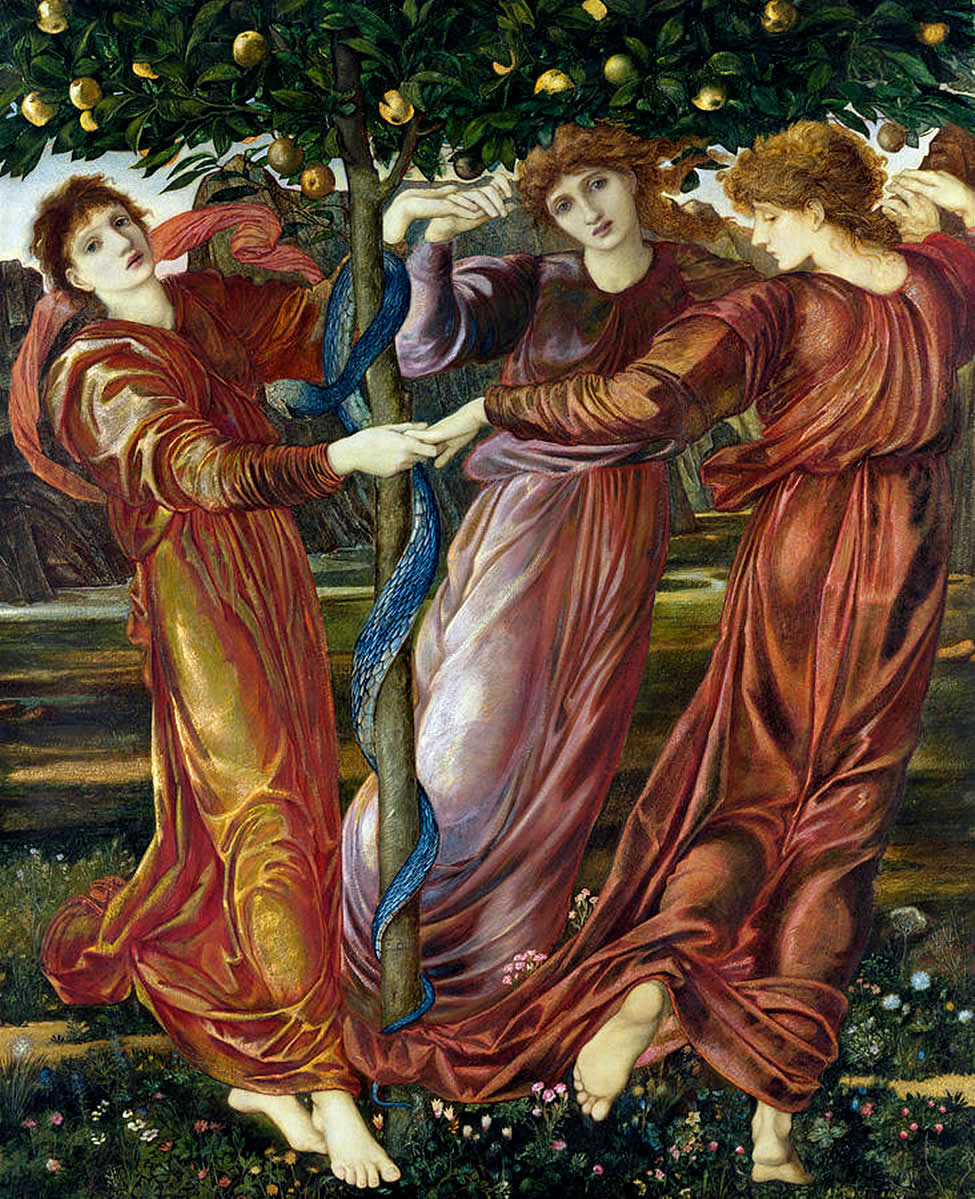
In the myths, the eleventh labor of Heracles takes him to the far west, to a garden at the edge of the world. There grow the golden apples that Gaia gave to Hera as a wedding gift. These fruits were said to grant immortality, and they were guarded by the Hesperides, the daughters of the evening, together with Ladon, a dragon with many heads. The task seemed impossible, and that is precisely why it is so rich in meaning.
Many ancient writers told this story in different ways. Hesiod spoke of the Hesperides, and later poets, painters and mythographers added their own details. The core remains the same: a hero must reach a sacred place that few can enter, and he must solve a problem that no simple strength can solve.
The Garden at the Edge of the World
The garden lies beyond the known lands, in a place where the sun sets. The Hesperides were usually seen as singing nymphs who tended the trees. Their name is linked to the evening sky, to the hour when light fades and the world grows quiet.
The garden is therefore a threshold, a place between day and night, where the ordinary rules of travel no longer hold. Artists of later centuries loved to paint it, with its tall trees, its quiet light and its glowing fruit.
The apples themselves were golden, and gold in the ancient world was a sign of incorruptible things. They stood for a life that does not decay, a gift that ordinary mortals cannot keep.
Ladon, the Watchful Serpent
Ladon, the dragon, coiled around the tree that bore the apples. In Hesiod he is said to have a hundred heads and to speak in many voices, a sign of his watchfulness and of his power. He is the guardian of the threshold. Those who want the fruit must first pass him, and the passage is never easy.
Many interpreters have read Ladon as a symbol of time and of the great cycles of life, which coil around every gift that the gods offer. Others see him as the fear that rises before any great discovery. In both readings, the serpent asks whether the seeker is ready.
The Bargain with Atlas
Heracles could not reach the apples on his own. He asked the Titan Atlas, who bears the heavens on his shoulders, to fetch them for him. Atlas agreed, but first he had to be relieved of the burden of the sky. So Heracles took the weight of the heavens upon himself and held the sky while Atlas went to the garden.
This is the turning point of the labor. The hero proves that he can bear a crushing weight, the weight of the cosmos, in order to earn a share of its wisdom. Some interpreters see Atlas and Heracles as two aspects of the same seeker: the one who carries the world, and the one who finds the path to what the world holds most precious.
The Trick of Heracles
When Atlas returned with the apples, he offered to carry the sky a little longer while Heracles was away. He wanted to keep the burden that had been placed on him. Heracles, however, was clever. He asked Atlas to take the sky back for a moment so that he could place a cushion on his shoulders, for the weight was painful. Atlas agreed, and the hero walked away with the apples.
The story is famous for this cunning. It shows that wisdom is not only about strength, but also about patience, diplomacy and a good sense of timing. The hero returns the burden without being trapped by it.
What the Apples Teach
In the esoteric tradition, the golden apples are often read as a symbol of the highest knowledge, the kind of understanding that is hidden at the center of the tree of life. The garden is the place where this knowledge grows.
The seeker who wants it must pass the guardian, carry a heavy responsibility for a time, and then leave with wisdom while refusing to be ruled by the mechanism that guarded it.
This reading suggests that spiritual gifts do not come cheaply. They require courage, humility and cunning, and the willingness to carry something heavy for the sake of a larger good.
Closing
The eleventh labor is a story about the price of wisdom. Heracles reaches the garden, faces the watchful serpent, carries the sky and returns with the golden fruit. Along the way he learns that strength must be joined with cleverness and that no burden must become a prison.
Whatever one believes about immortality, the myth offers a clear image of the seeker who walks to the edge of the known world and comes back with a gift that changes the way he sees the sky.
Related Esoteric Inquiries
- Hercules' Twelfth Labor: Cerberus and the Underworld
- Hercules' Tenth Labor: The Cattle of Geryon
- Hercules' Ninth Labor: The Belt of Hippolyta
Lux Esoterica.
2026.


Comments