Hercules' Twelfth Labor: Cerberus and the Underworld
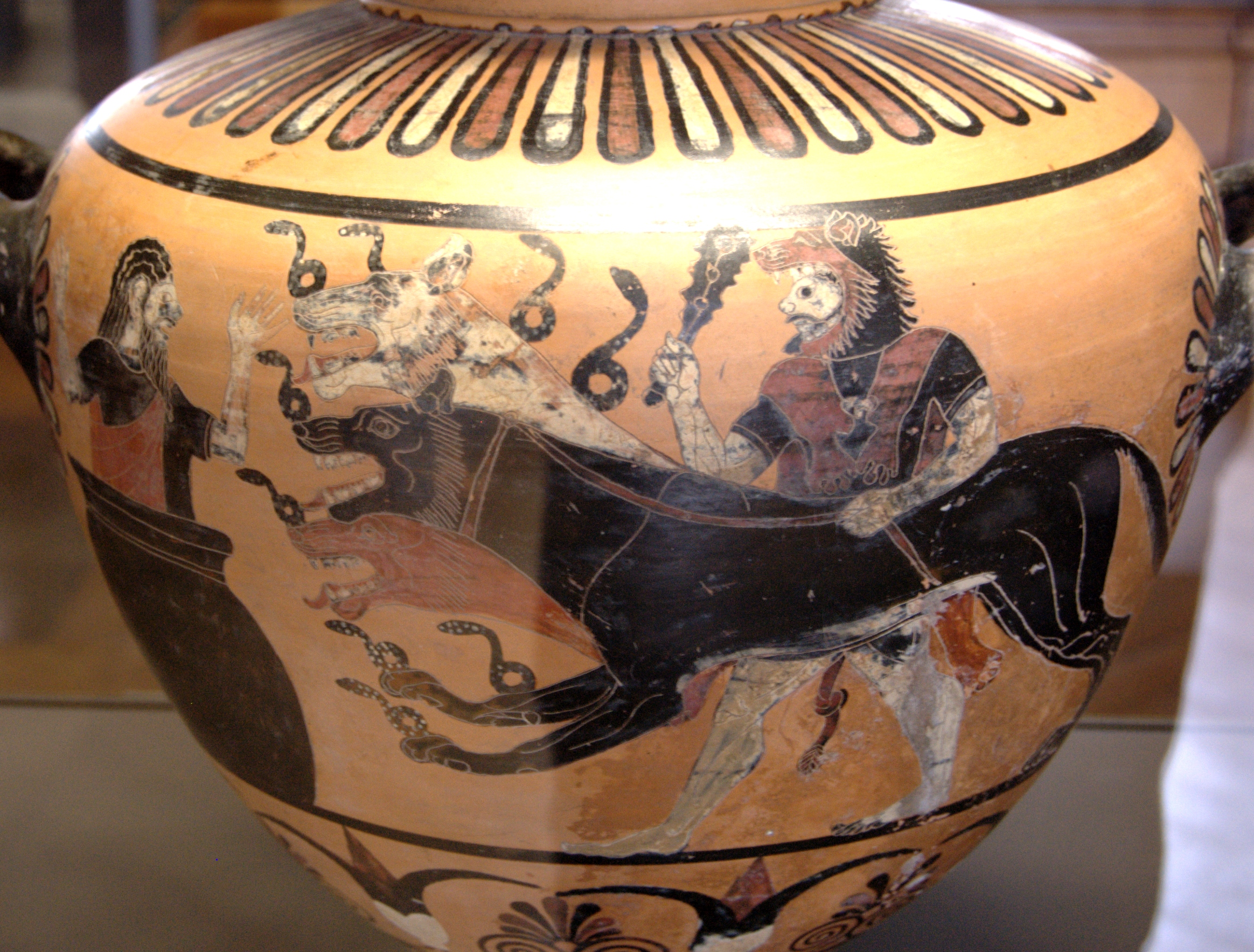
The twelfth and last labor of Heracles, known to the Romans as Hercules, is the most dangerous of all. King Eurystheus, who set the twelve tasks, sent the hero down into the underworld to bring back Cerberus, the hound that guards the gate of the dead. Of all the labors, this one is the descent, and many readers see in it the deepest image of the hero's journey.
The story has many versions, and the older Greek sources do not agree on every detail. Yet the core is clear: a living man goes where the living should not go, meets the lord of the dead, and returns with the guardian of the gate.
The Descent into Hades
In the myths, the entrance to the underworld lay at the edge of the known world, beyond rivers of grief and forgetfulness. Heracles was helped in some versions by Athena and Hermes, who guided him through the dark. To reach the dead, he had to cross the waters that separate the living from the realm where the shades of the dead drift without voice.
This passage is called a nekyia in Greek, a journey into the land of the dead. Many writers have read it as a symbol of the dark night of the soul, when a person faces the fact of mortality and must go on anyway. The hero does not enter as a tourist. He enters because he has been ordered to, and because his path requires it.
Cerberus, the Gate Guard
Cerberus is usually shown with three heads, and in some sources with a serpent's tail and a mane of snakes. He guards the entrance so that the dead do not leave and the living do not enter. His three heads have been read as symbols of the past, the present and the future, or as a sign of the dangers that surround every gate. Whatever the interpretation, the hound stands for the fear that rises at the threshold of the unknown.
In the tradition, fear is not a simple enemy. It is the guardian that marks where the real change begins. Those who learn to face their fear often find that its form is less terrible than it seemed from afar.
The Condition of Hades
Hades agreed to let Heracles take Cerberus, but on one condition: the hero must master the beast without using weapons. No sword, club or bow could be used. The victory had to come from strength and nerve alone. This rule is one of the most striking parts of the myth, because it removes every easy means of escape.
Many readers see here a lesson about inner work. Outer tools cannot always solve an inner crisis. The student must face the fear with the whole self, without hiding behind a shield.
The Wrestling with Fear
Heracles wore the skin of the Nemean Lion, a trophy from his first labor, which had made him invulnerable to ordinary blows. He seized the hound and held it, even as its heads snapped and its tail struck. The myth does not say that he killed the beast. He held it until it yielded, and then he brought it up into the light of the upper world.
Seen as a symbol, the scene shows that fear is not destroyed but mastered. The hero does not pretend that the danger is gone. He keeps his grip, refuses to flinch, and carries the darkness into daylight, where it can be seen and understood. In the alchemical image of the Great Work, this is the moment when the hidden matter is brought up to the sun.
Cerberus and the Shadow
The modern language of shadow work offers a helpful way to read the twelfth labor. The shadow holds the fears and wounds that a person pushes out of sight. When it is ignored, it stays in the underworld of the mind and grows in silence. When it is faced and held with care, it can lose its power to frighten and become part of a more whole self.
This does not mean becoming cruel to the fear. It means refusing to run from it. A person can bring fear into the light by naming it, speaking about it with a trusted friend, or writing it down, without letting it rule every decision.
Closing
The labor of Cerberus is a story of courage in the face of the unknown. Heracles returns to the living world with the hound, and with the knowledge that the gate of death can be faced without losing oneself. Whether one reads the myth as a tale of heroism, an image of the soul's descent or a lesson in facing fear, its core message is the same: the deepest monsters are often guardians, and the way through them begins with a steady grip and an open eye.
Related Esoteric Inquiries
- Hercules' Eleventh Labor: The Apples of the Hesperides
- Hercules' Tenth Labor: The Cattle of Geryon
- Hercules' Ninth Labor: The Belt of Hippolyta
Lux Esoterica.
2026.


Comments