The Nolan Flame: The Life and Legacy of Giordano Bruno
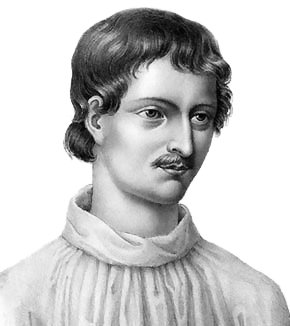
Giordano Bruno: The wandering philosopher whose life was a constant pursuit of Hermetic light and infinite truth.
The Wanderer of Truth: Introduction
He was not a man of a single land, nor of a single idea. Filippo Bruno, born in Nola in 1548, became Giordano Bruno, the Nolan—a restless soul who traversed Europe not as a mere traveler, but as a messenger of a reality that the world of his time was not yet ready to digest. His life was a mosaic of exile, intellectual combat, and an unwavering devotion to hidden wisdom.
At Lux Esoterica, we honor his memory not just as a martyr, but as the supreme example of the seeker who prefers the flames of the stake over the betrayal of his own vision of the cosmos.
From the Cloister to Exile: The Early Years
At seventeen, Bruno entered the Order of Preachers (Dominicans) in Naples. It was there that his intellect began to shine with a dangerous intensity. However, his curiosity did not stop at official theology; he immersed himself in the forbidden texts of Erasmus and, most significantly, the Corpus Hermeticum.
For Bruno, religion was not a collection of static dogmas, but a system of symbols meant to lead to the direct experience of the Divine. This freedom of thought led to his first accusation of heresy in 1576. Thus began his long pilgrimage through Geneva, Lyon, Toulouse, and finally Paris, where his fame as a master of mnemonics caught the attention of King Henry III.
The Master of Memory in the European Courts
Bruno was no mere armchair philosopher. He possessed a memory that many considered magical. In Paris and London, he published his most influential treatises on the Art of Memory. For him, organizing images within the mind was a form of "spiritual architecture." It was not about remembering data, but about reflecting the order of the universe (the macrocosm) within the individual (the microcosm).
During his stay in England, he moved within Elizabethan circles and debated his ideas of an infinite universe at Oxford. But Bruno was always a man of contrasts: his passionate nature and sharp tongue earned him as many enemies as admirers. His life was a constant flight from the structures that sought to limit his thought.
The Return to the Trap: Venice and the Inquisition
In 1591, Bruno made the fatal mistake of accepting an invitation from the Venetian nobleman Giovanni Mocenigo to teach him the arts of memory. Mocenigo, disappointed at not obtaining immediate magical powers and frightened by Bruno's radical ideas, denounced him to the Inquisition.
Bruno spent the last eight years of his life in the prisons of Venice and Rome. During his interrogations, he defended his convictions with a dignity that astonished his captors. He maintained that his philosophy of infinity and the transmigration of souls was compatible with a purified Christianity, but the judges sought a total recantation that he was never willing to give.
Campo de' Fiori: The Final Sacrifice
On February 17, 1600, Bruno was led to the Campo de' Fiori. His tongue was bound with a wooden gag so that he could not speak to the crowd. He was burned alive, staring fixedly at a crucifix offered to him—not with contempt for the figure of Christ, but for the institution that used fire to combat ideas.
His last recorded words to his judges echo through the centuries: "Perhaps you pronounce this sentence against me with greater fear than I receive it."
Conclusion: The Legacy of an Infinite Life
The biography of Giordano Bruno is the chronicle of a soul that refused to be contained. His life teaches us that knowledge has a price, but the sovereignty of the spirit is the only treasure that truly matters. Bruno did not die in 1600; his vision of a living and conscious universe is reborn every time a seeker dares to look beyond the boundaries of the established.
May his life be the staff that guides us in the transformations ahead in this 2026 cycle. The light of Nola continues to shine in the darkness of history.
Lux Esoterica.
2026.


Comentarios