Giordano Bruno: The Martyr of the Infinite Worlds
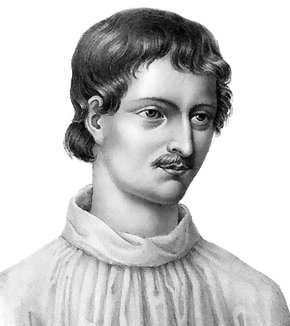
On the morning of February 17, 1600, a procession made its way to the Campo de' Fiori, the flower market of Rome. At its center was a gaunt man of fifty-one, a former friar who had spent seven years in the prisons of the Inquisition.
According to a report, when his sentence was read, he turned to his judges and said, in Latin, that perhaps they pronounced it with greater fear than he received it. Then he was bound to a stake and burned. His name was Giordano Bruno, and he is one of the most debated figures of the Renaissance: for some a martyr of free thought, for others a magician, for others a wandering poet-philosopher whom nobody could quite classify.
From Nola to Exile
Bruno was born in 1548 in Nola, near Naples, and christened Filippo. At seventeen, he entered the Dominican order and took the name Giordano. He was gifted, particularly in the art of memory, and was once presented to the pope. But he was also restless and independent, and in 1576, when charges of heresy loomed, he fled the monastery.
The next fifteen years were a long wandering. He taught in Geneva, Toulouse and Paris, where King Henry III admired his memory arts. He spent two years in England, lecturing at Oxford and living in London, where he wrote his Italian dialogues, among them The Ash Wednesday Supper, On Cause, Principle and Unity, On the Infinite Universe and Worlds and The Heroic Frenzies. He later traveled through Germany and Bohemia.
The Infinite Universe
Bruno's most famous idea is that the universe is infinite. The accepted view in his day was that the stars were fixed to a sphere around the Earth, or, after Copernicus, around the Sun. Bruno argued that there is no such boundary. The stars are suns like ours, he wrote, and around them may circle other worlds, perhaps with living beings.
His reasons were not those of a modern astronomer, who relies on telescopes and measurement. Bruno had neither. His case rested on philosophy and theology. An infinite God, he reasoned, would not make a finite universe, and the ancient atomists and the thinker Nicholas of Cusa had pointed in the same direction.
Bruno was also an early and enthusiastic supporter of Copernicus. The idea that he was a scientific martyr, in the manner of later figures, is therefore too simple. He was a philosopher whose thought happened to anticipate parts of later science.
The Art of Memory
Bruno also practiced and taught the art of memory, the ancient technique of storing information in an imagined building or on a series of images. His On the Shadows of Ideas (1582) goes further than most mnemonic manuals. It uses rotating wheels, borrowed from the medieval thinker Ramon Llull, with symbols that combine to represent all the things in the world.
For Bruno, the practice was more than a memory trick. It was a way to bring the mind into harmony with the order of the cosmos.
The historian Frances Yates, in a book of 1964, argued that Bruno was above all a Hermetic magus who wanted to renew a lost Egyptian religion. Other scholars have disagreed, stressing his philosophical arguments, and the debate continues.
The Trial
In 1591, Bruno accepted an invitation from a Venetian nobleman, Giovanni Mocenigo, who wanted lessons in the art of memory. Mocenigo became disillusioned and denounced him to the Venetian Inquisition in 1592. Bruno was transferred to Rome and held for seven years while the case was prepared. The proceedings involved the Jesuit cardinal Robert Bellarmine, who also dealt later with Galileo.
The records are incomplete, and the exact charges are still discussed. They seem to have centered on theological points: doubts about the Trinity and the divinity of Christ, about transubstantiation, and about the Church's account of the soul, along with his teaching of many worlds.
Bruno refused to give up the points that he held to be true. In February 1600, he was declared an impenitent heretic and handed over to the secular authorities.
Remembering Bruno
In 1889, a bronze statue of Bruno, with his hooded head bowed, was unveiled on the site of his burning, in the Campo de' Fiori. It was erected by freethinkers, and its presence remains a symbol of intellectual freedom. The Church of the time saw him as a heretic and a threat. Today the question of how to remember him is shared among historians, philosophers and believers.
It is worth remembering that Bruno was a difficult man. He was proud, sharp-tongued and quarrelsome, and he made enemies in every city. He was also unusually brave and kept his convictions when giving them up might have saved his life.
Closing
Looking at the night sky today, we know that the stars are suns, and that many have planets. Bruno could not know that, and he did not prove it. But he insisted on a vast, living universe, long before anyone could measure it.
Perhaps that is what draws readers to him: not the correctness of his reasoning, but the courage with which he looked into the dark and refused to turn away.
Related Esoteric Inquiries
- The Nolan Flame: The Life and Legacy of Giordano Bruno
- Jacob Boehme's Aurora: The Birth of Cosmic Consciousness
- Martyr of the Infinite: Giordano Bruno and the Courage to See
Lux Esoterica.
2026.


Comments