Jacob Boehme's Aurora: The Birth of Cosmic Consciousness
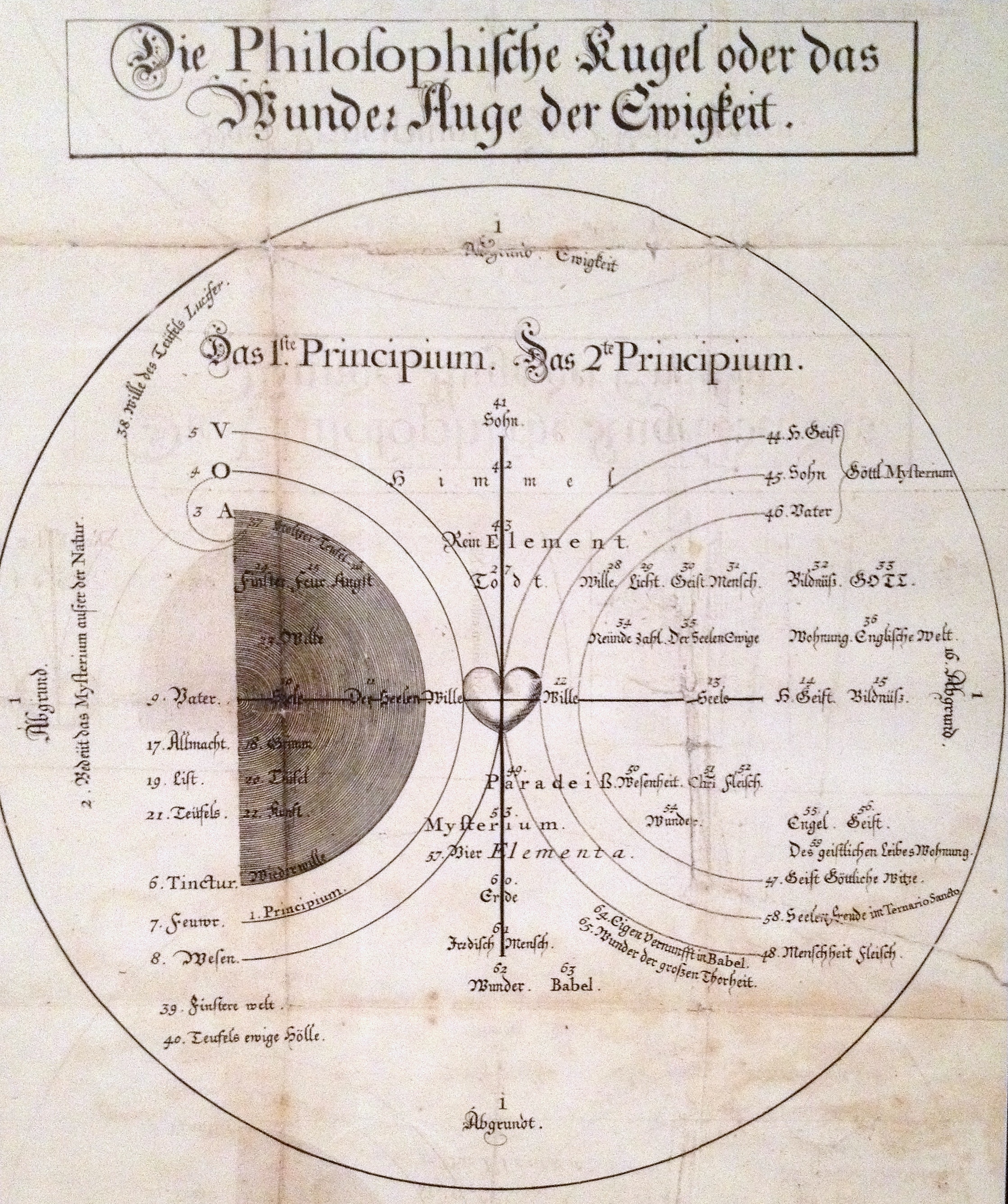
The Philosophical Sphere: Boehme's complex diagram illustrating the emergence of Light and Form from the 'Ungrund' (the Abyssal Nothingness).
The Cobbler of Görlitz: Introduction
History often entrusts its most profound secrets to the most unlikely messengers. In the early 17th century, the heavy silence of Protestant Germany was broken by the voice of a humble shoemaker. Jacob Boehme (1575–1624) had no university degree, no knowledge of Latin or Hebrew, and no formal training in theology. Yet, after a series of spontaneous mystical illuminations, he produced a body of work that would earn him the title of the "First German Philosopher" and establish him as a titan of Christian Theosophy.
In the Lux Esoterica tradition, Boehme represents the ultimate triumph of direct spiritual experience over dogma. He did not read about the architecture of heaven in a book; he saw it unfold in the reflection of sunlight on a pewter dish.
The Morning Redness: Aurora
His first manuscript, written secretly over several years, was titled Aurora: Die Morgenröte im Aufgang (The Dawn: The Root or Mother of Philosophy, Astrology and Theology). The title itself is an alchemical manifesto. The "Morning Redness" refers to the transitional state between the dark night of ignorance and the full light of divine consciousness.
Boehme described a universe that was not a static creation, but a dynamic, agonizing process of becoming. He saw God not as a distant monarch, but as the Ungrund—the abyssal, unconditioned "Nothingness" out of which all "Somethingness" desires to emerge.
The Dialectic of Light and Dark
Before Hegel or Jung formulated their theories of opposites, Boehme understood that light cannot exist without darkness. He posited that the universe operates through the tension of "Seven Qualities" or source-spirits. The first three are dark, contracting, and bitter—the necessary friction of material existence. The last three are luminous, expansive, and joyous.
The fourth quality, the "Flash of Fire" (the Schrack), is the lightning bolt of consciousness that connects the two realms. It is the moment when the friction of the dark qualities suddenly ignites into spiritual awareness. For the modern seeker navigating the turbulent energies of 2026, Boehme’s cosmology offers a profound comfort: the darkness, the anxiety, and the pressure of the world are not punishments; they are the necessary friction required to strike the spark of the Divine.
Spiritual Alchemy and the Signature of All Things
Boehme borrowed heavily from the alchemical vocabulary of Paracelsus, but he interiorized it. He was not interested in transmuting lead into gold in a physical laboratory; his focus was the transmutation of the human soul.
In his later work, The Signature of All Things, he taught that the external form of every plant, mineral, and animal is a "signature" revealing its internal, spiritual virtue. The entire physical world is a language spoken by the Divine, and the spiritually awakened human—the integrated microcosm—is the only creature capable of reading it.
Conclusion: The Fire in the Mind
Jacob Boehme was heavily persecuted by the local clergy for his writings. He was forbidden to write, exiled from his town, and treated as a heretic. Yet, his ideas flowed across borders, deeply influencing figures from Isaac Newton and William Blake to the early Romantics.
Boehme teaches us that the "Morning Redness" is not a historical event; it is a psychological process that happens within the individual. As we stand at the threshold of the Great Conjunctions of 2026, we are invited to look into our own darkness and wait for the flash of fire.
The dawn is rising.
Lux Esoterica.
2026.


Comentarios