The Baku: The Japanese Spirit That Eats Nightmares
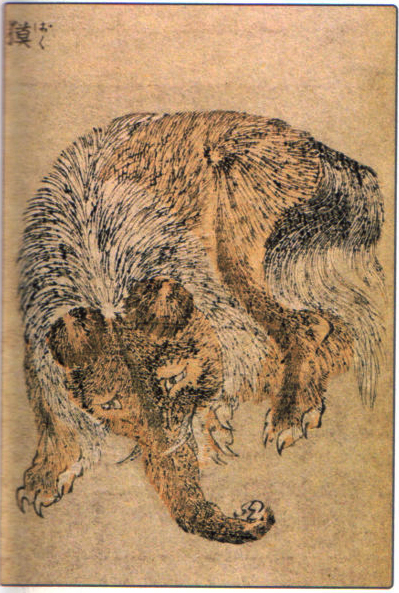
Japan's answer to the nightmare is not a ward, a prayer, or a dreamcatcher hung above the bed. It is an animal—and the animal must be called. The baku is the dream-eater: a benevolent composite beast with the trunk of an elephant, the eyes of a rhinoceros, the tail of an ox, the paws of a tiger, and a body often bear-like—assembled, says the charming old account, from the pieces left over when the gods finished making all the other animals: the divine workshop's sweepings, gathered into one creature whose office would be, fittingly, to consume the sweepings of the human mind. The protocol of his service was taught to Japanese children for centuries and is still taught: wake from a nightmare, and say, three times, "Baku-san, come eat my dream." The baku comes—invisible, prompt, professional—and devours the nightmare, which cannot then return or come true; and the sleeper may go back to sleep in a swept room. His image was carved on the pillow-boxes of the Edo period and embroidered on bedding; his name was written on sails hung in the sleeping room; on the night of Setsubun, the year's turning, one slept with a picture of the baku beneath the pillow so that the year's first dream, if bad, would be eaten before it took effect. He is the gentlest spirit in the whole Japanese bestiary—and his single warning-clause, as we shall see, is among the deepest things any folklore ever said about the appetite for consolation.
From Chinese Talisman to Bedside Servant
The baku came to Japan from China, where the mo—a beast identified with the tapir, whose disjointed, assembled look the legend's anatomy plainly describes—was already a talisman: its pelt, or its painted image, repelled evil and pestilence; to sleep on a mo-skin, wrote the Tang poets, kept sickness and ill dreams away. Japan received the creature, kept its composite body, and gradually specialized it: from general apotropaic beast to the specific, personal, on-call devourer of nightmares—the transformation complete by the Muromachi and Edo centuries, when the baku's written name alone, brushed on a slip of paper, guarded the bed, and the first-dream ships of the New Year (the treasure-ships whose picture under the pillow summoned lucky dreams) carried the character baku on their sails as insurance: if the luck failed and the dream turned bad, the eater was already aboard. Hokusai and his contemporaries drew him with affectionate seriousness—trunk curled, tiger-pawed, unbeautiful and indispensable—and shrine-carvers set his image under the eaves of temples, where he shares the guardian posts with lions and elephants: the only monster in the row whose whole ferocity is directed at dreams.
He belongs, within the Japanese system, to the economy of sleep that also includes the nightmare-bringers he polices, and within the world system to a select fellowship: the devourers stationed at the mind's night-borders. But his originality is radical, and easiest to see by contrast. The West's classic responses to nightmare are defensive—iron under the pillow, prayers at the four corners, the hag ridden off by force; the nightmare is an intruder to be barred. The baku's Japan made the opposite analysis: the nightmare is a product—the mind's own nightly refuse—and what refuse requires is not a wall but a sanitation service: something that comes when called, eats what the sleeper produced, and leaves the premises clean. The difference is doctrinal. Barred horrors return; eaten ones are metabolized—converted, in the baku's digestion, say the kindest tellings, into fortune: the nightmare devoured becomes luck, as compost becomes garden.
The Warning Clause: The Hungry Eater
And then the tradition, with the precision of all deep folk-systems, installs the caution. The baku must not be called frivolously—and the baku must not be too hungry. A dream-eater summoned for every small unpleasantness, or summoned by a sleeper who has nothing else in his nights, may eat more than the nightmare: the tellings warn that a baku still hungry after the bad dream will go on to devour the good dreams too—the hopes, the aspirations, the bright material of the sleeping mind—leaving the sleeper safe, swept, and empty: a man without nightmares and without dreams, which the tradition regards, correctly, as a fate and not a cure. The clause is the whole psychology of consolation in one image. Every soul keeps some baku on call: the numbing agent, the distraction, the professional devourer—chemical, doctrinal, or digital—summoned three times in the dark to eat what frightens us; and the folk warning stands over every one of them: what eats your nightmares will, if overfed with summonses, eat your dreams. The instrument that consumes the unbearable does not distinguish, past a certain appetite, between the unbearable and the merely intense; called too often, it clears the whole night. The baku's correct use is the tradition's quiet discipline: he is for the true nightmare—the recurring, the unmetabolizable, the dream that would otherwise come true in the daylight of a life—and the rest of the night's darkness is to be endured, read, and even harvested, for the mind's refuse and the mind's riches ferment in the same cellar. Not everything cold in the night is to be banished; some of it teaches—as Japan's own snow-country knows best, in the person of Yuki-onna, the white lady of the frozen dark whose cold instructs what warmth means.
The dream-culture around him shows how seriously the office was taken. Japan kept, and keeps, a whole jurisprudence of the year's first dream—the hatsuyume of the New Year nights, whose contents (Mount Fuji best of all, then a hawk, then an eggplant, by the famous ranking) set the year's luck; and it was precisely into this high-stakes night that the baku was most carefully deployed: the treasure-ship picture under the pillow bore his name or image so that a bad first dream could be devoured before registration, while a good one sailed on untouched—the eater stationed, like a customs officer, at the year's border. Sick-rooms and children's bedding carried his embroidered figure; the ivory netsuke-carvers made him small and snub for the sash; and the great temple carvers set him under the eaves in pairs, trunk curled, beside the lion-dogs—the guardian of the invisible approaches, as the lions guarded the visible ones. Even his zoology served the office: when the actual tapir reached Japan's menageries, the public recognized him at sight—the trunk, the patchwork look, the mild eye—and gave the animal the monster's name and the monster the animal's benign reputation, each lending the other credibility in one of folklore's happiest mergers.
The Esoteric Reading: The Beast of Leftovers
The esoteric summary belongs to the baku's own anatomy. He is made of leftovers—the pieces remaining when creation finished its proper animals—and he eats leftovers: the psychic remainders that the day's completed forms could not use. The symmetry is the doctrine: the mind's refuse is consumed by a power that is itself composed of refuse—redeemed scraps assembled into a guardian; nothing in the divine economy is wasted, and the sweepings of the workshop are commissioned to sweep. Whoever would build an inner baku—a right relation to their own nightmares—builds it, says the image, from their own leftovers: the discarded experiences, the odd unusable pieces of a history, assembled into the composite, unbeautiful, faithful thing that can face the night's productions without disgust and eat what must be eaten. And the summons is the practice: three times, by name, aloud—the nightmare handed over in an act of speech, not suppressed in silence; the tradition's insistence that the eater must be called is its insistence that the terrors of the night are discharged by articulation—named, addressed, given to something—and never by the clenched and wordless endurance that merely stores them for tomorrow's sleep.
The baku thrives in modern Japan—summoned still by children taught the three-fold call by grandmothers who were taught it in their turn, plush at the toy shops, carved under the temple eaves, resident in the games and cartoons that carried him to the world's children, his name shared now with the tapir in every zoo, whose keepers report visitors telling their children, correctly, that this is the animal that eats bad dreams. The pillow-papers are still sold at the shrines each New Year. The gentle protocol of his summoning has not changed in five centuries and needs no translation to cross any border: when the true nightmare comes—the one that recurs, the one that would come true—do not lie silent with it; say the words, three times, to whatever composite and faithful thing your tradition or your history has assembled for the office: come and eat my dream. And then, the clause: call it for the nightmares only. Leave the strange dreams, the sad dreams, the difficult and fermenting dreams uneaten on the table of the night—they are not refuse, and the beast, bless him, cannot tell the difference. He was made of leftovers, and he assumes, unless carefully instructed, that everything is one.
Sleep well; the eater is on call, and the good dreams, left uneaten, know the way home.
Lux Esoterica.
2026.


Comments