Yuki-onna: The Snow Woman of Japan, Beauty of the Frozen Night and the Cold That Teaches What Warmth Means
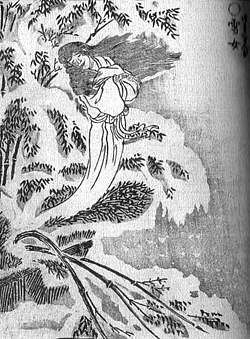
Yuki-onna — Toriyama Sekien, from the Gazu Hyakki Yakō ("The Illustrated Night Parade of One Hundred Demons"), 1776. Sekien's encyclopedic cataloguing of yōkai gave many Japanese supernatural beings their definitive visual form. His Yuki-onna is serene and beautiful, the cold expressed in the stillness of the figure rather than in any explicit threat — the danger is in the beauty, not in spite of it.
In the mountains of Japan — particularly in the heavy-snow regions of Niigata, Yamagata, and Akita on the Sea of Japan coast, where the winter snowfall is measured in meters and the blizzard can reduce visibility to nothing within minutes — there is a tradition of a figure that appears when the storm is worst. She comes out of the white. She is white herself: white skin, white kimono, white hair in some traditions, her breath the cold breath of the storm. She is extraordinarily beautiful. And she is dangerous in the way that extreme cold is dangerous: not because she is malevolent in a simple sense, but because what she is and what you need to survive her are fundamentally incompatible.
Yuki-onna (雪女, "Snow Woman") is one of the most widely distributed and most emotionally complex figures in Japanese supernatural tradition — a yōkai (supernatural being) who belongs to the category of elemental spirits, beings whose nature is the direct expression of a natural force, in this case winter itself. She is not simply a monster who haunts the snow; she is the snow, in the sense that the blizzard contains her and she contains the blizzard, and the quality of the encounter with her depends entirely on the quality of what the person caught in the storm brings to it.
The Appearance: White on White
Yuki-onna's physical description varies across the different regional traditions of Japan — there is no single canonical form, because she is a figure of the folk tradition rather than an official religious text — but certain elements are consistent enough to constitute her defining appearance.
She is always white: pale skin, sometimes translucent, white kimono, white hair or no discernible hair at all. In some traditions her lips are blue; in others they are unnaturally red against the white of her face. She has no feet — she floats above the snow rather than walking on it, leaving no footprints. She is always described as beautiful: extraordinarily, preternaturally beautiful, the kind of beauty that is itself disorienting, that makes the person encountering her stop and stare at exactly the moment they should be running.

Yuki-onna — from the Hyakkai-Zukan by Sawaki Suushi, 18th century. The figure in her most classical form: the pale beauty in the storm, the white figure against the dark of night, the combination of extreme cold and extreme loveliness that defines the Yuki-onna encounter. She is looking directly at the viewer in this image, which is itself the beginning of the encounter.
Her breath is described as cold — cold enough, in some traditions, to freeze a person solid when directed at them, cold enough to produce blizzard conditions even when the air is still. In the most dramatic versions of the tradition, she can summon storms, direct snow and wind, freeze rivers by touching them. But she is not simply a destructive force; she is a force that can be encountered, that has rules and responses, that can be survived and even allied with under the right conditions.
The Two Modes: Death and Mercy
The Yuki-onna tradition divides cleanly into two modes of encounter, which are often combined in the same story.
In her deadly aspect, Yuki-onna approaches travelers stranded or lost in the snow, breathes on them with her cold breath, and they freeze to death. In some versions she takes their life-force (ki) directly, leaving behind a drained corpse that has the appearance of sleeping peacefully in the snow — the death that winter itself often produces, the hypothermia that arrives as a kind of warmth and sleepiness rather than as pain. In these versions, she targets the weak, the lost, the drunk, the elderly — those whose hold on the warmth of life is already tenuous.
In her merciful aspect, Yuki-onna spares the young and the beautiful, sometimes those who remind her of something she lost or something she values. In the most famous version of the Yuki-onna story — preserved by Lafcadio Hearn in his collection Kwaidan (1904) — a young woodcutter named Mosaku and his apprentice Minokichi are caught in a snowstorm and take refuge in a ferryman's hut. During the night, the Yuki-onna enters and kills the older man. She approaches the young man to kill him as well — and then stops. She looks at him for a long time. Finally she says: "I intended to treat you as I treated that old man. But I cannot help feeling some pity for you, because you are so young... I will spare you... But if you ever tell anyone — even your own mother — what you have seen this night, I will kill you."

Yuki-onna — from Sogi Shokoku Monogatari, an early text of tales collected by the linked-verse poet Sōgi (1421–1502). This is one of the oldest surviving depictions of Yuki-onna in text and image, showing the figure in her most basic form: the white woman in the storm, the supernatural feminine presence in the winter landscape.
The Promise and Its Breaking: The Human Dimension
In the Hearn version, the story continues. Years later, Minokichi meets a beautiful young woman on the road — a woman with white skin and unusual eyes, traveling alone. He marries her; she is called O-Yuki ("Snow"). They have children together; she is a devoted wife; the years pass in ordinary happiness.
One winter evening, as Minokichi sits by the fire working and O-Yuki sews, he suddenly remembers that night in the snow, and the woman he saw then, and how she looks so like O-Yuki. And he begins to tell the story — the story he was commanded never to tell.
O-Yuki listens in silence. When he has finished, she stands. And in the lamplight he watches her change: she becomes what she was, the white woman of the snow, the cold that does not flinch. She says: "Minokichi, that woman was I... I warned you that I would kill you if you ever spoke of it to any person. But I cannot kill you now, for the sake of those children who are sleeping in the next room... Remember, if ever they have reason to complain of you, I will treat you as you deserved."
Then she is gone. Into the snow. Never to return.
The story's structure is precise: the broken promise is the hinge on which everything turns. The Yuki-onna gave mercy once, on condition of silence. The condition was maintained for years — decades — and then broken not from malice but from memory, from the impulse to share what is past, from the ordinary human tendency to make narrative of experience. The mercy is real; the children are real; the love was real. And the departure is also real, and absolute.
Regional Variations: A Family of Snow Spirits
The Yuki-onna is not a single figure but a family of related regional traditions. In different parts of Japan, different names and slightly different attributes characterize the snow woman:
In Iwate Prefecture, she is associated with the spirit of a woman who died in the snow and whose ghost returns to take revenge on or warn travellers. In Aomori, she may appear as an older woman, more clearly threatening, without the beauty that makes the central-tradition Yuki-onna's danger seductive rather than obvious. In some traditions of the Tōhoku region, she is protective rather than threatening — a guardian of those who respect the mountain and the winter, dangerous only to the foolish or the disrespectful.

Yuki-onna — from Bakemono no e ("Picture of Monsters"), c. 1700, Harry F. Bruning Collection. One of the oldest known illustrated depictions of Yuki-onna: the white figure against the snow, the kimono and flowing hair suggesting movement even in stillness, the supernatural feminine presence fully established as a recognized category of supernatural being by the early Edo period.
The Onibaba tradition (the Old Demon Hag, a related figure) and the Yama-uba (Mountain Hag) share some of Yuki-onna's territory: all are supernatural feminine figures associated with wild places, with the cold or the remote, with both the capacity for destruction and the capacity for an ambiguous maternal care that can become devouring. The Yuki-onna is the most beautiful and the most seasonal of this family — she belongs specifically to winter, to the snow, to the months when the cold is at its most lethal.
Lafcadio Hearn and the Western Discovery
The Yuki-onna entered Western consciousness primarily through Lafcadio Hearn (1850–1904), the Irish-Greek writer who emigrated to Japan in 1890, took Japanese citizenship, married a Japanese woman from a samurai family, and spent the rest of his life translating Japanese folk culture for Western readers. His collection Kwaidan: Stories and Studies of Strange Things (1904) — published in the year of his death — became the primary source through which Western readers encountered Japanese supernatural tradition, including the Yuki-onna story.
Hearn's Kwaidan was the basis for Masaki Kobayashi's celebrated 1964 film Kwaidan, which adapted four of the stories in the collection into an anthology film of extraordinary visual beauty — the Yuki-onna story rendered in stylized theatrical settings that captured the abstract, dream-like quality of the supernatural encounter.
The film's Yuki-onna sequence contributed to the global image of the figure: the vast white landscapes, the unnaturally beautiful woman in the storm, the promise and its breaking. Contemporary anime, manga, and video game culture has built extensively on this image, with Yuki-onna appearing in dozens of contemporary Japanese popular culture contexts — sometimes terrifying, sometimes sympathetic, sometimes both simultaneously.
The Esoteric Yuki-onna: The Cold That Clarifies
The Yuki-onna's deepest significance in the esoteric imagination is as the figure of what extreme cold does to consciousness: it clarifies, it strips away the unnecessary, it reveals what is genuinely essential. The person caught in a blizzard has no room for pretense, no capacity for the ordinary evasions of comfortable existence; what matters and what doesn't becomes unmistakably clear in the cold.
The Yuki-onna, in this reading, is the spirit of that clarification: the supernatural being who embodies the stripping quality of extreme cold, who in encountering you reveals — through the quality of your response to her — what you are made of. Those who panic, who are already weakened, who lack the inner warmth that comes from genuine life-force — they are frozen. Those who have enough stillness to meet her beauty without being destroyed by it, who have enough warmth in them to survive the encounter — they may be spared, or even, in some versions, blessed.
The promise she exacts is not arbitrary. Silence about certain encounters is the mythological encoding of the requirement not to reduce the numinous to the ordinary through careless speech — not to flatten the extraordinary experience of encounter with the divine or with the depths of nature into a story told by the fireside as though it were something that had been resolved and filed away. The Yuki-onna's mercy requires that the encounter remain alive in the person who survived it — present as an ongoing reality rather than as a past event now available for retrospective narration.
Minokichi tells the story when it has become history to him — and that is exactly the moment he loses what the encounter gave him.
The snow is still falling. The white figure is still out there, in the white, indistinguishable from the storm that carries her. And the quality that determines whether the encounter will be death or mercy is the same quality that determines everything in the winter landscape: how much inner warmth you have, and whether you know when to speak and when to remain still.
— Lux Esoterica


Comentarios