The Secret of the Yonaguni Monument: The Submerged Pyramid of Japan
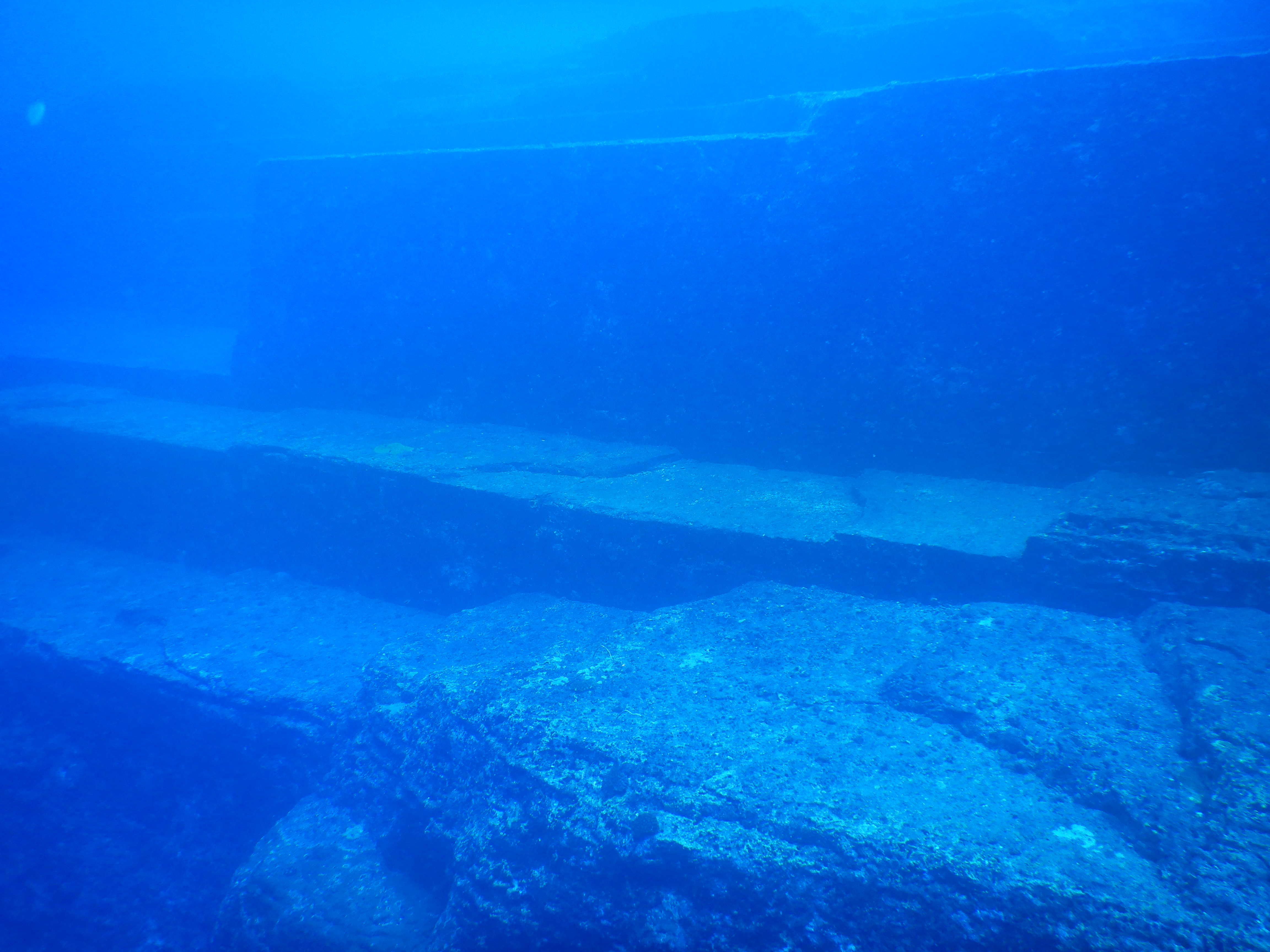
Off the coast of Yonaguni, the westernmost island of Japan, lies a rock formation under the sea. It was first reported in 1986 by local divers, and it has been studied and debated ever since. The formation includes steep faces, flat terraces and rows of blocky steps, and it sits about twenty-five meters below the surface.
Its shape is so regular in places that many visitors see it as the work of human hands, while many geologists see a natural product of the rock. The site is one of the most discussed underwater features in the world.
The question is simple to ask and hard to answer: were these stones shaped by people, or by nature? The answer matters for archaeology, and it also feeds a much larger body of legend. This post separates the evidence from the myth.
What Divers Found
The formation extends for a long stretch along the seabed, with terraces, walls and sharp angles. Some faces look almost flat, and some steps have square corners. Divers have described channels, a carved shape that some call a star, and large stone blocks lying around the base. Visitors often find the site impressive because its patterns seem to repeat.
Such patterns are striking, but they must be checked. Natural rock can fracture along joints and planes, and water can wear some surfaces into shapes that look planned. Careful observation is the first step.
The Case for Human Work
The marine geologist Masaaki Kimura has studied the site for many years, and he argues that some features show signs of human work. He points to walls, a possible carved symbol, channels and tool-like stones. In his view, the site may have been shaped by people in an earlier age, when the area was above sea level.
Kimura's position is taken seriously by some researchers, and it has encouraged further study. Yet his claims have not yet been confirmed by most of the scientific community, and they remain a matter of active debate.
The Case for Natural Origin
Most geologists who have examined the formation favor a natural explanation. They point to sandstone layers that break along fault lines and joints, and to the way that waves and currents can carve rock over long periods. From this view, the regular angles are the result of natural fracture, not of design.
Geologists who study similar formations in other coastal areas often describe how layered rock breaks into blocks and terraces over time, and they use these comparisons to test the natural hypothesis. The natural explanation does not dismiss the site's beauty.
It simply asks for stronger evidence before accepting a human origin. That evidence would include clear tools, dated layers and signs of use that most experts have not yet found.
The Question of Sea Level
Some writers have argued that the formation was dry land during the last Ice Age, when sea levels were much lower. This is a real point of interest. Sea levels did rise significantly at the end of the last glacial period, so parts of the coast now underwater were once exposed. However, showing that the area was once dry does not prove that people built the formation.
Researchers still need dating of the rock surfaces, of sediments and of any objects found nearby to settle the question. Until then, the sea level fact is a clue, not a conclusion.
The Legend of Mu
Because the formation lies in a sea that was once land, it has been linked to Mu, a legendary lost continent said to have sunk in the Pacific. The idea of Mu grew from writings of the early twentieth century, and it was popularized by writers who claimed to have learned about an ancient civilization from secret tablets.
These claims have no archaeological support. Mu does not appear in the scientific record, and the stories about it were not based on field evidence.
It is therefore important to keep the legend separate from the site itself. A real underwater formation can be studied without accepting the story that a lost civilization built it.
Sound, Energy and Altered States
Some modern accounts propose that the formation was an acoustic chamber or a ceremonial altar that amplified sound or energy. These ideas make for an exciting story, but they lack evidence. There is no sign that the rock was used to produce special frequencies, and claims about altered states are not supported by anything found at the site.
Closing
The Yonaguni formation is a striking piece of the seabed, and it invites careful study. Whether its shape is natural or partly shaped by human hands, the site deserves scientific attention. The question will be answered by evidence, not by wishful thinking. For the curious reader, the best approach is to enjoy the mystery, to follow the research and to keep an open mind while asking for proof.
Related Esoteric Inquiries
- The Secret of the Derinkuyu Underground City: The Antediluvian Refuge
- The Enigma of the Great Pyramid: The Piezoelectric Power Plant
- The Secret of the Puma Punku Megaliths: Acoustic Levitation in Bolivia
Lux Esoterica.
2026.


Comments