The Ley-Line Tapestry of Avebury
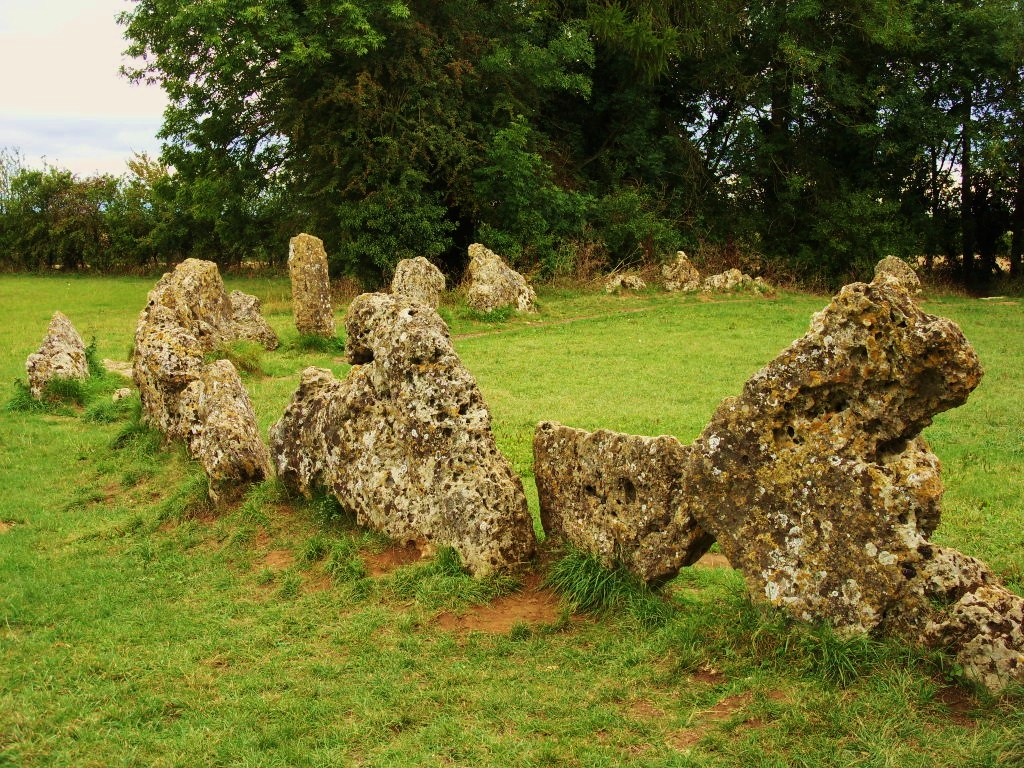
While the monolithic grandeur of Stonehenge commands the attention of the profane, the true initiate’s gaze is inevitably drawn a few miles north, to the sprawling, enigmatic landscape of Avebury. Here, the earth itself has been sculpted, mounded, and pierced with colossal sarsens, not merely to mark the passage of the seasons, but to weave a complex, terrestrial tapestry of invisible power. Avebury is not a monument in the conventional sense; it is a monumental mechanism, a central nexus in the vast, subterranean nervous system of the British Isles, a place where the serpentine currents of the telluric grid converge, cross, and coil in a grand, esoteric dance.
The orthodox perspective, constrained by a materialistic worldview, sees Avebury as a site of primitive ritual, a desperate attempt by early agrarians to appease the capricious spirits of nature. But this is a profound misreading of the evidence. The scale of the undertaking, the sheer tonnage of stone moved and placed with pinpoint accuracy, the intricate geometry of the circles within circles, all point to a civilization possessing a highly sophisticated understanding of geomancy and planetary mechanics. The architects of Avebury were not frightened peasants; they were terrestrial engineers, manipulating the energetic fabric of the earth with the same precision that a modern technician manipulates the flow of electrons through a circuit board.
To grasp the function of Avebury, one must first accept the reality of ley lines—the invisible pathways of etheric energy that crisscross the globe. These leys are not arbitrary lines drawn on a map; they are the natural arteries of the planet, conducting the vital force, the anima mundi, from regions of high potential to regions of low potential. Just as a river follows the contours of the physical landscape, the leys follow the contours of the energetic landscape, weaving through valleys, crossing underground aquifers, and intersecting at points of intense power.
Avebury sits squarely at one of the most significant intersections in the global ley network. It is the heart chakra of the English landscape, the point where the Michael and Mary leys—the two great serpent currents that serpentine across southern England—converge and intertwine. The entire complex, from the massive outer henge to the inner circles of stone, is designed to capture, contain, and modulate these powerful, opposing forces, blending the solar, masculine energy of the Michael line with the lunar, feminine energy of the Mary line.
The sarsen stones themselves, massive blocks of silicified sandstone, were chosen for their specific energetic properties. Like the granite of Carnac, these stones possess a crystalline structure that allows them to interact with the telluric currents, acting as massive capacitors that store and release the planetary life force. But unlike the ordered, parallel alignments of Carnac, the stones of Avebury are arranged in circles, the most powerful and fundamental shape in esoteric geometry.
The circle is the symbol of unity, of the infinite, of the unmanifest potential from which all creation springs. By arranging the sarsens in concentric rings, the architects created a localized vortex, a spiraling vortex of energy that draws the telluric currents inward, concentrating them within the central space. This concentrated energy field is not static; it is dynamic, pulsating with the rhythms of the earth and the heavens, a living, breathing entity that responds to the changing seasons, the phases of the moon, and the subtle fluctuations of the planetary grid.
The deep ditch and massive chalk bank that surround the outer circle—the henge—serve a dual purpose. On a physical level, they demarcate the sacred space, separating the profane world from the realm of the initiate. But on an energetic level, the henge acts as a massive insulation barrier, preventing the accumulated telluric energy from dissipating into the surrounding landscape. The chalk itself, porous and resonant, absorbs the subtle vibrations of the stones, amplifying the energetic field and creating a palpable sense of tension and expectation within the enclosure.
As one walks the processional avenues that lead into the Avebury complex—the West Kennet Avenue and the Beckhampton Avenue—one is effectively walking the path of the serpent, tracing the meandering course of the ley lines as they approach the central nexus. These avenues, flanked by alternating pairs of tall, pillar-like stones and broad, diamond-shaped stones, represent the polarization of the energetic currents, the dynamic interplay of the masculine and feminine principles. The initiate, traversing these avenues, is systematically prepared, their own energetic centers aligned and balanced in anticipation of entering the central vortex.
The ultimate purpose of the Avebury complex was not merely the generation and storage of telluric energy; it was the utilization of that energy for the spiritual evolution of humanity. The concentrated field within the inner circles provided a unique environment, a high-frequency zone where the veil between the physical and the subtle realms was thinned, allowing the initiate to experience profound states of expanded consciousness. It was here, amidst the silent sarsens, that the ancient mysteries were enacted, the rituals of initiation that guided the aspirant through the labyrinth of the self toward the ultimate realization of their divine nature.
The ceremonies conducted at Avebury were intimately tied to the agricultural cycle, the rhythmic dance of sowing and reaping, of death and rebirth. But these agricultural rites were merely the exoteric shell, the outer form concealing a deeper, esoteric truth. The true alchemy of Avebury was the alchemy of the soul, the transformation of the base metal of the human ego into the pure gold of spiritual illumination. By attuning themselves to the powerful telluric currents concentrated within the circles, the initiates could accelerate their own evolutionary process, shedding the limitations of the physical body and ascending to higher planes of existence.
Furthermore, the Avebury complex is intrinsically linked to the surrounding landscape, a vast, interconnected network of megalithic sites that includes Silbury Hill, West Kennet Long Barrow, and Sanctuary. Silbury Hill, a colossal, man-made mound of chalk and earth, acts as a massive energetic accumulator, drawing down the celestial energies and channeling them into the telluric grid. The West Kennet Long Barrow, an ancient chambered tomb, served as a resonance chamber, a place of profound stillness where the initiates could undergo the symbolic death and rebirth required for true spiritual transformation. Sanctuary, a concentric timber and stone circle located at the end of the West Kennet Avenue, represented the culmination of the initiatory journey, the point of ultimate synthesis and integration.
This entire landscape is a monumental text, a book written in earth and stone that encodes the profound wisdom of the ancient geomancers. It speaks of a universe that is alive, conscious, and deeply interconnected, a universe where the physical and the spiritual, the terrestrial and the celestial, are inextricably bound together. The builders of Avebury understood that they were not merely inhabitants of the earth, but active participants in the grand, unfolding drama of creation, responsible for maintaining the balance and harmony of the planetary grid.
The subsequent destruction and desecration of Avebury, the toppling and breaking of the stones by zealous religious reformers and pragmatic farmers, was not merely an act of vandalism; it was a profound act of spiritual violence, a deliberate severing of the connection between humanity and the vital forces of the earth. The silence that now hangs over the stones is not the silence of peace, but the silence of a severed limb, the tragic mute testimony to a lost wisdom and a forgotten heritage.
Yet, the energetic blueprint of Avebury remains, deeply imprinted within the etheric fabric of the landscape. The telluric currents, though diminished and scattered, still flow through the ancient pathways, and the sarsens, though fallen and broken, still hold the memory of their former glory. For those who approach the site with reverence and sensitivity, the invisible tapestry of Avebury begins to reveal itself, a subtle web of energy that connects the stones, the earth, and the cosmos in a profound and unbreakable embrace.
The revival of our connection to sites like Avebury is not a matter of romantic nostalgia; it is an urgent necessity for the survival and evolution of our species. We must relearn the language of the earth, the subtle grammar of geomancy and telluric resonance. We must recognize that the health of the planet and the health of our own souls are inextricably linked, and that by restoring the energetic balance of the earth, we are simultaneously healing ourselves.
As we stand amidst the colossal stones of Avebury, we are not merely observing the relics of a dead past; we are standing at the threshold of a possible future, a future where humanity reclaims its rightful role as the stewards and harmonizers of the planetary grid. The ley-line tapestry of Avebury awaits our conscious engagement, a vast, complex mechanism of spiritual transformation ready to be activated once again by the awakened consciousness of the new humanity. The serpent currents still flow; the stones still remember. It is up to us to listen, to learn, and to resume the grand, esoteric work that was begun so many millennia ago.
Lux Esoterica.\n2026.


Comentarios