The Mystery of the Nazca Lines in the Peruvian Desert
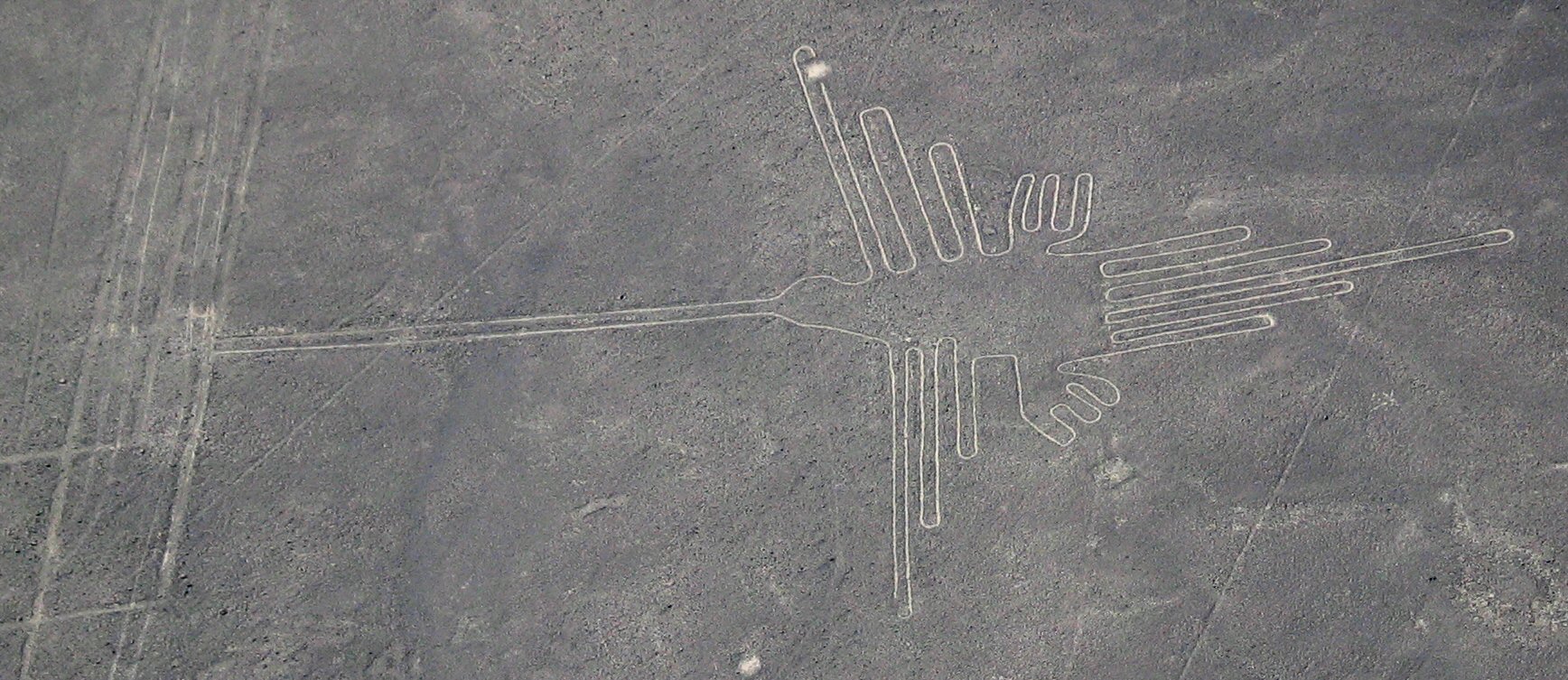
Between the arid foothills of the Andes and the cold swells of the Pacific Ocean lies one of the most enigmatic landscapes on Earth. In southern Peru, across a windswept plateau spanning hundreds of square kilometers between the towns of Nazca and Palpa, ancient hands transformed the desert into an immense, open-air temple. Here, etched into the dark crust of the plain, are hundreds of colossal geoglyphs: geometric figures, vast runways, straight lines stretching uninterrupted toward distant horizons, and monumental portraits of creatures drawn with unbroken precision.
For over a thousand years, these titanic engravings remained largely invisible to travelers on foot. Seen from the surface, they appear merely as faint depressions in the gravel, easily dismissed as ancient pathways or dry river courses. Only when human beings ascended into the sky during the early decades of the twentieth century did the full magnitude of the pampa reveal itself. From high above, the chaotic desert floor resolves into a grand tapestry of cosmic artistry.
Why did an ancient civilization, flourishing between roughly 500 BC and 500 AD without the aid of flight, craft colossal images that can only be appreciated from the heavens? The riddle of the Nazca lines is not merely an archaeological puzzle; it is an enduring confrontation between terrestrial labor and celestial aspiration.
The Alchemy of the Desert Canvas
To comprehend the sheer survival of these markings across two millennia, one must look closely at the unique environment of the Peruvian pampa. The desert plateau of Nazca is among the driest and most inhospitable places in the world. Sheltered from moisture-laden winds by the high Andean cordillera to the east and cooled by the Humboldt Current to the west, the region receives less than an inch of rain per year.
The ground itself is carpeted with a dense layer of small pebbles and gravel oxidized by centuries of fierce sun and thin air, creating a dark, reddish-brown patina known to geologists as desert varnish. Beneath this sunbaked surface veneer rests a pale, light-colored layer of clay, gypsum, and sand.
The technique used by the ancient Nazca and Paracas people was both remarkably simple and physically monumental:
- Workers methodically cleared away the dark, iron-oxide stones by hand or with rudimentary wooden rakes.
- The collected stones were piled neatly along the borders of the clearing, forming raised rims that frame the exposed white subsoil.
- The high thermal absorption of the dark surrounding pebbles generates a stable cushion of warm air at ground level, which shields the desert floor from the strongest coastal gales.
- The gypsum in the soil reacts with nocturnal ocean mist, cementing the exposed earth into a hard, plaster-like surface that resists erosion.
Through this elegant synergy between human intention and natural preservation, the drawings have endured almost untouched by the passage of centuries. Every line drawn in this remote plateau remains as clear and crisp as the day the first stone was moved.
The Desert Bestiary and Geometric Splendor
The geoglyphs of the Nazca plateau fall into two primary categories: the zoomorphic biomorphs and the massive geometric configurations.
The figurative drawings, though fewer in number than the straight lines, have captured the imagination of the world due to their astonishing elegance and continuous, single-line design. The contours of each creature are typically drawn in a single, unbroken stroke that never crosses itself, entering the figure at one point and exiting at another, forming an immense labyrinthine outline:
- The Hummingbird (El Colibrí): Stretching over three hundred feet from the tip of its slender beak to its spread tail feathers, the hummingbird is depicted in full flight, its wings outstretched in a posture of dynamic suspension. In Andean mythology, the hummingbird is a sacred herald associated with nectar, blossoming flowers, and the arrival of life-giving water from mountain sanctuaries.
- The Spider (La Araña): Measuring approximately one hundred and fifty feet across, this creature presents one of the most perplexing anatomical mysteries of the desert. The drawing accurately depicts a member of the rare arachnid genus Ricinulei, a blind spider native only to the deep recesses of the Amazonian rainforest hundreds of miles to the east. Most astonishingly, the drawing portrays an extended reproductive organ located on the third leg—a microscopic biological detail that cannot be discerned without specialized optical instruments.
- The Monkey (El Mono): Spanning over three hundred feet, the monkey is drawn with nine fingers and a spectacular, coiled spiral tail. To the ancient peoples of the coast, monkeys were exotic creatures of the lush tropical forests, deeply associated with rain, mist, and fertility. The spiral tail mirrors the sacred vortex forms found in water eddies and cosmic motions.
- The Giant Condor (El Cóndor): With a majestic wingspan exceeding four hundred feet, the condor represents the sovereign sovereign of the Andean heights. As the sacred bird capable of traversing the boundary between the mortal earth and the heavenly realm, the condor served as the supreme mediator between mankind and the sky spirits.
- The Hands and the Tree: Colossal stylized engravings depicting open hands with unusual digit counts and a sacred tree anchored to the soil, reflecting the primal connection between human vitality and vegetative growth.
Beyond these magnificent biomorphs lie thousands of geometric shapes: vast trapezoids, elongated triangles, concentric spirals, and ruler-straight lines (ray centers) that extend across miles of barren rock without bending or wavering, slicing over dry ravines and climbing steep hillsides with unerring precision.
The Aviation Paradox
The central question that has confounded observers since the discovery of the Nazca geoglyphs is the problem of perspective. How—and more importantly, why—did a terrestrial society construct images whose scale requires an altitude of hundreds of feet to be comprehended as unified compositions?
From an engineering standpoint, modern researchers have demonstrated that the geometric proportions could have been plotted on the ground using simple surveying techniques:
- Small master drawings or ceramic models served as prototypes.
- Teams of artisans used wooden sighting poles, plumb bobs, and long cords made of woven cotton or plant fibers to scale the figures up to monumental sizes.
- Wooden stakes preserved at the terminal points of several lines have been radiocarbon-dated to the Nazca period, confirming the ancient origins of the surveyed vectors.
Yet the practical ability to execute large drawings does not resolve the spiritual motive. Why invest countless generations of communal effort to carve elaborate portraits of spiders, monkeys, and hummingbirds into the desert floor if the creators themselves could never stand back to admire their handiwork?
This fundamental paradox has led thinkers down many paths, ranging from speculative notions of ancient hot-air ballooning using woven textiles to theories of extraterrestrial contact popularized in mid-twentieth-century literature. However, the true answers appear to lie much deeper within the sacred worldview of the Andean peoples, where sight was not confined to physical eyes, and terrestrial space was an altar for the divine.
Maria Reiche and the Cosmic Calendar
The modern study of the Nazca lines is inextricably linked to the lifetime devotion of Maria Reiche, a brilliant German mathematician and geographer who arrived in Peru in the 1930s. Captivated by the mysterious markings after working with American historian Paul Kosok, Reiche dedicated over fifty years of her life to the protection, mapping, and interpretation of the desert drawings.
Living in a modest adobe dwelling at the edge of the pampa, armed with a broom, measuring tapes, and a sextant, "The Lady of the Lines" painstakingly cleared dust from thousands of forgotten figures. Her mathematical investigations led to the development of the archaeoastronomical theory of Nazca:
- Reiche proposed that the vast plateau was the world's largest open-air astronomical observatory and agricultural almanac.
- She documented that many of the longest straight lines pointed directly toward the rising or setting points of the sun during the summer and winter solstices. For an agrarian society on the hyper-arid coast, the summer solstice (in December) marked the critical moment when glacial runoff began flowing from the Andean peaks down into the dry coastal riverbeds.
- She sought correlations between the biomorphic figures and celestial constellations. To Reiche, the Spider was an earthly manifestation of the constellation Orion and the Pleiades, whose movements across the nocturnal sky signaled seasonal agricultural shifts.
- The colossal trapezoids, she argued, served as gathering plazas where celestial events could be observed and celebrated against the backdrop of an uncluttered horizon.
While later computerized astronomical calculations have suggested that only a fraction of the thousands of lines align with major stellar events, Reiche’s pioneering work forever cemented the understanding that the Nazca lines were deeply attuned to the rhythmic cycles of the cosmos.
Subterranean Waters and the Sacred Walkway
In recent decades, archaeologists and anthropologists such as Anthony Aveni, Johan Reinhard, and David Browne have reframed our understanding of the pampa by focusing on the ultimate source of survival in the desert: water.
The Nazca valley is an intensely arid environment where rivers flow on the surface for only a few weeks each year, if at all. To survive, the Nazca people became master hydraulic engineers, constructing a sophisticated network of puquios—subterranean aqueducts and spiraling access wells that tapped into deep underground water tables and channeled moisture directly to their fields.
This profound dependence on hidden water sources shaped the spiritual geography of the desert:
- Many of the prominent straight lines and trapezoidal clearings follow the subterranean flow of underground aquifers and fault lines carrying mountain runoff beneath the pampa.
- The geoglyphs were not intended merely as stationary images to be admired from afar; they were dynamic ritual avenues (ceques) designed to be physically traversed.
- The single, unbroken lines of the biomorphs functioned as sacred labyrinths. Religious processions of priests and pilgrims would walk along the single path in solemn single file, their feet tracing the sacred anatomy of the creature.
- Archaeologists have unearthed fragments of ceremonial ceramic vessels, panpipes, and spondylus seashells deliberately smashed at the intersections and turning points of the lines, representing offerings left during prayers for rain and agricultural fertility.
In this light, walking the line was an embodied prayer. By treading upon the sacred contours, the pilgrims believed they were stimulating the telluric pulse of the earth, invoking the water spirits dwelling inside the distant mountain peaks (Apus), and maintaining harmony between their fragile society and the natural forces of life.
Terrestrial Yantras and Shamanic Flight
Beyond the astronomical and hydraulic dimensions lies the esoteric reality of the pampa as a sacred mandala. Across numerous ancient traditions, sacred geometry was understood as a sacred bridge between the physical and metaphysical planes.
In the esoteric view, the Nazca plateau functions as an enormous terrestrial yantra—a sacred geometric diagram carved into the living skin of the earth to anchor celestial archetypes into the local telluric currents:
- The Marriage of Heaven and Earth: In Andean cosmology, reality is divided into three interconnected realms: Hanan Pacha (the celestial upper world of stars, sun, and rain), Kay Pacha (the terrestrial middle world of humans, animals, and plants), and Uku Pacha (the subterranean inner world of ancestors, water, and seeds). The Nazca lines served as the physical nexus where these three worlds met. The geoglyphs drew down celestial energies from Hanan Pacha, inscribed them upon Kay Pacha, and directed their influence into the underground waters of Uku Pacha.
- Visionary Astral Flight: The priests and shamans of the Paracas and Nazca traditions were practitioners of profound visionary arts. Through the ritual ingestion of sacred plants, most notably the San Pedro cactus (Echinopsis pachanoi or Wachuma), which is frequently depicted in Nazca ceramic iconography, the initiate attained an altered state of consciousness known in archaic shamanism as the nagual flight. In this state of ecstatic trance, the spirit untethered itself from the physical body, rising into the astral ether. From this elevated vantage point, the shaman could view the glowing geometries of the pampa in their entirety, navigating the spiritual geography of the cosmos and communicating directly with the celestial deities.
To the ancient Nazca seer, there was no contradiction between drawing a figure on the ground and seeing it from the sky. The physical world was understood as a reflection of higher spiritual patterns, and the visionary gaze was not bound by the limitations of the mortal eye.
The Eternal Dialogue
Two thousand years after their creation, the Nazca lines remain an astonishing testament to human devotion. On this silent, sun-drenched plateau, an ancient people inscribed an indelible hymn of devotion, weaving together hydrology, astronomy, geometry, and transcendental mysticism.
As the evening sun sets over the Pacific, casting long golden shadows across the stones of the pampa, the Hummingbird, the Spider, and the endless shining vectors continue their silent communion with the stars. They remind us that our ancestors did not build solely for their own immediate comfort, but to establish an eternal dialogue with the vast universe that surrounds us.
Related Esoteric Inquiries:
- The Nazca Lines: Sacred Geoglyphs Drawn for the Gods
- The Mystery of the Marfa Lights: Ghost Lights of Texas
- The Mystery of Karahunge: The Stones with Eyes and the Armenian Star-Gates
Lux Esoterica.
2026.


Comments