The Nazca Lines: Sacred Geoglyphs Drawn for the Gods
On the arid pampa of southern Peru, between the towns of Nazca and Palpa, a pre-Columbian culture created between approximately 500 BCE and 500 CE one of the most mysterious bodies of art in human history: the Nazca Lines — thousands of geometric forms (straight lines, spirals, trapezoids) and figural geoglyphs (animals, plants, human figures) etched into the desert surface by removing the reddish surface stones to reveal the lighter ground beneath. The largest figures extend over several kilometers. They were created with an accuracy that astounds modern engineers, who have replicated them only with significant effort using modern tools. And they were created with a full understanding that they could not be seen from the ground — the monkey's tail, the spider's legs, the condor's wingspan are only comprehensible from the air. The civilization that made them had no aircraft. The most enduring question is not who made them (the Nazca culture) or how (with stakes, ropes, and meticulous planning) but why — what purpose could be served by creating sacred images on a scale only the gods could see?
 [Unavailable: ❌ https://upload.wikimedia.org/wikipedia/commons/thumb/f/f7/L%C3%ADneas_de_Nazca%2C_Nazca%2C_Per%C3%BA%2C_2015-07-29%2C_DD_49.JPG/500px-L%C3%ADneas_de_Nazca%2C_Nazca%2C_Per%C3%BA%2C_2015-07-29%2C_DD_49.JPG ❌]
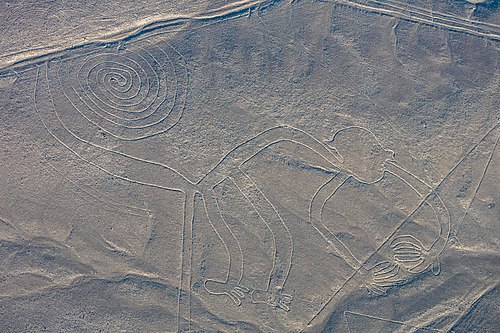
The Monkey — a spiral tail of enormous elegance, the body drawn in a single continuous line; the monkey is associated in Andean cosmology with the Amazon rainforest and its abundance; the Nazca people lived on the edge of the desert but traded with forest peoples; the monkey may represent their knowledge of a world beyond their immediate landscape
 [Unavailable: ❌ https://upload.wikimedia.org/wikipedia/commons/thumb/4/42/L%C3%ADneas_de_Nazca%2C_Nazca%2C_Per%C3%BA%2C_2015-07-29%2C_DD_54.JPG/330px-L%C3%ADneas_de_Nazca%2C_Nazca%2C_Per%C3%BA%2C_2015-07-29%2C_DD_54.JPG ❌]
The Spider — 46 meters long, drawn with extraordinary anatomical accuracy including the reproductive organ visible only under magnification; some researchers have identified it as a member of the genus Ricinulei, found only in the Amazon; the spider was associated in Andean traditions with the prediction of rain — a matter of existential importance in this desert
 [Unavailable: ❌ https://upload.wikimedia.org/wikipedia/commons/thumb/a/a5/L%C3%ADneas_de_Nazca%2C_Nazca%2C_Per%C3%BA%2C_2015-07-29%2C_DD_52.JPG/500px-L%C3%ADneas_de_Nazca%2C_Nazca%2C_Per%C3%BA%2C_2015-07-29%2C_DD_52.JPG ❌]
The Hummingbird — 93 meters long, its beak pointing toward the winter solstice sunrise; the hummingbird in Andean tradition was associated with resurrection (its ability to enter torpor and revive) and with the supernatural messenger between worlds; its precise orientation to the solstice suggests the Lines functioned at least partly as an astronomical calendar
 [Unavailable: ❌ https://upload.wikimedia.org/wikipedia/commons/thumb/4/48/L%C3%ADneas_de_Nazca%2C_Nazca%2C_Per%C3%BA%2C_2015-07-29%2C_DD_55.JPG/500px-L%C3%ADneas_de_Nazca%2C_Nazca%2C_Per%C3%BA%2C_2015-07-29%2C_DD_55.JPG ❌]
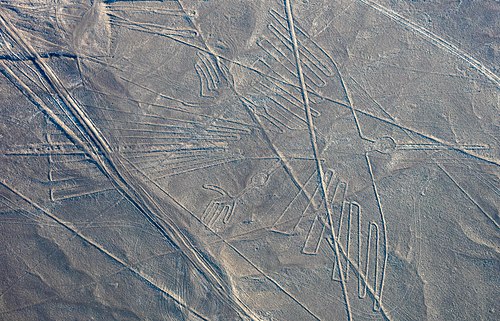
The Condor — wingspan of approximately 135 meters; the Andean condor was the supreme sacred bird of South American civilizations: its ability to soar at great altitude identified it with the sky world and the divine; a creature that could fly to the elevation of the gods was naturally associated with the relationship between the human and the divine
 [Unavailable: ❌ https://upload.wikimedia.org/wikipedia/commons/thumb/c/cd/L%C3%ADneas_de_Nazca%2C_Nazca%2C_Per%C3%BA%2C_2015-07-29%2C_DD_39.JPG/500px-L%C3%ADneas_de_Nazca%2C_Nazca%2C_Per%C3%BA%2C_2015-07-29%2C_DD_39.JPG ❌]
The Whale — the killer whale was revered in Nazca culture as a powerful supernatural being associated with death, war, and the underworld; the orca appears frequently on Nazca pottery as a mythological figure; its presence in the geoglyphs on a desert plateau far from the ocean suggests these figures encode a complete cosmological system rather than literal landscape observation
 [Unavailable: ❌ https://upload.wikimedia.org/wikipedia/commons/thumb/8/8e/L%C3%ADneas_de_Nazca%2C_Nazca%2C_Per%C3%BA%2C_2015-07-29%2C_DD_50.JPG/250px-L%C3%ADneas_de_Nazca%2C_Nazca%2C_Per%C3%BA%2C_2015-07-29%2C_DD_50.JPG ❌]
The Dog — the domestic dog appears alongside exotic animals in the Nazca geoglyph corpus; the presence of the familiar alongside the cosmic suggests the Lines represented the full range of the Nazca world, from the household to the supernatural; some researchers propose the Lines were sacred pathways walked during ritual ceremonies
 [Unavailable: ❌ https://upload.wikimedia.org/wikipedia/commons/thumb/9/99/L%C3%ADneas_de_Nazca%2C_Nazca%2C_Per%C3%BA%2C_2015-07-29%2C_DD_61.JPG/500px-L%C3%ADneas_de_Nazca%2C_Nazca%2C_Per%C3%BA%2C_2015-07-29%2C_DD_61.JPG ❌]
The Tree — botanical forms appear among the animal geoglyphs; the tree in Andean sacred geography represented the connection between worlds (roots in the underworld, trunk in this world, branches in the sky world) — the same axis mundi structure that appears in the Norse Yggdrasil and the Mayan World Tree; the Nazca tree encodes a universal sacred symbol in local form
 [Unavailable: ❌ https://upload.wikimedia.org/wikipedia/commons/thumb/7/78/L%C3%ADneas_de_Nazca%2C_Nazca%2C_Per%C3%BA%2C_2015-07-29%2C_DD_64.JPG/960px-L%C3%ADneas_de_Nazca%2C_Nazca%2C_Per%C3%BA%2C_2015-07-29%2C_DD_64.JPG ❌]
The Heron — 900 meters long, one of the largest of the Nazca figures; herons were associated with water in a desert culture perpetually concerned with the availability of this resource; the Nazca hydraulic engineers who built the underground aqueducts (puquios) that supplied their cities with water may have related the water-bird to their most essential technology
 [Unavailable: ❌ https://upload.wikimedia.org/wikipedia/commons/thumb/9/92/L%C3%ADneas_de_Nazca%2C_Nazca%2C_Per%C3%BA%2C_2015-07-29%2C_DD_62.JPG/330px-L%C3%ADneas_de_Nazca%2C_Nazca%2C_Per%C3%BA%2C_2015-07-29%2C_DD_62.JPG ❌]
The Hands — a human figure with three fingers on the right hand and four on the left; one of the few anthropomorphic geoglyphs in the Nazca corpus; sometimes called 'the Astronaut' by proponents of extraterrestrial theories, the figure is now understood by archaeologists as a shamanistic figure in a ritual posture — the shaman as intermediary between the human and divine worlds
 [Unavailable: ❌ https://upload.wikimedia.org/wikipedia/commons/thumb/1/14/04-Nazca_Lines-nX-36.jpg/500px-04-Nazca_Lines-nX-36.jpg ❌]
The Parrot — one of many bird figures in the Nazca corpus; the density of bird geoglyphs (at least 18 species identified) suggests birds held special cosmological significance for the Nazca people, perhaps as messengers or as representations of the soul's journey between worlds; the variety of species depicted demonstrates sophisticated zoological observation combined with sacred intent
Related Esoteric Inquiries:
- The Sky-Walkers of the Pampa: Decoding the Nazca Geoglyphs
- Machu Picchu: The Lost City of the Inca
- The Enigma of the Nazca Lines: The Geoglyphs of the Gods
Lux Esoterica.
2026.


Comments