Azrael: The Angel of Transition, Gentle Companion at the Threshold of Eternity
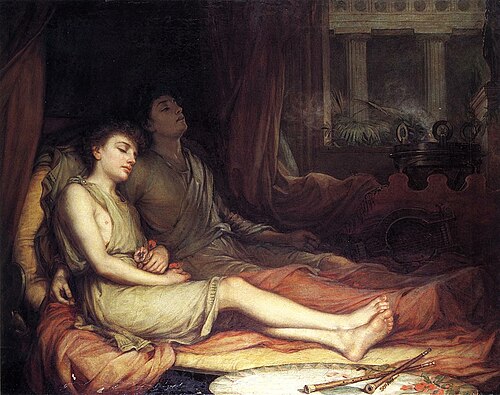
John William Waterhouse, "Sleep and His Half-Brother Death" (1874) — the ancient Greek tradition of depicting death as the gentle twin of sleep, a beautiful rather than terrible presence, resonates deeply with the nature of Azrael as understood in Islamic and Jewish mystical tradition: not a destroyer, but a compassionate companion at the final threshold.
Of all the great angelic beings, none is more universally dreaded — and none, upon genuine acquaintance, more profoundly misunderstood — than Azrael, the Angel of Death. In popular imagination, shaped by centuries of plague iconography and the grim reaper of medieval art, the angel who stands at the threshold of death appears as a skeletal, hooded figure of absolute terror, come to drag the soul away by force into an unwelcoming darkness. This image is almost entirely at odds with how Azrael is actually described in the mystical traditions that know him most deeply.
In Islamic tradition — where he is called Izra'il (also Malak al-Mawt, the Angel of Death) — and in Jewish mystical tradition — where the Angel of Death is later identified with the name Azrael — this being is understood not as an adversary of life but as its faithful completion: the one who arrives at the appointed moment to escort the soul from its earthly dwelling into the wider reality from which it came. He is not the enemy of the soul. He is its last and most intimate companion — the one who is present at the single most important transition of each human life, whose entire purpose is to ensure that that transition is accomplished with the dignity, care, and divine intentionality that every soul deserves.
The Name: Help of God
The name Azrael (עֲזְרָאֵל, Azra'el) is composed of azra (help) and El (God): "Help of God" or "One whom God helps." This is a striking name for an angel of death. It says nothing about destruction, nothing about darkness, nothing about the taking away of life. It says: divine assistance. The being whose function is to receive the departing soul is named for the quality of divine help — the infinite care of the divine expressed in the most vulnerable, most frightening, most unavoidable moment of every life.
The etymology suggests something that all the great mystical traditions confirm: death, in the divine economy, is an act of help. Not help in the trivial sense — not the relief of a burden, not the end of pain (though it may include these) — but help in the deepest sense: the assistance of a being in accomplishing the transition for which all of its earthly existence has been preparation, the crossing of a threshold that cannot be crossed alone, the completion of the arc of a life in the hands of a being who knows exactly where that arc was always headed.
Azrael in Islamic Tradition
In the Quran and Hadith, the Angel of Death (Malak al-Mawt) is described with remarkable detail. The Quran (6:61) describes him as arriving with his appointed deputies to take the souls of the dying: "When death comes to one of you, our messengers take him, and they never fail in their duty." His appearance is calibrated to the nature of the soul he receives: for the righteous soul, he appears in a beautiful form; for the soul unprepared for its crossing, in a more terrible aspect.
The name Izra'il (or Azra'il) appears not in the Quran itself but in Hadith literature — the sayings and traditions attributed to the Prophet Muhammad. He is described as one of the four great archangels alongside Jibril (Gabriel), Mika'il (Michael), and Israfil (the blower of the trumpet at the Last Day). His stature, like Sandalphon's and Metatron's, is cosmic: it is said that one foot rests in the East and one in the West, and that the earth itself fits between his two hands.

Hypnos and Thanatos on an Attic white-ground lekythos (c. 450 BCE, British Museum) — the Greek twin gods of Sleep and Death bear the body of a warrior. The ancient intuition of death as the gentle twin of sleep reflects the same wisdom encoded in the name and nature of Azrael.
The Islamic tradition is explicit that Azrael does not act on his own authority. He comes only when God commands: each soul has its appointed time, written in the divine book before the soul's earthly life began, and Azrael takes the soul when that time arrives — not a moment sooner, not a moment later. He is, in the fullest sense, the executor of divine will in the most intimate act of the created order.
A particularly moving tradition describes Azrael's response when God first assigned him the task of receiving the souls of the dying. The other angels had refused, unable to bear the grief that such a task would involve. Azrael accepted — and immediately felt the weight of universal human sorrow. God comforted him: "I will conceal you behind a veil, so that they will not blame you; they will blame disease, or time, or fate." Azrael receives the blame that belongs to the inevitable; the divine wisdom conceals the hand behind the natural causes that appear to explain each death.
The Moment of Death: A Gentle Taking
Across both Islamic and Jewish mystical traditions, the moment of death — when Azrael receives the soul — is described in terms that are far removed from violence or terror. For the righteous soul, the traditions agree, the experience is one of extraordinary gentleness: the soul is drawn out like a thread of silk from a needle, gently and without pain.
The Prophet Muhammad described the state of the believer at the moment of death: the soul is greeted by angelic presences of such beauty and fragrance that any desire to return to the earthly body dissolves immediately. Azrael arrives not as a grim stranger but as the culmination of a journey — the escort who has been with the soul throughout its life, waiting for this appointed moment with the patience of eternity.
Jewish tradition similarly distinguishes between the death of the righteous (a gentle taking, compared to drawing a hair from milk) and the death of those who have hardened themselves against the divine — for whom the crossing is experienced as more difficult. But even in the difficult cases, the destination is the same: the soul is escorted to the divine presence for review, for purification, and for what comes next.
Azrael and the Grieving
An often-overlooked aspect of Azrael's ministry is his relationship not only with the dying but with those who remain: the grieving, the bereaved, the ones left behind when a beloved soul departs. In various folk traditions and mystical texts, Azrael is invoked not only by the dying but by those who mourn — as the one who can serve as a bridge between the departed and the living, the one who knows where the soul has gone and can carry love in both directions.

Death depicted in a medieval Book of Hours (De Vaulce Hours, c. 15th century) — the medieval European tradition of the Grim Reaper represents one cultural interpretation of the Angel of Death, very different from the more compassionate vision of Azrael in Islamic and Jewish mysticism.
This comforting function is implicit in the name itself. "Help of God" — the help that God sends at death is not only for the dying. It is also for those who love the dying, and who must find a way to live with what remains when a beloved presence has departed. Azrael knows grief. He is the being who, in the Islamic tradition, accepted the burden of universal human sorrow when all other angels declined. He is acquainted with every loss that has ever been experienced, and he carries it all — not crushed by it, but transformed by it into a compassion of oceanic depth.
The Sufi Vision: Rumi and the Encounter
The Sufi mystical tradition within Islam developed the most sophisticated and beautiful theological and poetical treatments of Azrael. Rumi, in his Masnavi, uses the encounter with the angel of death as a central image for the nature of spiritual awakening. In one of his most famous stories, a man sees Azrael and is so terrified that he begs Solomon to transport him instantly to India to escape. When the man arrives in India, Azrael is already there — waiting, with the appointment that was always scheduled for that place and that time.
Rumi's point is not that death is inescapable as a counsel of despair, but that the flight from death is itself the flight from life — and that the acceptance of death, the turning toward rather than away from the angel who waits, is the beginning of genuine freedom. The soul that accepts Azrael, that meets his gaze rather than fleeing it, discovers that what it feared was not an ending but a doorway.
In the Sufi path, the encounter with one's own mortality is considered one of the great spiritual catalysts: the event that strips away every illusion about what matters and what does not, that concentrates the attention, that makes the soul serious about its true purpose in a way that nothing else can. The Sufi practitioner is encouraged to meditate on death daily — not as morbid obsession, but as the greatest teacher of what is worth living for.
Thanatos: The Universal Wisdom
The Greek tradition's Thanatos — the personification of death as the twin brother of Hypnos (Sleep) — shares the essential insight that the mystical traditions encode in Azrael: death is not violence but transition, not destruction but transformation, not the enemy of life but its completion and its continuation in another form.
In Homer, Thanatos and Hypnos work together to carry the body of the fallen warrior Sarpedon from the battlefield to his homeland — a final act of care and dignity. Death is not an abandonment; it is an escort. The dead are not dropped; they are carried. This ancient Greek wisdom resonates through every tradition that has intuited, behind the terror of death, the reality of an angelic presence whose entire purpose is to ensure that the final journey is made with care.
The Inner Azrael: Learning to Live by Learning to Die
For the contemplative and esoteric traditions, Azrael embodies an inner principle: the capacity to accept impermanence — to hold the reality of death not at arm's length but at the center of one's awareness, as the teacher that gives everything its proper weight and urgency.
The meditative traditions of many cultures — Buddhism, Stoicism, Sufism, Christian contemplative prayer — all recommend the regular contemplation of one's mortality, not to induce despair but to induce wisdom: the clarity of perspective that comes when one genuinely accepts that this particular life, in this particular form, will not go on forever, and that the time available is therefore precious and not to be wasted on what does not matter.
To invite the Azrael-principle into one's inner life is to ask: What would I do differently if I knew this was my last year? My last month? My last day? And then to begin living that way — not tomorrow, but now.
The angel who waits at the end of every life is not waiting to take something from us. He is waiting to reveal — in the moment of crossing — what we always were, beneath the layers of fear and distraction and unfinished business. He is the one who sees through to the soul. And the soul, meeting his gaze at last, discovers what Rumi's saint discovered: there was never anything to fear. There was only a door. And the door was always open.
— Lux Esoterica


Comentarios