Raziel: The Angel of Secrets, Keeper of the Divine Mysteries

William Blake, "The Angel of Revelation" (c. 1803–05, British Museum) — standing with one foot on sea and one on land, the angel of the open book embodies the vision of cosmic knowledge made available to humanity, the central mystery of Raziel's ministry.
Among the great angelic intelligences of Jewish mystical tradition, Raziel occupies a position of singular and extraordinary importance: he is the keeper of all divine secrets, the celestial scribe who stands closest to the throne of God and hears the decrees of heaven as they are spoken — and who, in one of the most beautiful and poignant stories in all of angelology, chose to share that knowledge with humanity in its moment of greatest need.
His name alone announces everything: Raziel (רָזִיאֵל, Razi'el) is composed of raz (רָז, secret) and El (אֵל, God): "Secret of God" or "God is my mystery." He is not merely the angel who guards secrets. He is the angel who is the secret — the personification of divine mystery itself, the being in whose very nature the unknowable and the revealed meet and interpenetrate. His existence is a declaration that the mysteries of the universe are not sealed forever, that divine knowledge flows, that the cosmos has a teacher who desires to be understood.
The Closest Angel to the Throne
In Kabbalistic and Merkabah mystical literature, Raziel is consistently described as standing closer to God's throne than any other angelic being. This proximity is not merely spatial; it is epistemological. Raziel hears everything that is decreed in the divine court: the secrets of creation, the hidden architecture of the universe, the names and natures of all things, the laws that govern the movements of stars and souls, the paths of the Sefirot on the Tree of Life, and the deep structures of reality that underlie the visible world.
This position makes him unique among angels. While Michael is the divine warrior, Gabriel the herald of revelation, and Raphael the healer sent to help the afflicted, Raziel is something more interior: the one who listens to God's own thinking, who is trusted with the overflow of divine wisdom that cannot yet be spoken into the world. He is the celestial librarian of the unspoken — the one who has recorded everything that God knows, in a book whose contents would transform any being who read them.
That book is one of the most famous objects in all of Jewish mystical lore.
The Sefer Raziel HaMalakh: The Book of the Angel Raziel
The Sefer Raziel HaMalakh — the Book of the Angel Raziel — is one of the oldest and most venerated texts of Jewish esotericism. The book as it has come down to us is a medieval compilation, likely assembled between the 7th and 13th centuries CE, drawing on much older mystical material from the Hekhalot and early Kabbalistic traditions. But the legend of the book — the story it tells about its own origin — is far older, embedded in the very earliest layers of Jewish mythological thought.
According to this legend, the Sefer Raziel was not written by human hands. It was written by Raziel himself, who inscribed in it all the secrets of the universe — the knowledge of how God created the world, the hidden properties of every plant and stone and star, the names and functions of every angelic being, the structure of the seven heavens, the paths between worlds, and the deepest mysteries of the human soul and its relation to the divine. The book was written in a language older than Hebrew, in letters of fire on sapphire tablets, and contained within it not merely information but power: the power to work wonders, to understand creation from within, to speak with authority in the divine language that called the world into being.
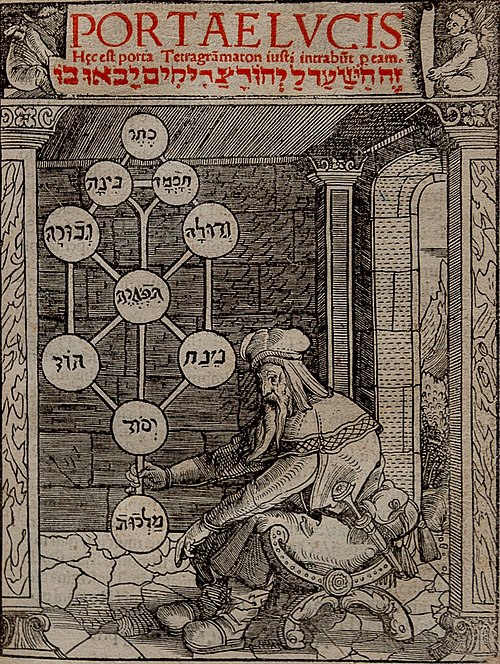
Portae Lucis (Gates of Light), 1516 — a foundational Kabbalistic work by Joseph Gikatilla, published in Augsburg. The tradition of inscribing cosmic secrets in books available to the initiated is central to the Raziel mythos: divine knowledge descends through angelic intermediaries into human hands.
Adam, Eden, and the First Gift of Knowledge
The most profound and emotionally resonant story about Raziel concerns the first human being. After Adam and Eve were expelled from the Garden of Eden — cut off from the direct presence of God, cast into a world of labor, mortality, and forgetting — Adam sat weeping at the edge of the Garden, overwhelmed by the magnitude of what had been lost. He understood that he and his descendants were now separated from the direct light of divine wisdom, that the intimate knowledge of God's nature he had possessed in Eden was fading.
It was at this moment that Raziel appeared.
The angel descended from the highest heaven bearing the sapphire book, and gave it to Adam with these words: "Do not be sorrowful. Though you are now separated from the direct presence of the divine, the wisdom of creation can still reach you through this book. The secrets of the universe are written here: you will find in them the knowledge of how to live, how to return to the source from which you came, and how the divine light is hidden within all created things."
Adam received the book, and through it learned all the mysteries — the structure of the cosmos, the nature of the soul, the hidden pathways back to the divine. It became the foundation of all wisdom that he passed to his descendants: the esoteric knowledge that would eventually crystallize into Kabbalah, into alchemy, into sacred science in all its forms.
The tradition holds that the book passed from Adam to his son Seth, and from Seth through the generations to Enoch — who is also, in later traditions, identified with the angel Metatron after his ascension. From Enoch it passed to Noah, who used its wisdom to construct the Ark; from Noah to Abraham; from Abraham through the patriarchs to Moses; and from Moses eventually into the mystical libraries of Solomon's Temple, where it became the seed of Israel's entire esoteric tradition.
Raziel and the Kabbalistic Tree of Life

The Kabbalistic Tree of Life showing the ten Sefirot — the divine emanations through which the infinite Ein Sof expresses itself in creation. Raziel is associated with Chokmah (Wisdom), the second Sefirah, the first flash of undifferentiated divine knowing before it takes specific form.
In the developed Kabbalistic system, each of the great archangels is associated with one of the ten Sefirot — the divine emanations on the Tree of Life through which the infinite God (Ein Sof) expresses itself in creation. Raziel's association is with Chokmah (חָכְמָה), Wisdom — the second Sefirah, positioned at the top right of the Tree.
Chokmah is the first flash of differentiated divine awareness: the point at which the absolute, formless light of the divine begins to know itself. It precedes understanding (Binah), which organizes and limits; it precedes knowledge (Da'at), which synthesizes; it is the pure, undirected flash of insight before it becomes coherent thought. It is divine wisdom in its most immediate and overwhelming form — not wisdom as accumulated knowledge, but wisdom as the direct apprehension of reality.
This is Raziel's domain. He embodies the kind of knowing that does not come from study or experience, but from proximity to the source — the knowing that floods into a consciousness that is perfectly open, perfectly still, and perfectly aligned with the divine. The Sefer Raziel HaMalakh, in this Kabbalistic reading, is not merely a book of magical procedures; it is a crystallization of Chokmah itself — divine wisdom in a form that the human mind can approach and study, even if it can never fully contain it.
The Jealousy of the Angels
The tradition around Raziel's gift to Adam includes a poignant counter-narrative. When the other angels saw Raziel descend to Adam with the divine book, many were furious. The mysteries of heaven were being given to a human being — a creature of earth and clay, a being who had already demonstrated its capacity for disobedience. They believed that cosmic secrets should remain in the heavenly realm, inaccessible to mortals.
A delegation of angels stole the book from Adam and threw it into the sea, hoping to prevent humanity from ever reading it.
God intervened. The divine command went out that the book should be recovered — and according to the tradition, it was the angel Rahab, lord of the sea, who retrieved it from the depths and restored it to Adam.
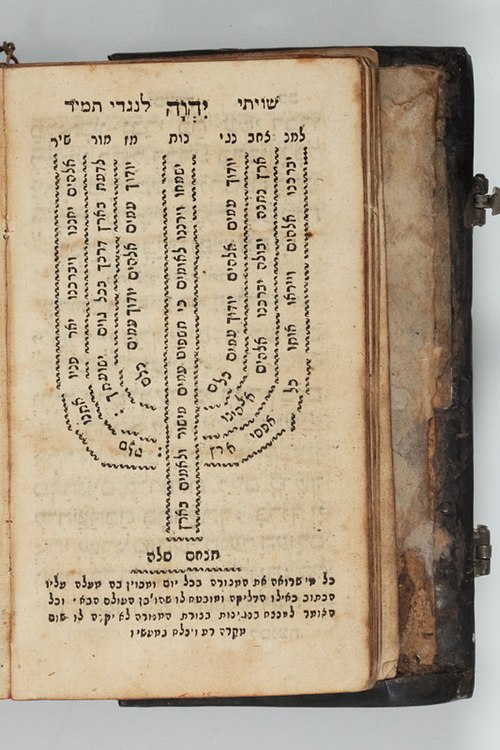
An illuminated Kabbalistic prayer book — the tradition of transmitting divine secrets through written texts, from the Sefer Raziel to the Zohar, reflects the belief that celestial wisdom can descend into the human realm and be preserved across generations.
This counter-narrative is theologically rich. It encodes the perennial tension between the esoteric and the exoteric, between the guardians of mystery who fear knowledge in unprepared hands, and the divine generosity that desires all of its children to awaken. The theft by the angels represents every force — internal and external — that tries to keep the human soul in ignorance. The recovery of the book represents the inexorable movement of divine wisdom toward the world: the knowledge that was always meant for humanity will always find its way back.
Raziel and the Enochic Tradition
The connection between Raziel and Enoch — the patriarch who "walked with God and was not, for God took him" (Genesis 5:24) — runs deep through Jewish mystical tradition. In the Book of Enoch and the later 3 Enoch (Sefer Hekhalot), Enoch is the human being who ascended to heaven and was transformed into the great angel Metatron. But before that transformation, the tradition holds, Enoch received the secrets of the cosmos — secrets that overlapped significantly with the content of Raziel's book.
In some readings, Raziel functioned as one of Enoch's celestial guides during his heavenly journey: the angel who explained to the ascending mystic the hidden architecture of the seven heavens, the nature and function of each class of angelic being, the secrets of the stars and their influence, and the deep patterns that underlie the visible creation. Raziel, in this tradition, is not merely a keeper of secrets but an active teacher — the one who meets the ascending soul and unveils the mysteries layer by layer as the soul proves capable of holding more light.
The Inner Raziel: The Mysticism of Not-Knowing
For the contemplative seeker, Raziel embodies a paradox that lies at the heart of all genuine mystical experience: the deepest wisdom begins with the recognition of how little we know.
The name "Secret of God" does not mean that the divine is permanently concealed. It means that the divine is inexhaustibly deep — that every layer of understanding opens onto further depths, that genuine wisdom is not the accumulation of information but the ever-increasing capacity to hold mystery without collapsing into certainty. Raziel stands at the throne of God and hears everything — and what he has learned, above all, is that the divine is always more than any description of it, always more than any name or concept or system.
To invoke the Raziel-principle in one's inner life is to cultivate what the Christian mystical tradition calls apophatic knowing — knowing through not-knowing, approaching the divine through the systematic release of every assumption about what it must be. It is to hold every spiritual insight as a gift rather than a possession, recognizing that the moment we own a spiritual truth, we begin to use it to defend ourselves from further revelation.
The book that Raziel carries is, in the end, not a fixed text. It is the living record of what the universe is saying, right now, to any consciousness that is still enough to hear it. Every genuine insight, every moment of clarity that comes through prayer or meditation or study or simply paying attention, is a page of that book. The book is always being written. Raziel is always handing it to humanity. The question is only whether we are present enough to receive it.
— Lux Esoterica
Related Esoteric Inquiries:
- Metatron: The Angel of the Divine Face, Celestial Scribe, and Bridge Between Worlds
- Erelim: The Valiant Ones, Heroic Angels of Divine Courage and Sacred Grief
- Malachim: The Divine Messengers, Angels Who Walk Among Us
Lux Esoterica.
2026.


Comments