Malachim: The Divine Messengers, Angels Who Walk Among Us

James Tissot, "Abraham and the Three Angels" (c. 1896–1902) — Abraham welcomes three strangers by the oaks of Mamre, not yet knowing them to be divine messengers. The scene captures the most fundamental mystery of the Malachim: that beings of the divine realm can enter the human world in forms indistinguishable from human travelers.
Of all the many orders and classes of angelic beings in Jewish mystical tradition, the Malachim hold a unique position: they are, quite literally, what the word "angel" means. The Hebrew word mal'akh (מַלְאָךְ) — plural malachim (מַלְאָכִים) — is the ordinary biblical word for angel, and its primary meaning is not "winged celestial being" or "radiant heavenly spirit" but something far more practical and relational: messenger.
An angel, in the foundational sense of the Hebrew tradition, is not defined by its appearance or its place in a celestial hierarchy. It is defined by its function: to carry a message from one place to another, from the divine realm to the human, from the source of all things to the particular human being who needs, at this moment, to hear what is being sent. The Malachim are the angels of action, of relationship, of contact — the beings who cross the boundary between heaven and earth and enter human experience directly, in forms that humans can encounter without being destroyed.
In the Kabbalistic tradition, where each angelic order is associated with one of the divine Sefirot on the Tree of Life, the Malachim are associated with Tiferet — Beauty, Harmony, the Heart. This is profoundly telling. The Sefirah that is the center of the Tree, the point where all the other forces meet and are balanced, the Sefirah of compassion and integration and love, is the home of the angels most intimately involved with human beings. The Malachim are not the most powerful or the most elevated of angelic orders. They are the ones sent with the greatest love.
The Name: Messenger as Theological Category
The Hebrew root from which mal'akh derives — related to mel'akhah (craft, work, the task one is sent to perform) — places the angel's identity entirely in what it does rather than what it is. This is a theological insight of remarkable depth.
In many religious traditions, angels are understood primarily as beings of a particular kind — luminous, powerful, spiritual rather than material, superior to humans in the hierarchy of creation. The Hebrew tradition, by naming them for their function, places the emphasis elsewhere. An angel is not defined by its luminosity or its powers; it is defined by the message it carries, the task it performs, the relationship it embodies. An angel that is not in the act of being sent — that has no message to deliver, no encounter to facilitate, no human being to reach — is, in a real sense, not yet fully itself.
This understanding has profound implications. It means that what makes the Malachim divine is not their nature alone but their availability — their readiness to carry the divine word across the gap between the infinite and the finite, to enter the human realm in whatever form will allow them to be heard. They are the embodiment of divine communication: the proof that the divine does not remain enclosed in its own perfection but reaches outward, persistently and endlessly, toward the particular human beings in particular moments of their particular lives.
The Malachim in Hebrew Scripture
The Malachim are by far the most frequently appearing class of angelic beings in the Hebrew Bible. They appear in virtually every book, in virtually every kind of situation — not in the overwhelming cosmic visions of Ezekiel and Isaiah, but in the intimate particularity of human life.
Hagar, the Egyptian slave, encounters an angel of the Lord who finds her in the wilderness after she has fled from Sarah's harshness. The angel calls her by name, asks where she has come from and where she is going, and promises her that her son Ishmael will become a great nation. This is no cosmic vision; it is an intimate, personal encounter, as specific as a conversation between two human beings.
Abraham sits at the door of his tent in the heat of the day at the oaks of Mamre and looks up to see three men standing nearby. Without knowing who they are, he runs to meet them, bows to the ground, and offers them rest, water, and food. The three eat. Only gradually does it become clear that these are no ordinary travelers — they are divine messengers, and among their number is the divine presence itself. The meal of hospitality becomes a divine encounter.
Jacob wrestles through the night with a man — or an angel — and refuses to let go until the being blesses him. At dawn, the stranger (who does not reveal his name) blesses Jacob and renames him Israel: "one who struggles with God and with humans and has prevailed" (Genesis 32:28). Jacob names the place Peniel — "face of God" — saying: "I have seen God face to face, and yet my life was spared."

Aert de Gelder, "Jacob Wrestling with the Angel" (c. 1700, Dulwich Picture Gallery) — the night-long struggle that transforms Jacob into Israel captures the nature of the deepest Malakh encounters: not gentle whispers but profound confrontations that leave the human being permanently changed.
What unites all these encounters is their specificity and their transformative quality. The Malachim do not deliver abstract messages; they arrive at particular moments in particular lives with exactly what that person, in that moment, needs — whether comfort, challenge, information, or the blessing that can only come through struggle.
The Problem of Angelic Form
One of the most debated questions in both Jewish and Christian theology concerns the form of the Malachim: how can spiritual beings appear as physical men? How can divine messengers eat bread and drink water?
Maimonides, in the Guide for the Perplexed, argued that the biblical descriptions of angels appearing in human form should be understood as prophetic visions rather than physical events — that the "three men" who appeared to Abraham were not literally present in physical form but appeared to him in an inner, prophetic experience. This rationalist interpretation aimed to protect the absolute incorporeality of divine and angelic beings.
The mystical tradition took a different approach. The Zohar and later Kabbalistic texts held that angels can indeed assume temporary physical forms when their mission requires it — that the material world is not so alien to the spiritual that a being of spirit cannot take on, temporarily, the appearance of matter for the purposes of a specific encounter. The Malachim, who serve as bridges between the divine and human realms, possess the capacity to cross in both directions: they can carry the divine downward into the material, and carry the human upward toward the divine.
The Malachim and Tiferet in Kabbalah
In the architecture of the Kabbalistic Tree of Life, Tiferet (תִּפְאֶרֶת, "Beauty" or "Splendor") occupies the central position — the sixth Sefirah, equidistant between the Crown (Keter) at the top and the Kingdom (Malkut) at the bottom, and equidistant between Chesed (Mercy) on the right and Gevurah (Judgment) on the left. It is the heart of the Tree: the Sefirah of balance, of integration, of compassionate love.
The association of the Malachim with Tiferet reflects their fundamental nature. They are the angels of the heart — not of the highest divine mysteries (like Raziel, who belongs to Chokmah) and not of the earthly dimension of divine governance, but of the compassionate center where divine love takes the form of direct engagement with the particular human being. Tiferet is the Sefirah most closely associated with the divine attribute of rachamim — deep, womb-like compassion, the compassion of a parent for a child. The Malachim are the agents of that compassion in the world.
Hermes: The Universal Messenger
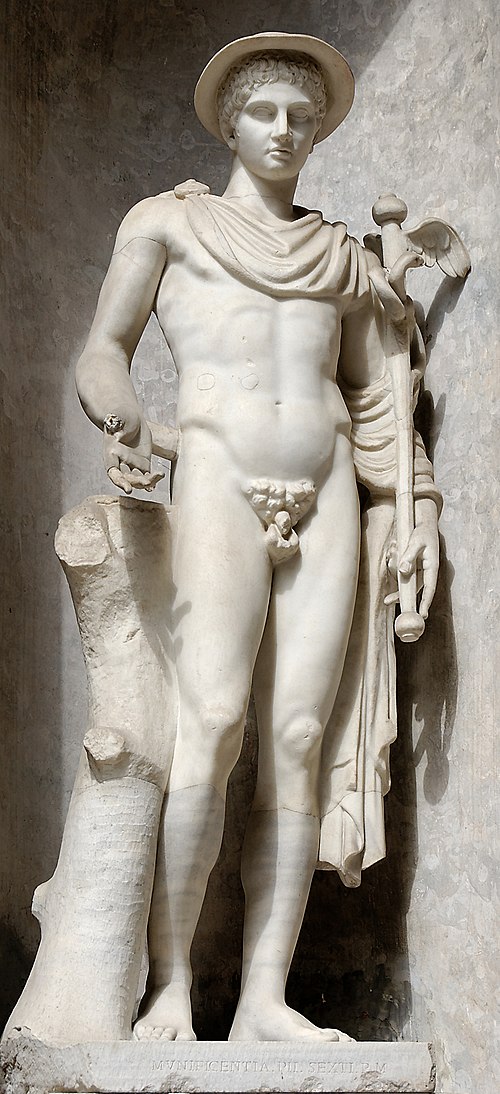
Hermes Ingenui (Vatican Museums, 1st century BCE) — the Greek divine messenger, with his winged sandals and caduceus, embodies the same function as the Malachim: the crossing of boundaries between worlds, the carrying of divine communication into the human realm, the facilitation of encounter between the mortal and the immortal.
The Greek god Hermes — messenger of the gods, guide of souls, crosser of boundaries — is the nearest Greek parallel to the Malachim. Like the Hebrew mal'akh, Hermes is defined not by his place in a hierarchy but by his function: he is the one who moves, who carries messages, who crosses from one realm to another and returns. He wears winged sandals (talaria) and carries the caduceus — the herald's staff — as emblems of his role as divine communicator.
But Hermes is also the psychopomp — the guide of souls to the underworld — and the patron of travelers, merchants, and thieves. He is the deity of crossings and thresholds, of all the points where one domain meets another. This breadth of function reflects the same principle that the Malachim embody: the divine messenger is not limited to a single kind of communication. The divine has messages to deliver at every kind of threshold — not only the threshold between heaven and earth, but the threshold between life and death, between known and unknown, between the world as it was and the world as it will be after the message arrives.
The Inner Malakh: Living as a Messenger
For the contemplative and esoteric traditions, the Malachim invite a profound question about human identity and purpose: What if each of us is, at certain moments, a malakh — a messenger — to the people around us?
The rabbinic tradition recognized this possibility. The Hebrew word mal'akh can refer to a human messenger as well as a divine angel; the same word covers both. The prophet Malachi's name simply means "my messenger." John the Baptist is called a mal'akh in the Synoptic Gospels. The idea that human beings can, at particular moments, function as divine messengers — carrying exactly what another person needs to hear, appearing at exactly the right moment, facilitating a transformation they could not have achieved alone — is not foreign to the tradition.
This possibility creates a responsibility. To be a messenger is to be transparent to the message — to carry it faithfully without distorting it through the filter of one's own desires, fears, and interpretations. The Malachim, in their purity, deliver exactly what they are sent to deliver, in exactly the way that the recipient can receive it. They do not improvise; they do not embellish; they do not withhold.
To cultivate the Malakh-principle in one's own life is to cultivate a quality of availability and transparency — to be present to what the moment needs, to what the person in front of you needs, to what the situation calls for — and to allow that to pass through you without obstruction. It is, perhaps, the most difficult and the most human of all the angelic qualities: not the fire of the Chasmalim, not the cosmic motion of the Ophanim, but the simple, faithful, consistent willingness to show up, to carry what is given, and to deliver it with care.
— Lux Esoterica
Related Esoteric Inquiries:
- Erelim: The Valiant Ones, Heroic Angels of Divine Courage and Sacred Grief
- Ishim: The Human-Formed Angels, Celestial Beings at the Threshold of Humanity
- Raziel: The Angel of Secrets, Keeper of the Divine Mysteries
Lux Esoterica.
2026.


Comments