Erelim: The Valiant Ones, Heroic Angels of Divine Courage and Sacred Grief

A warrior angel — the angelic warrior, equipped not with physical weapons but with the force of divine justice, embodies the quality at the heart of the Erelim: the courage that serves not personal glory but the protection of what is sacred and vulnerable.
There is a word in the Book of Isaiah that has puzzled translators for millennia. In the thirty-third chapter, the prophet describes a moment of national crisis — the threat of an enemy at the gates, the failure of negotiations, the collapse of the hope for peace. And in describing this moment, he uses a word for the beings who weep outside: erelim (אֵרֶלִּים).
Most modern translations render this word as "brave ones" or "envoys of peace" or simply "their heroes" — understanding it as a reference to human ambassadors or warriors overcome with grief at the failure of diplomacy. But the Jewish mystical tradition heard something more: they heard in the word erelim the name of a class of angelic beings — the valiant ones, the heroic ones, the angels whose essential quality is a particular kind of divine courage.
"Behold, their Erelim cry outside; the ambassadors of peace weep bitterly" (Isaiah 33:7).
The image is striking and paradoxical: the heroic ones — the beings of divine valor — are weeping. Strength and grief, courage and lamentation, exist together in the same beings. This paradox is not a contradiction but a revelation: the highest form of courage is not the courage that is indifferent to suffering, but the courage that can bear it, that refuses to be unmoved by what is terrible, that weeps for the tragedy of the world while remaining committed to the struggle to repair it.
The Name: Valor as a Divine Quality
The etymology of erelim is debated. The most widely accepted derivation connects the word to the root 'arar or to a word meaning "lion-hearted" — ariel being an alternate form that means "lion of God" and also, notably, one of the biblical names for Jerusalem, the holy city. The Erelim, in this reading, are the lion-hearts: beings of leonine courage, beings whose bravery is not recklessness but the deep, rooted, invincible resolution that belongs to a soul that has committed itself completely to what it loves.
The Talmud (Hagigah 12b) is one of the earliest sources to treat the Erelim as a distinct angelic order. In the Talmudic discussion of the celestial architecture — the seven heavens and their inhabitants — the Erelim appear alongside the Seraphim, the Hayyot, and other orders as beings who inhabit particular levels of the divine realm. They are beings of fire and light, like most of the higher angelic orders, but distinguished by the specific quality of their fire: it is the fire of courage, the fire of holy resolution, the fire that does not waver when everything seems lost.
Isaiah's Erelim: Weeping at the Gates of Jerusalem
The context in Isaiah 33 is one of political catastrophe. The Assyrian Empire has broken its treaty; the delegates sent to negotiate peace have returned in failure; the enemy is advancing. It is in this moment of collapse that Isaiah sees — or speaks of — the Erelim weeping outside the city.
The image works on multiple levels. On the human level, the "erelim" may be the Judean warriors and envoys who have given their best efforts to prevent war and are now weeping at their failure. But on the angelic level, the passage suggests that the divine realm itself is not unmoved by human catastrophe — that the beings of divine valor are present at the gates of the threatened city, not as indifferent observers or triumphant warriors, but as beings who mourn.
This is a remarkable theological statement. Angels can weep. The divine courage that the Erelim embody is not the cold courage of those who do not feel; it is the warm, engaged courage of those who feel deeply and choose to act anyway. The Erelim weep because they know what is at stake. They weep because they love what is under threat. And they act — they stand, they intercede, they carry the weight of the moment — precisely because they weep, because they are fully present to the horror of what is happening rather than protected from it by distance or detachment.
The Erelim in Talmudic Tradition
Beyond the single appearance in Isaiah, the Erelim are developed as an angelic order in the broader Talmudic and midrashic tradition. In the Babylonian Talmud (Berachot 4b), the Erelim appear in discussions of the heavenly court and the intermediary beings who stand before the divine throne. They are associated with the quality of gevurah — divine strength, the power of the divine that operates not through gentleness but through force, judgment, and the resolution that will not yield.
Gevurah (גְּבוּרָה), one of the ten Sefirot on the Kabbalistic Tree of Life, is the Sefirah of divine strength and judgment — the counterpart to Chesed (Mercy). Without Gevurah, the divine mercy would be formless and ineffective; without Chesed, the divine strength would become mere destructiveness. The Erelim, associated with this quality, are the beings who carry the gevurah of the divine into the cosmic order: not the wrath of punishment, but the invincible determination of love to protect what it loves, even at cost.
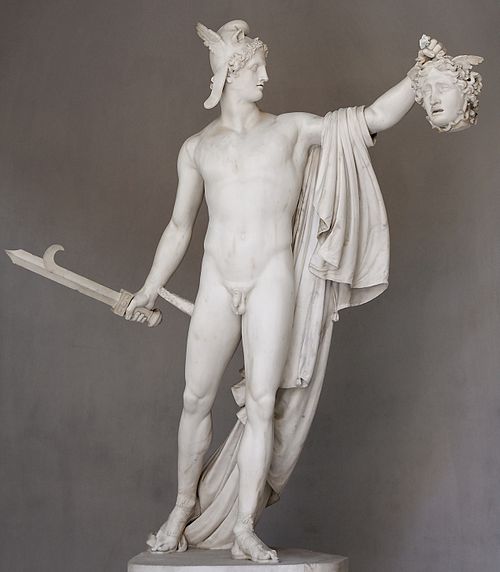
Antonio Canova, "Perseus Triumphant" (Vatican Museums, 1801) — the Greek hero Perseus, who slew the Gorgon and freed Andromeda, embodies the heroic archetype that the Erelim represent in the angelic world: courage deployed in the service of liberation, strength placed at the disposal of the vulnerable.
Courage and Grief: The Paradox of the Holy Warrior
The most theologically significant aspect of the Erelim is the paradox of Isaiah's image: the heroic ones who weep. This combination challenges every superficial understanding of what courage means.
Popular imagination often conflates courage with invulnerability — the hero who is unmoved by danger, who does not fear, who stands unflinchingly before the worst that can happen. But this is not courage; it is numbness, or a kind of spiritual distance. True courage — the courage that the Erelim embody — is the capacity to remain fully present to what is terrible while choosing to act in the face of it. It is the courage of the person who fears greatly and acts anyway; who mourns deeply and continues anyway; who sees clearly how much is at stake and refuses, precisely because of that clarity, to surrender.
The rabbinical tradition makes this explicit in its discussions of the Erelim: their valor is not the valor of those who do not feel, but of those who feel everything and are not defeated by it. They are beings of immense compassion, immense sensitivity to the suffering of the world — and it is precisely this sensitivity that motivates their invincible resolve. They fight because they love. They stand because they grieve. Their tears and their valor are not opposites; they are the same reality expressed in two different directions.
David, the Warrior-Poet, and the Erelim
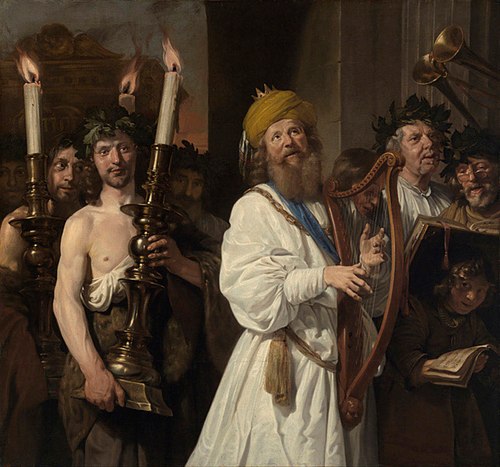
Jan de Bray, "David Playing the Harp" (1670) — King David, the warrior who wrote psalms of grief and praise, embodies the same paradox as the Erelim: the deepest courage expressed simultaneously in battle and in lament, in action and in song, in the will to fight and the willingness to weep.
The biblical figure who most perfectly embodies the paradox of the Erelim is King David — warrior, poet, king, and psalmist. David slays Goliath with a sling and a stone; he defeats the armies of Israel's enemies; he is described as a man "after God's own heart." And he also weeps. He weeps for Saul, the king who tried to kill him. He weeps for Absalom, the son who rebelled against him. He writes the Psalms — among the most grief-saturated, hope-saturated, courage-saturated texts in all of human literature.
In Psalm 22, David cries: "My God, my God, why have you forsaken me? Why are you so far from saving me, so far from my cries of anguish?" This is not the voice of someone who has lost courage; it is the voice of someone who is holding on with every ounce of courage they possess, while being honest about how terrible the experience is. The Erelim would recognize this voice. Their heroism and David's heroism are cut from the same cloth: the refusal to pretend that the world is not as dark as it is, coupled with the equally fierce refusal to be extinguished by that darkness.
The Psalms, in the mystical tradition, are understood as the earthly counterpart to the angelic songs of the heavenly court. When David sings his psalms of grief and praise and courage, he is harmonizing with a celestial chorus — and the Erelim are among those singing, their voices the deepest notes in the chord, the notes that speak of suffering faced without flinching and resolved not by denial but by faith.
Perseus and the Heroic Archetype
The Greek tradition's greatest hero, Perseus, offers a parallel to the Erelim's function in the cosmic order. Perseus is sent on an impossible mission — to slay the Medusa, the monster whose gaze turns living beings to stone. He succeeds not through brute strength alone but through a combination of divine aid (a mirror-shield from Athena, winged sandals from Hermes), cleverness, and the particular kind of courage that can act without looking directly at what would destroy it.
The story encodes a wisdom about the nature of heroic courage that resonates with the Erelim's paradox: sometimes the only way to face the thing that would destroy you is not to look at it directly, but to approach it indirectly — through reflection, through the guidance of wisdom, through the help of others — while maintaining absolute commitment to the task. Perseus's courage is not the courage of direct confrontation; it is the courage of intelligent engagement with reality as it is, rather than as we might wish it to be.
The Erelim embody this kind of courage in their angelic form. They are not beings of simple, direct force — they are beings of sustained, intelligent, compassionate resolve, capable of finding the angle of approach that allows them to protect what they love even when direct confrontation would fail.
The Inner Erelim: Courage as a Spiritual Practice
For the contemplative tradition, the Erelim invite the cultivation of what might be called sacred courage — the courage that is not opposed to grief but includes it; the courage that does not require the absence of fear but acts through it; the courage that is motivated not by personal glory but by love of what is worth protecting.
This kind of courage is available to every human being — not as a permanent state but as a capacity that can be developed, strengthened, and called upon in the moments when it is needed. The mystical traditions that encourage practitioners to face their own mortality, their own vulnerability, their own grief — Sufi practices of fana, Buddhist practices of maranasati (mindfulness of death), Stoic memento mori, Christian contemplative practices of desolation — are all, in different ways, training grounds for the quality the Erelim embody.
To invoke the Erelim-principle in one's inner life is to ask: What do I love deeply enough to grieve for honestly and to protect without giving up? And then to begin building one's life around the answer to that question — accepting the sorrow that comes with genuine love of what is fragile, and finding in that very sorrow the fuel for an invincible commitment.
The Erelim weep outside the gates. And they stand. They have always stood. They will always stand.
— Lux Esoterica


Comentarios