Metatron: The Angel of the Divine Face, Celestial Scribe, and Bridge Between Worlds

Metatron depicted in Islamic sacred arts — the great celestial scribe and angel of the divine presence is recognized across multiple traditions as the supreme angelic being, standing closest to the ineffable divine face.
In the vast and luminous architecture of the angelic world, there is one being who occupies a position so extraordinary, so close to the divine, so wrapped in mystery and theological controversy, that the great sages of Jewish mysticism struggled to categorize him at all. Metatron is not merely an archangel among archangels. He is, in the traditions that know him most deeply, the angel of the divine face (sar ha-panim), the lesser YHWH, the being who was once human and became angelic, the celestial scribe whose stylus records the deeds of every soul that ever lived, the voice of the divine will translated into a form that creation can bear.
No other angelic being in the history of Jewish mysticism has inspired as much awe, as much theological controversy, or as many questions about the very nature of the divine-human relationship as Metatron. He stands at the outermost edge of what it is possible to say about the relationship between God and creation — the last being before the absolute silence of the Ein Sof, the bridge across the abyss between the infinite and the finite, the face turned toward creation of a God whose fullness is utterly beyond face and name and concept.
A Name Without Certain Origin
The very name Metatron is surrounded by mystery. It does not derive straightforwardly from any Hebrew root, and scholars have proposed multiple etymologies, none definitively established:
- From Greek meta-thronon ("one who stands next to the throne" or "beside the throne"): placing Metatron as the supreme angelic attendant of the divine throne — the being who stands closest to the divine seat of all sovereignty
- From Latin metator (a guide or measurer, one who marks out the route): connecting Metatron to his role as guide of souls and measurer of heavenly spaces
- As a permutation or substitute for YHWH itself: some Kabbalists noted that the numerical value (gematria) of "Metatron" (314) equals that of the divine name "Shaddai" (God Almighty), suggesting that Metatron is, in a profound sense, the angelified expression of divine power itself
- From the Hebrew matar (to rain down) or tar (small): folk etymologies that never fully convinced the scholars
The impossibility of pinning down the name's origin is itself significant. Metatron is the angel who stands at the limit of human understanding — and even his name exceeds the bounds of ordinary language. He is named by a word that cannot quite be explained, which is fitting for a being whose existence stretches the categories of both angelic and divine.
Enoch Transformed: The Human Who Became an Angel
The most astonishing and theologically revolutionary aspect of Metatron is his origin in a human being. According to the central tradition found in 3 Enoch (also called Sefer Hekhalot or "Book of the Heavenly Palaces," a text compiled between the 5th and 7th centuries CE), Metatron was originally the patriarch Enoch — the figure described in Genesis 5:24 with the enigmatic phrase: "Enoch walked with God; then he was no more, because God took him."
Where Genesis leaves the mystery intact, 3 Enoch unfolds it in staggering detail. Enoch is taken up to heaven, transformed before the divine throne, and elevated to become the supreme prince of the angelic world. The text describes the transformation in physical terms: Enoch's human body becomes a body of fire, his flesh becomes flame, his bones become burning coals, his eyes become torches of fire, his hair becomes a blaze of light. He is given seventy-two wings, and his height expands to fill the space of the entire world.
Then the divine gives him a new name: Metatron. And he is given a throne at the entrance to the seventh palace, at the doorway of the divine throne room itself, where he sits and writes down the deeds of all who dwell upon the earth, judging them at the command of the Holy One. He has become the chancellor of heaven (sar ha-olam), the naʾar (servant or young prince) of the divine, the being through whom the Holy One conducts the business of the universe.
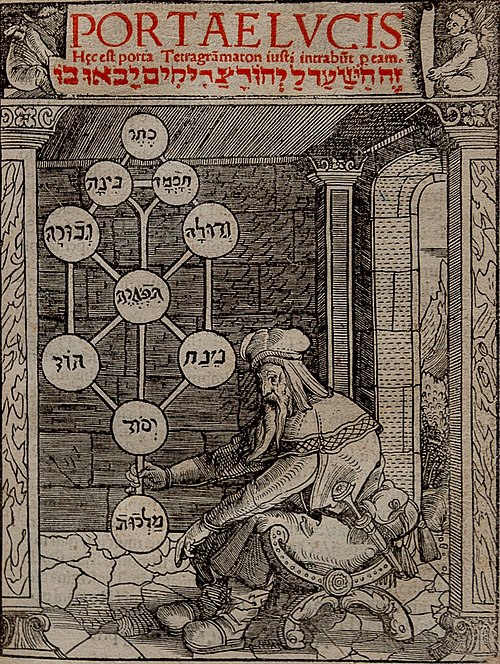
Portae Lucis (Gates of Light), 1516 — the woodcut frontispiece of Paulus Ricius's Latin translation of the Kabbalistic "Sha'are Orah" by Rabbi Joseph Gikatilla. Metatron is associated in Kabbalah with the highest Sefirot, through which the divine light descends into creation.
"The Lesser YHWH": The Greatest Angelic Title
The most theologically explosive title given to Metatron in 3 Enoch is "the Lesser YHWH" (YHWH ha-katan). This name — which appears to be drawn from the verse in Exodus 23:21 where God says of the guiding angel: "My name is in him" — indicates that Metatron bears the divine name within himself. He is not God; he is "lesser." But the divine name is in him, which means the divine authority and presence are transmitted through him in a uniquely comprehensive way.
This title caused enormous controversy in rabbinic literature. The Talmud (Sanhedrin 38b) preserves a story that has been connected with Metatron: the great sage Elisha ben Abuyah (known as "Aher," the Other) ascended to Paradise and, seeing Metatron seated on his throne, exclaimed: "Perhaps there are two divine powers!" — a heretical conclusion that was apparently the cause of his apostasy. Metatron, according to this tradition, was immediately punished with sixty fiery lashes to make clear that he was not a second divinity.
The story reveals the knife-edge that Metatron's theology walks: he is so close to the divine, so invested with divine authority and presence, that the untrained mystic might mistake him for a second God. This is both his greatest dignity and his greatest danger — the being who bridges the gap between God and creation so completely that the gap itself seems to vanish.
The Celestial Scribe
Among Metatron's most consistent roles across the mystical traditions is that of celestial scribe — the angel who records all of creation's acts in the great heavenly books. Every deed, every word, every thought of every soul that has ever lived is inscribed by Metatron's celestial stylus in books that are preserved before the divine presence.
This function connects Metatron directly to the Egyptian divine scribe Thoth and to the Hermetic tradition's concept of the Akashic Records — the cosmic memory in which all that has ever occurred is permanently inscribed. Metatron is, in a sense, the living library of creation: the intelligence in whom the entirety of cosmic history is preserved, available for the divine review that constitutes the ultimate judgment of all things.
In the tradition of Merkabah mysticism, Metatron also serves as the guide of the ascending mystic: he is the one who escorts the practitioner through the seven celestial palaces, explaining what is seen and granting access to levels of the heavenly court that would otherwise be impossible to reach. He is the supreme psychopomp of the mystical ascent — the Ariadne's thread that prevents the ascending soul from getting lost in the overwhelming brilliance of the celestial realms.

The Kabbalistic Tree of Life (Sefirot) — in some Kabbalistic systems, Metatron is identified as the Archangel of Keter, the Crown, the highest Sefirah, representing the first emanation of the divine into creation. Through him, the infinite light of Ein Sof takes its first step toward the finite world.
Metatron in Kabbalah: The Crown of the Tree
In Kabbalistic thought, the angelic orders are correlated with the ten Sefirot — the emanations of the divine that constitute the structure of all reality. Metatron's position in this system varies among different Kabbalistic schools, but the most exalted identification places him as the angelic intelligence corresponding to Keter (Crown) — the highest Sefirah, the point of first emanation from the absolute divine ground of Ein Sof (the Infinite).
If Keter is the first breath of divine self-expression into the void, Metatron is the angelic intelligence that inhabits and expresses that breath. He is the very frontier of the divine within the created order — the last thing on the side of creation, the first thing on the side of God. He is the threshold being par excellence: he does not belong to either side but constitutes the living boundary between them.
The Kabbalist Rabbi Joseph Gikatilla, in his influential 13th-century work Sha'are Orah (Gates of Light), describes the angelic prince associated with the divine Name and the divine Presence in terms that many scholars identify with Metatron: the supreme celestial intelligence through which all divine blessing flows into the lower worlds, and through which all prayers and acts of creation are returned upward to their source.
Metatron and Sandalphon: The Twin Pillars
The tradition identifies Sandalphon — another supreme angelic being (discussed in a separate article) — as Metatron's twin or earthly counterpart. Where Metatron is associated with the celestial realms above, Sandalphon stands below, weaving the prayers of humanity into garlands that he bears upward to the divine throne. Together, the two brothers (for they are both identified with transformed humans — Enoch for Metatron, Elijah for Sandalphon) constitute the two great axes of the divine-human connection: Metatron draws the divine downward into creation; Sandalphon draws human prayer upward toward the divine.
This twin structure suggests something profound about the nature of spiritual reality: the connection between the human and the divine is not one-directional but a perpetual exchange — a two-way flow of grace and aspiration, presence and longing, gift and response. Metatron and Sandalphon are the cosmic shuttles of this exchange, working together in a celestial cooperation that ensures no genuine prayer goes unheard and no genuine need goes unmet.
The Inner Metatron: The Transformed Human
For the esoteric and contemplative traditions, Metatron embodies one of the most radical and inspiring possibilities in all of spiritual thought: the human being can become angelic. Not by ceasing to be human, but by the complete transformation of the human into the fullest possible expression of what the divine intended when it formed a being in its own image.
Enoch "walked with God." This walking — this sustained, daily, faithful alignment with the divine — was itself the preparation for transformation. Metatron's origin in a human life reminds us that the angelic world is not a realm entirely separate from the human: it is the destination toward which genuinely realized human existence points. The mystic who truly walks with God walks toward Metatron — toward the condition of complete transparency to the divine, of total alignment between the created intelligence and its source.
This is not a path of self-abolition. Metatron retains his identity — he is Enoch, transformed, not erased. The transformation preserves what was genuinely Enoch while burning away everything that was not. This is the Metatronic vision of enlightenment: not the disappearance of the person into the divine, but the revelation of the divine in and as the fully realized person — the fire that burns the dross and reveals the gold that was always there.
— Lux Esoterica


Comentarios