Buddhist Thangkas: Sacred Painting from the Heart of Tibet
A thangka is not a painting in the Western sense. It is a sacred object — a window, in the Tibetan understanding, through which the deity represented becomes present in the space of practice. Painted on cotton or silk by artists who undergo years of specialized training, who consecrate their work through prayer and ritual at every stage, and who follow precise iconographic codes governing every aspect of the image (gesture, color, attribute, posture, proportion), a thangka is simultaneously a work of art, a meditation support, a doctrinal statement, and a vehicle of transmission. The great thangkas of Tibet — some of them requiring years to complete, gilded with real gold, the lapis lazuli blues ground from the finest stones — encode the entire cosmology and practice of Vajrayana Buddhism in a visual language comprehensible to practitioners across all cultural boundaries.
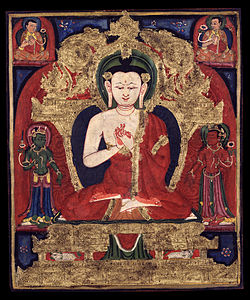
Buddha Vairocana — the White Buddha of the center and the dharmadhatu (realm of truth); one of the Five Dhyani Buddhas, his mudra is the Dharmachakra (turning the wheel of the teaching)

Dhyani Buddha Akshobhya — late 13th century, Honolulu Academy of Arts; the Blue Buddha of the East, his earth-touching mudra recalls the moment of the Buddha's enlightenment under the Bodhi tree

Buddha Ratnasambhava — Central Tibet, 1150-1225, LACMA; the Yellow Buddha of the South, associated with equanimity and the transmutation of pride into the wisdom of equality

Buddha Amitayus (Long Life) attended by bodhisattvas — 11th century, Metropolitan Museum; Amitayus is the longevity form of Amitabha, the Red Buddha of the West and the presiding deity of the Pure Land of Sukhavati

The One Hundred Jataka Tales — Tibet, 13th-14th century; the Jataka stories of the Buddha's previous lives encircle the central figure; in Tibetan thangkas, the narrative tradition and the meditative icon coexist in a single image

Vajrabhairava — c. 1740; the wrathful form of Manjushri, the bodhisattva of wisdom; with his buffalo head and multiple arms bearing the implements of transformation, he represents the fierce compassion that destroys delusion

Mahakala and the Dharma Protectors — the wrathful deities who guard the practice from obstacles; their terrifying appearance reflects not evil but the intensity of the energy required to cut through the deepest levels of ego-clinging

A Tibetan monk painting a thangka — photograph from the 1938 German Tibet Expedition; the artist's training begins with years of study in iconographic measurement (Tib: thig tshad) before a single brushstroke is applied to canvas

A thangka in progress — the preliminary sketch on prepared cotton canvas; every proportion is calculated according to the iconometric grids established centuries ago to ensure the deity's presence is correctly invoked

Temple festival and prayer wall, Tibet — the cultural context in which thangkas were created and used; the sacred images were part of a living practice environment, not objects of aesthetic contemplation


Comentarios