Mandalas: Sacred Geometry as a Map of the Cosmos and the Mind

Draw a circle. Place a point at its center. From that center, organize all the space within the circle according to a principle of sacred symmetry — concentric rings, radial axes, geometric forms nested within forms, each zone assigned a meaning, a color, a deity, a quality of consciousness. When you have finished, you will have done what human beings across half a dozen unconnected civilizations have done for three thousand years: you will have made a mandala.
The word comes from Sanskrit — mandala (मण्डल), meaning "circle" or "disk," though the concept it names is far richer than either translation suggests. A mandala is simultaneously a cosmological diagram (a map of the universe from its center outward), a psychological map (a diagram of consciousness in its various states and levels), a ritual object (a physical or visualized sacred space in which deities are invoked and spiritual practice is conducted), and a work of art (a geometric composition of extraordinary beauty that encodes, in its symmetry and proportion, a vision of the divine order underlying the apparent chaos of phenomena). In the traditions that have developed it most fully — Tibetan Vajrayana Buddhism and Hindu Tantra — the mandala is all of these simultaneously, each dimension inseparable from the others.
The mandala tradition in Buddhism developed from early Indian precedents into its fullest elaboration in the Vajrayana (Diamond Vehicle) Buddhism of Tibet, Nepal, and Japan — the esoteric branch of Buddhism in which elaborate ritual practices, visualization techniques, and the transmission of secret teachings from master to student are central. In Vajrayana, the mandala is not merely a devotional image but an operative spiritual technology: a structure that the practitioner learns to visualize internally, in complete detail, until the visualization becomes as vivid and stable as ordinary perception. The practitioner then enters the mandala — not physically, but through the disciplined power of imagination — and receives initiation from the deities that inhabit its zones. This practice of deity yoga — the meditative identification of the practitioner with a particular deity whose mandala they inhabit — is central to Vajrayana spirituality and represents one of the most sophisticated uses of visual imagination for spiritual transformation in any tradition.
The structure of the Buddhist mandala is rigorously determined by canonical texts called sadhanas (practice manuals) that specify every detail: the number of concentric circles and their meanings, the number of gates (always four, oriented to the four cardinal directions), the deity at the center and the deities of each zone, the colors assigned to each direction (white/east, yellow/south, red/west, green/north, blue/center — or, in some traditions, differently ordered), and the relationship of the whole to the doctrinal content of the tradition. The mandala as a whole represents the pure palace (vimana) of the central deity — the divine palace in which the awakened mind dwells, whose architecture is the architecture of enlightenment itself. To visualize the mandala is to visualize one's own mind in its enlightened form.
The greatest single mandala in the Tibetan Buddhist tradition — and one of the most complex ritual and cosmological systems in any religion — is the Kalachakra (Wheel of Time) mandala, associated with the Kalachakra Tantra, a text said to have been taught by the Buddha himself at the request of the King of Shambhala. The Kalachakra mandala has three concentric palaces stacked vertically, with 722 deities inhabiting its zones; its construction, in colored sand by teams of trained monks, takes weeks of meticulous work and concludes with the ritual dissolution of the completed mandala — the sand swept into a jar and poured into a river — as a teaching on the impermanence of all phenomena, even the most beautiful. The Kalachakra initiation, in which the Dalai Lama transmits the Kalachakra teaching to large public gatherings, is among the most attended Buddhist rituals in the world, drawing hundreds of thousands of participants.
In the Hindu tradition, the mandala's closest equivalent is the yantra — a geometric diagram, typically drawn or engraved on metal, used as a visual focus for meditation and ritual. The greatest of all yantras is the Sri Yantra (Sri Chakra), a diagram of nine interlocking triangles — four pointing upward (representing Shiva, the masculine principle) and five pointing downward (representing Shakti, the feminine principle) — generating from their intersections a pattern of forty-three smaller triangles, surrounded by two rings of lotus petals and a square enclosure with four gates. The Sri Yantra represents the entirety of the cosmos as the dynamic interplay of masculine and feminine divine principles, and its contemplation is understood to lead, through progressive stages of understanding, to the recognition of the non-dual ground that underlies and generates all apparent duality. The Sri Yantra and the Tibetan Buddhist mandala arrive at similar cosmological and psychological maps from different starting points — one through the devotional theology of Shaktism, the other through the philosophical analysis of mind in Madhyamaka and Yogachara Buddhism — and their structural resemblance has led scholars to explore the deep connections between Hindu Tantra and Vajrayana Buddhism.
The mandala entered the vocabulary of Western psychology through the work of Carl Gustav Jung, who encountered mandala imagery in the spontaneous drawings of his patients and in his own visionary experiences during the crisis years of 1913–1917, when he had broken with Freud and was undertaking what he later called his "confrontation with the unconscious." Jung observed that mandala imagery — circular, symmetrical, centered — tended to arise spontaneously in the dreams, drawings, and waking visions of individuals experiencing psychological crisis, and that the production of such imagery often seemed to correlate with a movement toward psychological integration. He theorized that the mandala was a natural symbol of the Self — the organizing center of the psyche, the totality of the personality both conscious and unconscious — and that its spontaneous appearance was the psyche's own attempt to restore order and center to a consciousness that had become fragmented or overwhelmed. Jung's interpretation, published in Psychology and the East (1978) and other works, introduced mandala imagery to a Western audience that had previously known it only as exotic Eastern decoration, and established the concept of the psychological mandala that has become a staple of art therapy and popular spirituality.
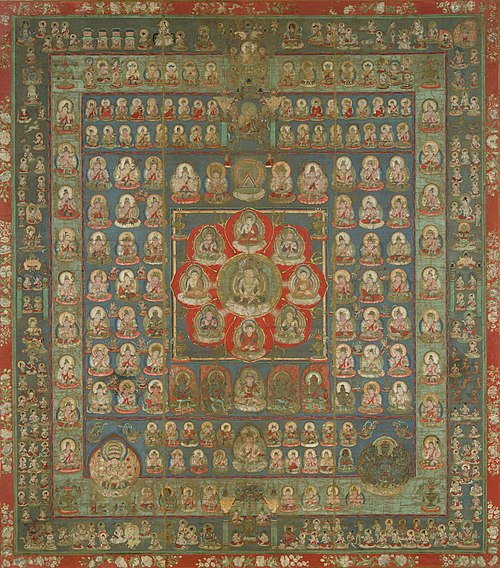
The Womb Realm Mandala (Taizokai Mandala) and the Diamond Realm Mandala (Kongokai Mandala) together constitute the Ryokai Mandala — the "Mandala of the Two Realms" — the doctrinal and ritual foundation of Japanese Shingon Buddhism, the esoteric school founded by Kukai (774–835 CE) after his studies in China. These two mandalas — one representing the potential of enlightenment inherent in all phenomena (the Womb Realm), the other representing the realized wisdom of enlightenment (the Diamond Realm) — were understood by Kukai as the two aspects of a single enlightened reality, and their contemplation in relationship to each other was the central meditative practice of Shingon. The Taizokai mandala's concentric zones of deities — from the central "Womb of the Great Compassion" outward through twelve zones to the outer guardians — are a complete map of the Mahayana Buddhist pantheon and of the structure of awakened mind.
Beyond Tibet and Japan, mandala-like structures appear in traditions across the world with a consistency that suggests either historical connection or something deeper in human consciousness. The rose windows of Gothic cathedrals — circular, divided into geometric sections, organized around a central light — have been analyzed as mandalas of Christian cosmological content. The Medicine Wheel of Plains Indian spiritual traditions is a circular cosmological diagram organized around the four directions. The Aztec Sun Stone is a mandala encoding the Mexica cosmological cycle. The labyrinth patterns of Chartres Cathedral, the geometric floor decorations of Islamic mosques, the geometric compositions of Navajo sand paintings: all share the fundamental mandala structure of circle, center, axis, and symmetrical order — suggesting that this may be one of the deepest and most universal archetypes of the sacred human imagination.
The making of a mandala is itself understood, in both Buddhist and Hindu traditions, as a spiritual act — a form of meditation in which the practitioner who constructs or visualizes the diagram enacts the ordering of consciousness around its divine center. The monk constructing a sand mandala grain by grain, holding the chak-pur (metal funnel) with total concentration for hours and days, is not merely making an image — he is performing the integration of mind, breath, and intention that the mandala represents. When the completed mandala is swept away, the dissolution is not destruction but teaching: the perfection of the center, once genuinely encountered, leaves a trace in the practitioner that no external dissolution can erase. The mandala exists, ultimately, not in sand or paint or stone, but in the clarity of mind that produced and inhabited it.
The images in this gallery bring together mandalas from multiple traditions: Tibetan Buddhist thangka mandalas in their full painted splendor; sand mandalas being constructed and dissolved; Hindu yantras in their geometric precision; Japanese Shingon realm mandalas; Jain cosmological diagrams; and the spontaneous mandala drawings that Jung documented from his patients and himself. Together they form a portrait of one of the human spirit's most persistent and universal attempts to make visible the invisible structure of the cosmos — and of the awakened mind that, at the center of the circle, perceives it.
 [Unavailable: ❌ https://upload.wikimedia.org/wikipedia/commons/thumb/b/bb/Vishnu_Mandala.jpg/500px-Vishnu_Mandala.jpg ❌]
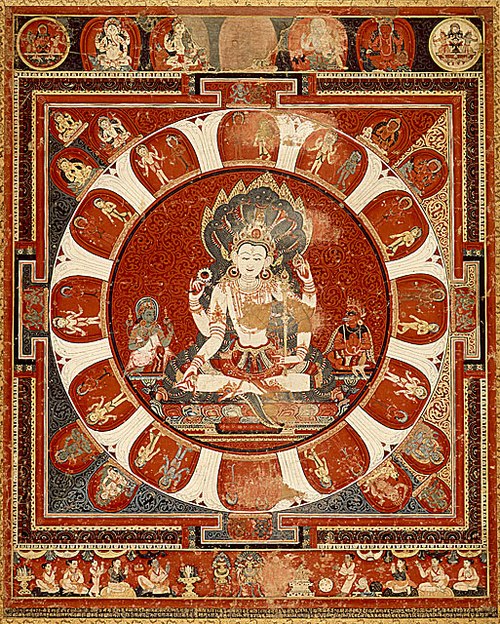
Vishnu Mandala — Hindu tradition; the god Vishnu at the center of a concentric geometric diagram surrounded by his divine attributes and associated deities; the Hindu mandala (which shades into the yantra tradition) organizes the divine pantheon into a hierarchical spatial diagram in which the central deity radiates outward through zones of diminishing divine intensity toward the boundary of the human world
 [Unavailable: ❌ https://upload.wikimedia.org/wikipedia/commons/thumb/a/a2/Taizokai.jpg/500px-Taizokai.jpg ❌]
Taizokai Mandala (Womb Realm Mandala) — Japanese Shingon Buddhism; one of the two great mandalas of the Ryokai (Two Realms) system foundational to Japanese esoteric Buddhism; the Womb Realm Mandala represents the potential of enlightenment inherent in all phenomena, organized in twelve concentric zones from the 'Womb of Great Compassion' at the center outward through the full Buddhist pantheon; the paired Diamond Realm mandala represents realized wisdom
 [Unavailable: ❌ https://upload.wikimedia.org/wikipedia/commons/thumb/a/a0/Vajravarahi_Mandala.jpg/500px-Vajravarahi_Mandala.jpg ❌]
Vajravarahi Mandala — Tibetan Buddhism; Vajravarahi (Thunderbolt Sow), a fierce tantric form of the dakini (female wisdom-energy), stands at the center of her pure palace; the four gates of the mandala, oriented to the cardinal directions and guarded by protective deities, mark the boundary between the ordinary world and the enlightened space of the central deity; to visualize this mandala is to visualize one's own mind in its most powerful liberated form
 [Unavailable: ❌ https://upload.wikimedia.org/wikipedia/commons/thumb/7/70/Mandala_of_the_Six_Chakravartins.JPG/500px-Mandala_of_the_Six_Chakravartins.JPG ❌]
Mandala of the Six Chakravartins — the chakravartin (wheel-turner) is the universal sovereign of Buddhist cosmology, the monarch whose just rule brings peace to all four continents; six chakravartins arranged in a mandala format represent the six realms of existence each governed by wisdom; the mandala as political and cosmological diagram encodes the Buddhist understanding of enlightened governance as a function of wisdom rather than power
 [Unavailable: ❌ https://upload.wikimedia.org/wikipedia/commons/thumb/6/60/Kalachakra_mandala_in_a_special_glass_pavilion.jpg/500px-Kalachakra_mandala_in_a_special_glass_pavilion.jpg ❌]
Kalachakra sand mandala — the Wheel of Time mandala, the most complex in Tibetan Buddhism, with 722 deities inhabiting three concentric palace levels; sand mandalas are constructed grain by grain by trained monks over days or weeks, then ritually dissolved — the sand swept away and poured into a river — as a teaching on impermanence; the Kalachakra initiation, transmitted by the Dalai Lama, draws hundreds of thousands of participants worldwide
 [Unavailable: ❌ https://upload.wikimedia.org/wikipedia/commons/thumb/f/fd/Buddha_mandala.jpg/500px-Buddha_mandala.jpg ❌]
Buddha mandala — Shakyamuni Buddha at the center surrounded by attendant bodhisattvas and protective deities; the pure palace (vimana) of the mandala represents the enlightened mind's natural environment — a space of perfect purity and clarity in which the qualities of awakening (compassion, wisdom, skillful means) are fully present; to meditate on the Buddha mandala is to recognize these qualities as one's own natural state
 [Unavailable: ❌ https://upload.wikimedia.org/wikipedia/commons/thumb/1/1c/Sankhitta_Sangheyani_Cosmography.jpg/500px-Sankhitta_Sangheyani_Cosmography.jpg ❌]
Sankhitta Sangheyani Cosmography — Jain cosmological diagram in mandala format; the Jain universe (loka) is organized in a precise vertical and horizontal structure that has been mapped in mandala-like diagrams since at least the medieval period; the Jain cosmological mandala encodes the three realms (heavens, human world, hells) and the progression of souls toward moksha (liberation) at the apex of the universe
 [Unavailable: ❌ https://upload.wikimedia.org/wikipedia/commons/thumb/9/9f/Mandala_Golden_Flower_Jung.JPG/500px-Mandala_Golden_Flower_Jung.JPG ❌]
Mandala — The Secret of the Golden Flower, Carl Jung's commentary edition; Jung encountered mandala imagery in the spontaneous drawings of patients in psychological crisis and in his own visions during 1913-1917; he theorized the mandala as a natural symbol of the Self — the organizing center of the psyche — and its spontaneous appearance as the psyche's attempt to restore order and wholeness; his 1929 collaboration with Richard Wilhelm on the Chinese Taoist text 'The Secret of the Golden Flower' brought this analysis to a broad audience
 [Unavailable: ❌ https://upload.wikimedia.org/wikipedia/commons/thumb/a/a7/Mahavra_1900_art.jpg/500px-Mahavra_1900_art.jpg ❌]
Mahavira — Jain manuscript painting, c. 1900; Mahavira, the twenty-fourth and final tirthankara (ford-maker) of the current cosmic cycle, is frequently depicted in mandala-like compositions surrounded by his divine assembly; the Jain tradition has one of the most elaborate cosmological systems of any religion, encoding in its mandalas and diagrams a universe of almost mathematical precision in which the liberation of consciousness from matter is mapped in geometric terms
 [Unavailable: ❌ https://upload.wikimedia.org/wikipedia/commons/thumb/0/09/Maitighar_Mandala.jpg/500px-Maitighar_Mandala.jpg ❌]
Maitighar Mandala — Kathmandu, Nepal; Nepal, at the cultural crossroads of Hindu and Buddhist civilization, has maintained one of the richest living mandala traditions in the world; the Newari Buddhist communities of the Kathmandu Valley produce thangka mandalas, yantra diagrams, and architectural mandalas (in the form of stupas and temple complexes) that continue a tradition unbroken since at least the medieval period and represent the living inheritance of the Indo-Tibetan Buddhist synthesis
Related Esoteric Inquiries:
- The Mandala: Sacred Circle, Map of the Cosmos, and Mirror of the Whole Self
- Mandalas: Sacred Circles as Maps of the Universe and the Self
- Sacred Geometry, Yantras, and Mandalas: Architecture of the Cosmos in Ancient and Contemporary Art
Lux Esoterica.
2026.


Comments