The Mandala: Sacred Circle, Map of the Cosmos, and Mirror of the Whole Self
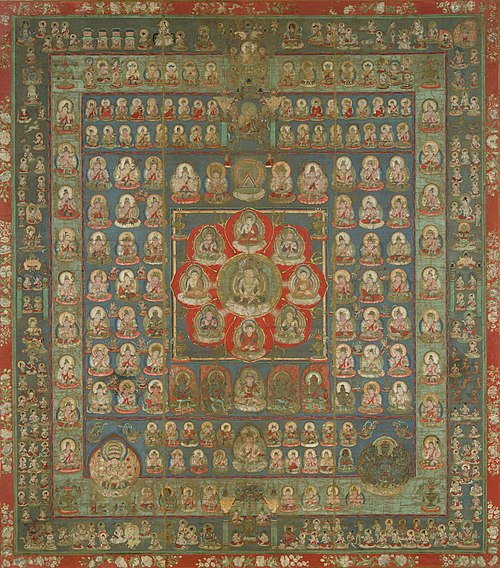
The Taizokai (Womb Realm Mandala), one of the two great mandalas of Japanese esoteric Buddhism — a complete cosmological map of awakened reality.
Draw a circle. Inside the circle, draw a square. Inside the square, draw another circle. Fill it with lotuses, palaces, deities, seed syllables. Repeat the pattern inward until it can go no smaller. Look at what you have made.
You have drawn the world.
This is the fundamental logic of the mandala — a Sanskrit word meaning "circle" or, more precisely, "that which contains the essence." For more than two thousand years, across Hinduism, Buddhism, and their many branches, the mandala has served simultaneously as a cosmological diagram, a meditation support, a ritual space, a tool of spiritual initiation, and — as Carl Jung would discover in the 20th century — a spontaneous expression of the psyche's own drive toward wholeness.
To look carefully at a mandala is to encounter one of the deepest convictions of the human spirit: that the universe has a center, that everything radiates from that center in ordered, meaningful patterns, and that the human being who can align with that center will find — there, in the midst of the circle — something like home.
What Is a Mandala?
In its most basic form, a mandala is a geometric diagram organized around a central point, typically circular in outline, with the interior space structured by concentric rings and cardinal directions. But this simple description barely captures the richness of the form. In practice, mandalas range from small geometric yantras (Hindu ritual diagrams) drawn in a few minutes on paper, to elaborate Tibetan thangka paintings that take months to complete, to vast architectural structures — temples and entire sacred cities — designed as three-dimensional mandalas to be inhabited and walked through.
The word mandala appears in the Rigveda (composed c. 1500–1200 BCE), where it simply means "circle" or "section" — the Rigveda itself is divided into ten mandalas (books). But the specialized meaning of mandala as a sacred cosmological diagram develops in the Tantric traditions of Hinduism and Buddhism, emerging clearly in the literature of the first millennium CE.
In Tantric cosmology, the mandala is not merely a representation of the cosmos — it is the cosmos, instantiated in miniature. Creating a mandala, inhabiting it through visualization or ritual, and meditating upon it are ways of participating in the cosmic order directly. The practitioner who enters the mandala does not merely contemplate the universe from outside; they are absorbed into it, identified with its center, recognized as one of its expressions.
The Hindu Yantra: Geometry as Divine Presence
In Hinduism, the mandala principle finds its most concentrated expression in the yantra — a geometric diagram that functions as the visual body of a deity. While the mandala tends to be complex, populated with multiple figures and narrative elements, the yantra is typically austere: pure geometry, number, and sacred syllables, stripped to the essential pattern.
The most celebrated of all Hindu yantras is the Sri Yantra (or Sri Chakra), the diagram of the goddess Lalita Tripura Sundari — "the Beautiful Lady of the Three Worlds." The Sri Yantra consists of nine interlocking triangles: four pointing upward (representing Shiva, masculine principle, consciousness) and five pointing downward (representing Shakti, feminine principle, energy), generating a field of forty-three smaller triangles arranged in concentric rings, surrounded by a lotus of eight petals, a lotus of sixteen petals, and three concentric squares with four gateways — the whole enclosed in a circle.
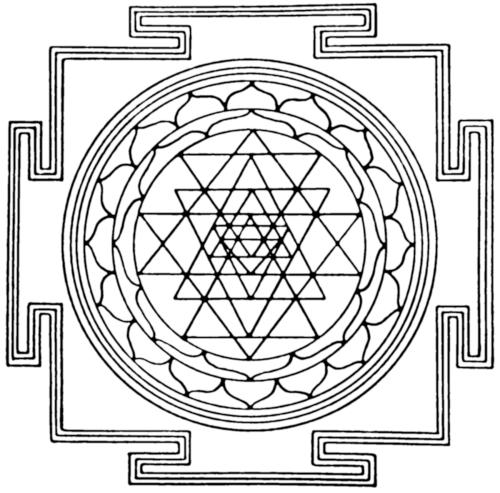
The Sri Yantra, the supreme **yantra** of Hindu tradition — nine interlocking triangles encoding the union of Shiva and Shakti, consciousness and energy.
The symbolism of the Sri Yantra is total: it encodes the creation, maintenance, and dissolution of the universe; the union of masculine and feminine principles; the descent of consciousness into matter and its return to its source. To meditate upon the Sri Yantra — to allow the gaze to rest at its center point, the bindu, the dimensionless point from which all creation emanates — is to reverse the process of cosmic manifestation and return the meditating mind to its unconditioned source.
In tantra, the yantra is not merely a symbol of the divine. Properly consecrated through ritual, the yantra is the divine. The deity is understood to take up residence in the geometric form; worshipping the yantra is worshipping the deity in their most essential, concentrated form.
Other major Hindu yantras include the Kali Yantra, the Durga Yantra, the Saraswati Yantra, and the Shiva Yantra, each encoding the energy of its corresponding deity through specific geometric configurations, colors, and seed syllables (bija mantras) placed at the diagram's key intersections.
Buddhist Mandalas: The Pure Land Made Visible
In Buddhism, the mandala tradition is equally rich, though its emphases differ. Buddhist mandalas are primarily maps of enlightened reality — diagrams of the world as it appears from the perspective of an awakened mind, populated by Buddhas and bodhisattvas rather than Hindu deities.
The earliest Buddhist mandalas appear in the Tantric texts of Vajrayana Buddhism, the "Diamond Vehicle" that developed in India between the 5th and 10th centuries CE and was transmitted to Tibet, Nepal, China, and Japan. These texts describe elaborate visualization practices in which the practitioner mentally constructs the mandala of a specific deity — a palace with four gates, four guardians, and the central Buddha or bodhisattva enthroned at the heart — and then identifies with that central figure. The meditation is both devotional and transformative: by inhabiting the perspective of an enlightened being, the practitioner gradually actualizes that enlightenment in themselves.
In Tibetan Buddhism, mandalas appear in two primary forms: painted (on thangka scroll paintings or temple walls) and sand (created from colored mineral powders). The painted mandala is a permanent meditation support; the sand mandala is a ritual object created for a specific ceremony and then ritually destroyed.
The Sand Mandala: Creation and Sacred Impermanence

A Chenrezig sand mandala created by Tibetan monks at the House of Commons, London, during the Dalai Lama's visit in 2008 — a masterwork of sacred art that was dissolved at the ceremony's close.
The creation of a Tibetan sand mandala is one of the most extraordinary acts of meditation in any spiritual tradition. Trained monks — who may have studied the specific mandala's iconography for years — work for days or weeks laying down millions of grains of colored sand with metal funnels, building the mandala from the center outward according to precise specifications transmitted in sacred texts. The work requires not only artistic skill but continuous ritual intention: each grain of sand is placed as an act of offering, concentration, and prayer.
When the mandala is complete — often a circular design several feet in diameter, with hundreds of figures, symbols, and geometric fields rendered in extraordinary detail — a ceremony is held. The monks chant. And then, deliberately and systematically, they sweep the sand into the center. The completed mandala is destroyed. The sand — now consecrated, infused with the energy of the deity — is gathered and poured into a nearby river or stream, carrying its blessings into the natural world.
The sand mandala is, among other things, a teaching on impermanence — the central Buddhist insight that all conditioned phenomena arise and pass away, and that clinging to their persistence is the root of suffering. The most beautiful thing, painstakingly created, is released. The act of creation is its own completion; the result does not need to persist to have been real and meaningful. This is not nihilism but liberation: the mandala was never meant to be owned.
In the Kalachakra (Wheel of Time) ritual — the most elaborate mandala ceremony in Tibetan Buddhism, performed publicly by the Dalai Lama at major international gatherings — the construction and dissolution of the Kalachakra mandala is understood to purify the environment and promote world peace. The mandala radiates its blessing not only to those present but to all beings.
Carl Jung and the Mandala as the Self
In 1918, Carl Jung — at a period of intense personal crisis, following his rupture with Freud and a harrowing encounter with his own unconscious material — began drawing small circular images in his notebooks each morning. He did not know what they were or why he was drawn to make them. Over time he recognized them as attempts to capture the state of his psyche: "I saw that everything, all the paths I had been following, all the steps I had taken, were leading back to a single point — namely to the mid-point. It became increasingly plain to me that the mandala is the center."
Jung went on to study mandalas from Eastern traditions and from the spontaneous drawings of his patients, who produced them — with no knowledge of Eastern art — in states of psychological crisis or transformation. His conclusion was that the mandala is a universal expression of what he called the Self — not the ego, the conscious personality, but the deeper organizing principle of the whole psyche, conscious and unconscious together.
In Jungian archetypes theory, the circle with the center is the fundamental symbol of the Self: wholeness, completeness, the integrated totality of the personality. When the mandala appears spontaneously — in a patient's drawing, a dream, a vision — it signals that the psyche's own drive toward integration and wholeness is active. It is, Jung wrote, "a window into eternity."
Jung collected mandalas from around the world and studied them in his Psychology and Alchemy and Mandala Symbolism (1972). He saw them in Celtic cross designs, in Gothic rose windows, in the arrangement of medieval cities around their central cathedrals, in Navajo sand paintings, in the ground plans of Asian temples. The mandala, he concluded, is not a cultural artifact but a psychic fact: a form that arises wherever human consciousness turns toward its own center.
The convergence of Jung's psychological insight with the ancient traditions of Hinduism and Buddhism is one of the most remarkable encounters between Eastern and Western thought in the 20th century. Both the Tantric monk visualizing the mandala of Chenrezig and the Zurich patient spontaneously drawing concentric circles are following, from entirely different angles, the same psychic logic: the movement toward the center, the integration of the whole, the recognition that the individual self and the cosmic order share a common structure.
Mandala Meditation: A Practical Guide
Working with mandalas as a meditation support requires no special training — only attention and a willingness to let the image work on you rather than analyzing it intellectually.
Gazing meditation (trataka): Place a mandala image at eye level, approximately a meter away. Soften your gaze without unfocusing it. Let the eye rest at the center point. Notice what happens in the periphery as the central point holds your attention. Hold this for ten to twenty minutes. The practice tends to produce a quality of inner stillness that ordinary concentration does not, because the mandala's structure mirrors the structure of consciousness itself — it does the work of centering the mind that the mind normally has to do for itself.
Visualization practice: Choose a mandala from a tradition you feel drawn to. Study its iconography enough to have a clear mental image. Close your eyes and attempt to build the mandala in your imagination, from the center outward. This is a form of creative meditation that trains both concentration and visual imagination. The difficulty of the practice is itself the point: sustaining a complex, detailed inner image requires a quality of attention that ordinary mental activity never achieves.
Drawing your own mandala: Take a compass and draw a circle on blank paper. Mark the center point. Begin to fill the circle with whatever patterns, images, colors, or symbols arise spontaneously. There are no rules. The only instruction is to keep returning to the center as you work, and to let the image grow from that center point outward. When finished, sit with the image. What did arise? What do you notice? The mandala you have drawn is a record of your psyche's state in that moment — a form of sacred geometry generated from within.
The Mandala as Universal Pattern
The mandala appears wherever human consciousness turns to the sacred: in the circular arrangement of Stonehenge, in the rose windows of Chartres and Notre-Dame, in the ground plan of Angkor Wat and Borobudur (themselves three-dimensional walking mandalas), in the compass rose of maritime navigation, in the labyrinth walked by medieval pilgrims on cathedral floors, in the circular medicine wheel of Plains Indian traditions, in the Celtic cross.
This universality is not coincidence. The mandala is not a cultural invention but a discovery — a recognition of something in the structure of consciousness and cosmos that everywhere the human mind, turning toward its own center, encounters the same form. The circle with the center. The whole organized around its essential point. The many arising from the one, and the one recognized in every part of the many.
The invitation of the mandala, across all traditions, is the same: find your center. Return to it often. And recognize that the center you find within yourself is, in the deepest sense, the center of everything.
— Lux Esoterica
Related Esoteric Inquiries:
- Mandalas: Sacred Geometry as a Map of the Cosmos and the Mind
- Mandalas: Sacred Circles as Maps of the Universe and the Self
- Sacred Geometry, Yantras, and Mandalas: Architecture of the Cosmos in Ancient and Contemporary Art
Lux Esoterica.
2026.


Comments