Esoteric Freemasonry: The Inner Temple, the Hidden Symbols, and the Great Work
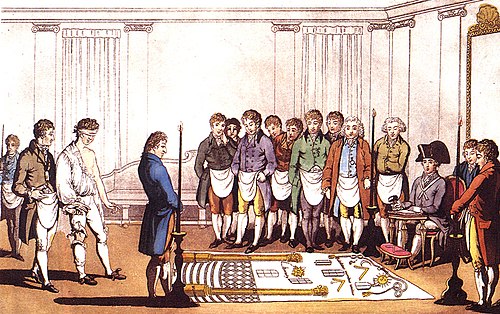
A Masonic initiation ritual depicted in an 18th-century engraving: the candidate, blindfolded and symbolically poor, is presented to the Lodge and its assembled brethren as the first step in the journey from darkness to light
Behind closed doors, in rooms hung with Masonic regalia -- the square and compass, the letter G, the columns of Solomon's Temple -- a blindfolded man kneels. A cord is placed around his neck. He is told he comes as one who is poor, destitute, and in darkness, seeking to be brought to light. The ceremony that follows is thousands of years old in its imagery, several centuries old in its present form, and still practiced tonight in thousands of lodges across the world.
Freemasonry is the world's oldest and largest fraternal organization still in active operation -- with an estimated four to six million members worldwide -- and also one of the most misunderstood. It has been accused of conspiracy, of Satanism, of controlling governments and banks. It has been celebrated as the spiritual matrix of the American founding and the French Enlightenment. Its actual nature is, as usual, more interesting than either its defenders or its critics tend to admit.
At its core, Freemasonry is a system of initiatic self-development using the symbolism of architecture and stonemasonry as a philosophical language. The lodge room is a map of the universe. The working tools of the operative mason become instruments of moral instruction. The legend of the ancient Temple of Solomon is a drama of death and resurrection, of lost knowledge and its recovery. Whether Freemasonry is a religion, a philosophy, a social club, or an esoteric school -- and it has elements of all four -- what is beyond dispute is that it preserves a set of symbols and rituals of remarkable antiquity and depth.
From Stone to Spirit: The Historical Origins
The history of Freemasonry as we know it begins in the early eighteenth century, but it draws on older roots. Medieval operative stonemasons -- the craftsmen who built the cathedrals of Europe -- organized themselves into guilds that regulated admission to the trade, protected the secrets of the craft (in particular the mathematical and geometric knowledge required for large-scale stone construction), and maintained systems of recognition (passwords, grips, signs) by which a traveling mason could identify himself to lodge members in a new city and be guaranteed work and shelter.
By the seventeenth century, these operative guilds had begun admitting "accepted" or "speculative" members -- gentlemen, scholars, and men of affairs who were not practicing stonemasons but were drawn to the guild's symbolic system. The earliest documented initiation of a speculative Mason is that of Elias Ashmole (1646) -- the English antiquary, astrologer, and alchemist who also helped found the Royal Society.
On June 24, 1717, representatives of four London lodges met at the Goose and Gridiron tavern and formed the Grand Lodge of England -- the first regular Masonic governing body. This date marks the beginning of what Masons call "Speculative Masonry" in its organized form. Within decades, Masonry had spread to Continental Europe, the American colonies, and beyond, attracting members from the intellectual and political elite of the Enlightenment.
The three foundational degrees of "Craft Masonry" -- Entered Apprentice, Fellowcraft, and Master Mason -- use the allegory of a building apprentice's progress from rough stone to polished craftsman, culminating in the legend of Hiram Abiff, the master architect of Solomon's Temple who is murdered by three craftsmen seeking to extort from him the "Master's Word" (the lost word of Freemasonry, representing the lost knowledge of antiquity), and whose resurrection becomes a symbol of the Mason's own spiritual journey.
The Symbols: A Language of Stone and Light

The square and compass with the letter G: the universal symbol of Freemasonry. The square teaches morality (acting "on the square" with all people); the compass teaches the limitation of desires within due bounds; G stands for Geometry -- and for God.
Masonic symbolism is a complete philosophical language. Every implement in the lodge room is a teaching device, encoding principles of moral and spiritual development in physical form.
The square -- the carpenter's square used to test right angles -- teaches the Mason to be "square" with all people: honest, fair, upright in every transaction. The compass -- used to draw circles, to measure and contain -- teaches the Mason to circumscribe desires and passions within due limits. Together, as the central emblem of Freemasonry, they represent the constant interaction of matter and spirit, of earth and heaven, of the practical and the ideal.
The rough ashlar (an unhewn stone) represents the uninitiated person, raw and unpolished. The perfect ashlar (a smoothly dressed stone) represents the Mason perfected through the work of the lodge. The candidate's task is to shape himself, using the tools of Masonic wisdom, into an instrument fit for use in the construction of the spiritual Temple.
The letter G at the center of the compass and square stands for Geometry -- the foundation of architecture, the science the ancient builders regarded as the master art -- and simultaneously for God, the Grand Geometrician of the Universe who constructed the cosmos according to mathematical law. The juxtaposition is not accidental: Masonic philosophy holds that the study of creation's order leads to the knowledge of the Creator.
The Temple of Solomon -- its two great pillars Boaz (strength) and Jachin (establishment), its three great lights (sun, moon, and Master of the Lodge), its levels and plans -- is the architectural template around which all Masonic ritual is organized. The Temple is both a historical reality and a cosmic symbol: it represents the universe built by divine wisdom, and the human soul that seeks to align itself with that wisdom.
The Esoteric Current: Kabbalah, Hermeticism, and the Higher Degrees
Eighteenth-century Continental Freemasonry became a vehicle for the full range of Western esoteric learning. French and German lodges developed elaborate "high degree" systems beyond the three Craft degrees, incorporating material from Kabbalah, Hermeticism, Rosicrucianism, Templarism, and Neoplatonism.
The Scottish Rite (properly the Ancient and Accepted Scottish Rite), which extends Masonry to thirty-three degrees, is the most widespread of these systems. Despite its name, it originated in France in the mid-eighteenth century. Its degrees address themes ranging from the construction and destruction of Solomon's Temple, through the Knights Templar and their suppression, to the Kabbalah and the recovery of the lost Word of God.
The Societas Rosicruciana in Anglia (SRIA), founded in 1866, restricted its membership to Master Masons and brought explicitly Rosicrucian symbolism and philosophy into the Masonic framework. It was from this body that the founders of the Hermetic Order of the Golden Dawn drew some of their membership and their intellectual framework -- linking Freemasonry, Rosicrucianism, and the modern Western magical tradition in a direct historical chain.
Albert Pike and the Philosophical Synthesis
The most ambitious single attempt to articulate the esoteric dimension of Freemasonry belongs to Albert Pike (1809-1891) -- lawyer, Confederate general, poet, and Sovereign Grand Commander of the Southern Jurisdiction of the Scottish Rite from 1859 to 1891.

Albert Pike (1809-1891), author of "Morals and Dogma" (1871) -- the most comprehensive philosophical exposition of Masonic symbolism ever written, drawing on Kabbalah, Gnosticism, Zoroastrianism, and Neoplatonism
Pike's Morals and Dogma of the Ancient and Accepted Scottish Rite of Freemasonry (1871) -- 861 dense pages presenting the philosophical substance behind each of the thirty-two active degrees -- remains the most comprehensive esoteric treatment of Masonic symbolism ever written. Pike drew on every tradition of Western esotericism: the Zohar, the Chaldean Oracles, the Orphic mysteries, Hermetic philosophy, Gnosticism, and Neoplatonism, synthesizing them through the lens of Masonic allegory.
His famous -- and persistently misquoted -- passage about Lucifer as the "Light-Bearer" (from the Latin lux, light) has been the source of a century of anti-Masonic accusation. In context, Pike was describing the ancient Zoroastrian concept of light as the principle of divine truth, drawing on the same Lucifer-as-morning-star imagery that appears in Isaiah 14:12 and 2 Peter 1:19 -- not endorsing diabolism. The misrepresentation was largely the work of the French satirist Leo Taxil, whose 1885-1897 hoax claimed (falsely) that Pike led a Satanic inner circle of Freemasonry.
Famous Masons: Philosophy, Revolution, and Art

A Freemason explaining Masonic symbols to visitors, from a 19th-century illustrated publication on lodge customs and their philosophical meanings
The lodge rolls of eighteenth-century Freemasonry read as a who's who of the Enlightenment. Wolfgang Amadeus Mozart -- initiated in Vienna in 1784 -- composed music for Masonic ceremonies and embedded Masonic symbolism throughout The Magic Flute (1791), whose plot follows an initiation journey from darkness to light through the trials of earth, air, fire, and water. Joseph Haydn was a Mason. Johann Wolfgang von Goethe was initiated in 1780 and remained a Mason for life.
Among the founding fathers of the United States, Masonry was ubiquitous. George Washington was a Worshipful Master of his Lodge in Alexandria, Virginia. Benjamin Franklin was a Grand Master of Pennsylvania and later of the Lodge des Neuf Soeurs in Paris. John Hancock, Paul Revere, and the majority of the signers of the Declaration of Independence were Masons. The eye of Providence on the Great Seal of the United States -- later placed on the dollar bill -- shares iconography with Masonic lodge symbolism (though its direct origin is disputed by historians).
In France, Masonic lodges provided the intellectual crucible in which the ideas of the Revolution -- liberty, equality, fraternity -- were discussed and refined before they became political program. Voltaire was initiated weeks before his death in 1778. The relationship between Masonry and the Enlightenment is one of the central stories of Western intellectual history.
The Inner Meaning: Building the Temple Within
The medieval cathedral builders, working with stone and mathematics to give physical form to the mind of God, understood their work as prayer in three dimensions. The completed cathedral was not merely a building -- it was a theological argument made visible, a map of the cosmos and of the soul's relationship to its source.
Masonic philosophy inherits this understanding and turns it inward. The Temple being built is not a structure of stone. It is the human being: polished by experience, shaped by self-knowledge, fitted by moral discipline to take its place in the larger edifice of creation.
There is a persistent legend that somewhere within Freemasonry there is a supreme secret -- a Word, a Symbol, a knowledge -- that is revealed only at the highest degrees and that transforms those who receive it. The truth, which any senior Mason will eventually confirm, is both simpler and more demanding: the secret is that there is no secret. The transformation is the work itself. The Word is not spoken -- it is lived, degree by degree, choice by choice, in the daily encounter with the rough ashlar of one's own unfinished character.
The Stone that the builders rejected became the cornerstone. The work of building -- difficult, slow, never quite complete -- is the point. The Temple is never finished, because the work of becoming is never finished. And that is not a failure. It is the deepest teaching the Craft has to offer.
- Lux Esoterica


Comentarios