Michael Maier and the Atalanta Fugiens (Emblem 21): The Circle, the Square, and the Stone
The Instruction That Cannot Be Misread
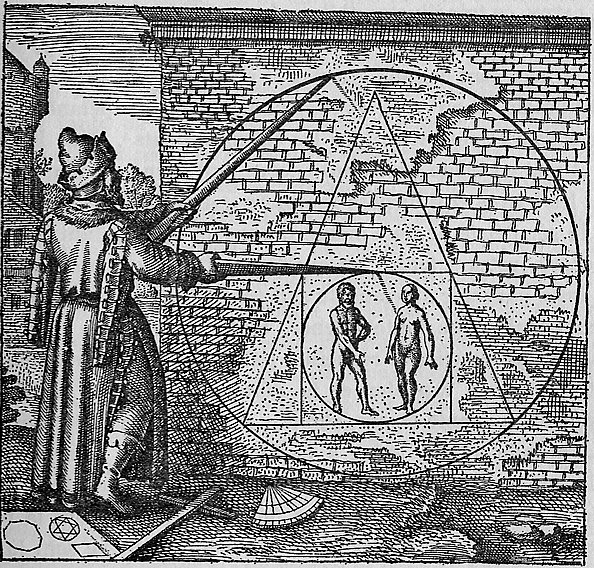
The twenty-first emblem of Michael Maier's Atalanta Fugiens (Frankfurt, 1617) carries what is perhaps the most geometrically precise—and philosophically vertiginous—instruction ever committed to the alchemical canon. Fac ex mare et foemina circulum, inde quadrangulum, hinc triangulum, fac circulum et habebis lapidem philosophorum. "Make of man and woman a circle; from this, a square; from this, a triangle; make a circle, and you will have the Philosopher's Stone." The sentence is short. Its economy is devastating. In five gestures—each one a figure a child could draw—Maier encrypts the whole grammar of the Opus Magnum, the Great Work of transmutation that the Western alchemical tradition spent two millennia attempting to articulate.
This is not metaphor. Or rather: it is metaphor operating at a level where the distinction between metaphor and literal instruction collapses entirely.
Michael Maier and the Architecture of the Work
Born in Rendsburg in 1568, Michael Maier was physician to Rudolf II of Prague—that most alchemically obsessed of all the Habsburg emperors—and later a wanderer through the courts of Protestant Europe, seeking, always, the company of those who understood the Art. The Atalanta Fugiens is his masterwork. Fifty emblems, each composed of three parts: an engraved copper plate, a Latin epigram, and a three-voice musical fugue in which a soprano cantus firmus pursues an alto dux while the bass provides its harmonic anchor. The book is simultaneously a treatise on alchemy, a collection of Renaissance engravings, and a musical composition designed to be heard, not merely read. To engage it only with the eyes is to perceive it as a torso without limbs.
Emblem 21 occupies a pivotal position. It stands at the threshold between the emblems of separation and purification—the nigredo and the first stages of the albedo—and the emblems of multiplication and projection that follow. It is the hinge. And hinges, as every smith knows, must bear the full weight of what swings upon them.
The Man and the Woman: Prima Materia in Its Divided State
The first term of the instruction is the pair. Ex mare et foemina—from man and woman. Not from gold and silver alone, nor from sulphur and mercury alone, though these symbolic couples are implied. The man and woman of the emblem's copperplate stand naked, side by side, within the geometer's workshop: embodied dualities awaiting their reunification. They are the Sol and the Luna of the alchemical sky. The King in his golden crown and the Queen in her silver mantle. Active principle and receptive principle. Fire and water. The coagula and the solve caught in a moment of perfect, poised opposition.
The tradition called this pair the Rebis—from res bina, the double thing. Before the Great Work can proceed, the philosopher must recognise the Rebis not as two separate substances but as two poles of a single continuum. The man is not separate from the woman any more than flame is separate from the heat it produces. Sundering them was the original wound. Reuniting them is the Art.
The First Circle: The Seal of the Coniunctio
Fac circulum. Make a circle. The instruction seems trivial. It is not. The circle is the most ancient of sacred forms: the figure without beginning and without end, the emblem of the One before differentiation, of Eternity before it consented to put on the garment of Time. In the Neoplatonic vocabulary that permeates Maier's thought, the circle is the Monad—Pythagoras's supreme unity, from which the many proceed and to which the many, in the fullness of the cycle, return.
To make a circle from the man and the woman is to perform the Coniunctio: the sacred marriage, the alchemical wedding, that moment of absolute fusion in which the two principles lose their separate identities and become a third thing that is neither one nor the other and yet contains both. This is what Paracelsus meant by the Mercurius Philosophorum—not the metal quicksilver, but the living medium, the third term that reconciles all opposites. The state that the Hermetic texts name Henosis: union with the One.
The circle is drawn around them. They dissolve into it. From two, one is born.
The Square: The Kingdom of the Four
Inde quadrangulum. From this, a square. Now the geometry grows more complex, and the philosophical demand more exacting. The circle, the emblem of undifferentiated unity, must be squared: translated into the fourfold articulation of the manifest world. Four elements—fire, water, earth, air. Four humours: choler, phlegm, melancholy, blood. Four seasons, four cardinal directions, four letters of the Tetragrammaton. The square is the signature of manifestation, the mark that spirit leaves when it descends into the arena of physical existence and consents to wear the garment of multiplicity.
This moment corresponds to the deepest phase of the nigredo, when the prima materia is most thoroughly dispersed, most thoroughly subjected to the tyranny of the particular. But there is no tyranny in Maier's square. The square is not a prison. It is a foundation. Nothing enduring can be built upon a circle alone; everything lasting is built upon a square. The geometer's hand tracing these angles is the hand of the architect of the cosmos, laying the cornerstone of the Temple of Solomon, driving the first stake into the ground of the eternal plan.
The four corners of the square are not walls closing in. They are four gates. Each gate faces a different wind.
The Triangle: The Tria Prima and the Breath of Three
Hinc triangulum. From this, a triangle. The square yields to the triangle as the fourfold yields to the threefold—as the four visible elements yield to the three invisible principles that Paracelsus, in one of the most consequential acts of alchemical revision, identified as the constitutive grammar of all matter: Sulphur (the principle of combustion, of soul, of luminous aspiration), Mercury (the principle of volatility, of mind, of the fugitive and the transforming), and Salt (the principle of fixity, of body, of the enduring form). The triangle is their emblem and their dwelling. Its three vertices mark the three modes of being through which the Philosopher's Stone must pass before it achieves its final incandescence.
The triangle is also, of course, the emblem of the Trinity in the Christian symbolism that permeates Maier's cultural world, and Maier—writing in the shadow of the Reformation, navigating with enormous delicacy between confessional antagonisms—knew precisely what weight that shape carried. The Sulphur is the Father: the primal fire, the generative act. The Mercury is the Son: the mediating Word, the Logos that descends to make the Father knowable. The Salt is the Spirit: the breath that preserves and quickens what fire and word together have brought into being. To inscribe the triangle is to invoke the three names of the One.
Three is not less than four. It is more. The Trinity does not reduce; it concentrates. What was dispersed across four quarters is now held in the sharp, luminous blade of a single form.
The Final Circle: The Stone Returned to Itself
Fac circulum. Make a circle. Again. The instruction repeats—but it does not mean the same thing twice. The first circle was the seed: the coniunctio that fused the masculine and feminine principles into their initial unity. This second circle is the fruit: the fully ripened Philosopher's Stone, the lapis philosophorum, the quinta essentia extracted from the four elements and three principles by the long, patient, and often agonising labour of the Art.
The circularity is not redundancy. It is the emblem of the Ouroboros, the serpent devouring its own tail: the Great Work returns to where it began, but the return is not repetition—it is completion. The stone that emerges from the final circle is not the prima materia that entered the first. It is the prima materia that has become conscious of itself. Gold that knows it is gold. Fire that has learned to be its own fuel. The pilgrim who departed from Jerusalem and has returned to it—but who is no longer the same pilgrim who left.
The Stone does not arrive from outside. It is disclosed from within. This is the secret that Emblem 21 conceals in plain sight: the geometric figures are not instructions for an external laboratory procedure. They are a map of an interior country.
The Squaring of the Circle: The Sacred Impossibility
Ancient geometers established with rigorous certainty that the squaring of the circle—the construction of a square whose area precisely equals that of a given circle, using only compass and unmarked straightedge—is, by the iron logic of transcendental numbers, impossible. The ratio of circumference to diameter is pi, an irrational and transcendental quantity, and no finite succession of rational steps can exhaust it. The alchemists knew this. They invoked the quadratura circuli precisely because it named the impossible as their destination.
The Philosopher's Stone is impossible. Every laboratory in every century has confirmed this. Every laboratory has pursued it regardless. This is not contradiction; it is the alchemical definition of the sacred: that which is worth pursuing because it cannot be reached by ordinary means, by the ordinary mind, by the ordinary will. The geometer in the emblem's copper plate does not look up from his compass to ask whether the task is possible. He draws. He does not demand from the cosmos a certificate of feasibility. He asks only whether his hand is worthy of the instrument it holds.
The sacred impossibility is the point. If the Stone could be made easily, it would not be the Stone.
The Fugue Behind the Emblem
Every emblem in the Atalanta Fugiens is accompanied by a three-voice musical fugue, composed by Maier himself. The twenty-first is no exception. The soprano traces the cantus firmus—the ancient, unchanging melody—while the alto pursues it at a measured interval, forever chasing, never fully overtaking. The bass holds the harmonic ground beneath them both: patient, immovable, the Salt of the musical body. This is not incidental ornament. The fugue is the emblem, rendered in the language of sound rather than image and line. The three voices are the Tria Prima—Sulphur pursuing Mercury while Salt sustains both—locked in the same geometric dance that the copper plate renders in visible space.
To hear the fugue while contemplating the image is to begin to understand what Maier meant by the Great Work as a total art: one that cannot be reduced to chemistry, or philosophy, or music, or iconography alone, but only exists in the trembling space where all four meet. He was composing not a book but an initiation.
Legacy and the Living Emblem
The influence of the twenty-first emblem on subsequent alchemical and occult thought was vast and largely unremarked. The operative Freemasons drew on its geometric vocabulary when they encoded the compass and square as emblems of the spiritual craft. The Rosicrucian manifestos of the early seventeenth century breathed its air. Carl Gustav Jung devoted sustained meditation to this very emblem in Psychology and Alchemy (1944), arguing that the circle-square-triangle sequence encodes not a chemical recipe but the individuation process—the psychological opus of becoming a whole human being, of making the Self from the raw material of the unconscious.
In the twentieth century, the emblem resurfaced in the work of Fulcanelli, René Schwaller de Lubicz, and the meticulous scholarship of Adam McLean. It keeps resurfacing. It will continue to do so.
Because the instruction has not yet been completed. Somewhere, in some interior country, a geometer still stands with compass raised. The circle is being drawn around a man and a woman who have only just consented to dissolve. The stone has not yet been made—and so the emblem remains alive, addressed to the one who reads it now, as it was addressed to every reader who opened Maier's Frankfurt quarto and found this page waiting for them in the middle of the book, like a door set into a wall that has no other feature, with a lock that has no keyhole, and a handle that turns only from the inside.
Lux Esoterica.
2026.


Comentarios