Rosicrucian and Hermetic Emblems: The Secret Symbols of the 17th Century
In 1614, an anonymous pamphlet titled Fama Fraternitatis appeared in Germany, announcing the existence of a secret brotherhood of enlightened scholars — the Brotherhood of the Rosy Cross — founded by the legendary Christian Rosenkreuz, who had spent years studying with Eastern sages before bringing their wisdom to Europe. Two more manifestos followed (Confessio Fraternitatis in 1615 and Chymical Wedding of Christian Rosenkreutz in 1616). Europe's intellectual community was electrified. Hundreds of scholars and seekers publicly applied for membership. The Brotherhood, if it had ever existed in literal form, did not respond. But the Rosicrucian movement the manifestos catalyzed — a synthesis of Hermeticism, alchemy, Kabbalah, and Paracelsian natural philosophy — became one of the most significant intellectual currents of the 17th century, influencing Leibniz, Newton, Descartes, and the founders of the Royal Society. Its visual tradition — embodied in the emblem books of Michael Maier, the cosmological diagrams of Robert Fludd, and the symbolic architecture of the Quinta da Regaleira — constitutes the richest visual synthesis of European esoteric thought ever produced.
 [Unavailable: ❌ https://upload.wikimedia.org/wikipedia/commons/thumb/9/94/Fama_Fraternitatis_Rosae_Crucis_%28page_1%29.jpg/250px-Fama_Fraternitatis_Rosae_Crucis_%28page_1%29.jpg ❌]
Fama Fraternitatis (1614) — the first Rosicrucian manifesto, published anonymously in Kassel; its opening announcement of a secret brotherhood in possession of a universal reformation of knowledge sent a shockwave through European intellectual circles; no author claimed it for over a century; modern scholarship attributes it primarily to Johann Valentin Andreae
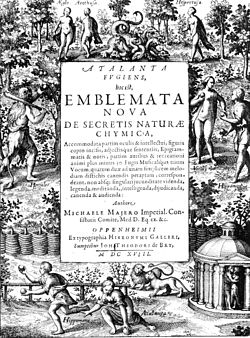 [Unavailable: ❌ https://upload.wikimedia.org/wikipedia/commons/thumb/e/e1/Michael_Maier_Atalanta_Fugiens.jpeg/250px-Michael_Maier_Atalanta_Fugiens.jpeg ❌]
Atalanta Fugiens title page, Michael Maier (1617) — the 'Fleeing Atalanta,' Maier's multimedia emblem book comprising 50 alchemical emblems, each with an engraving, an epigram, a prose discourse, and a musical fugue; the book encodes alchemical philosophy in multiple simultaneous media, making it the most ambitious synthesis of word, image, and music in the Western emblem tradition
 [Unavailable: ❌ https://upload.wikimedia.org/wikipedia/commons/thumb/6/68/Michael_Maier_Atalanta_Fugiens_Emblem_39.jpeg/250px-Michael_Maier_Atalanta_Fugiens_Emblem_39.jpeg ❌]
Atalanta Fugiens Emblem 39: The Sphinx — Maier's reinterpretation of the Oedipal riddle ('What walks on four legs in the morning, two at noon, and three in the evening?') as an alchemical teaching; the answer (man, in the stages of life) encodes the alchemical process of transformation through nigredo (infancy), albedo (maturity), and citrinitas (old age)
 [Unavailable: ❌ https://upload.wikimedia.org/wikipedia/commons/thumb/2/27/Templeofrosycross_highres.png/250px-Templeofrosycross_highres.png ❌]
Temple of the Rosy Cross (1618) — an engraving depicting the ideal Rosicrucian institution, a college of wisdom where theology, philosophy, mathematics, and medicine are unified in a single educational program; the image encodes the Rosicrucian vision of a reformed civilization in which the separation of science and spirituality has been healed
 [Unavailable: ❌ https://upload.wikimedia.org/wikipedia/commons/thumb/0/07/HermesTrismegistusCaucHighRes.jpg/250px-HermesTrismegistusCaucHighRes.jpg ❌]
Hermes Trismegistus — the legendary 'thrice-great Hermes,' the syncretic figure combining the Greek Hermes, the Egyptian Thoth, and the ancient sage who wrote the Hermetic corpus; the Rosicrucian movement understood itself as the inheritor of the Hermetic tradition transmitted through Egypt, Arabia, and Renaissance Florence
 [Unavailable: ❌ https://upload.wikimedia.org/wikipedia/commons/thumb/a/a2/Rose_Cross.png/250px-Rose_Cross.png ❌]
The Rosy Cross — the central symbol of Rosicrucianism: a cross (representing the body, the four elements, the crucifixion) upon which grows a rose (representing the soul, the quintessence, the resurrection); in alchemical terms, the cross is the matter and the rose is the spirit that transforms it; in the Golden Dawn system, each petal of the 22-petaled rose corresponds to a letter of the Hebrew alphabet and a path on the Tree of Life
 [Unavailable: ❌ https://upload.wikimedia.org/wikipedia/commons/thumb/b/b0/Rosicrucian_Concept_of_the_Tree_of_Pansophia.jpg/250px-Rosicrucian_Concept_of_the_Tree_of_Pansophia.jpg ❌]
Tree of Pansophia — the Rosicrucian 'Tree of All Wisdom,' mapping the branches of knowledge onto a living tree whose roots are in divine revelation and whose fruits are the sciences; the image encodes the Rosicrucian program of reunifying theology and natural philosophy — the healing of the split between faith and reason that had divided European thought since the Reformation
 [Unavailable: ❌ https://upload.wikimedia.org/wikipedia/commons/thumb/3/3c/Palacio_da_Regaleira%2C_Sintra%2C_Portugal.JPG/330px-Palacio_da_Regaleira%2C_Sintra%2C_Portugal.JPG ❌]
Well of Initiation, Quinta da Regaleira, Sintra, Portugal (1904-1910) — built by the eccentric millionaire António Carvalho Monteiro with Masonic and Rosicrucian symbolism throughout; the initiatory well descends through nine levels (the nine circles of Dante's inferno) to an underground network of tunnels leading to the palace gardens; a living monument to the esoteric imagination of the fin de siècle
 [Unavailable: ❌ https://upload.wikimedia.org/wikipedia/commons/thumb/e/e2/Tree_of_Life_Fludd.jpg/250px-Tree_of_Life_Fludd.jpg ❌]
Robert Fludd's cosmic diagram — the English physician and Rosicrucian sympathizer who produced the most elaborately illustrated esoteric cosmology of the early 17th century; Fludd's diagrams integrate Kabbalistic, Hermetic, and musical principles into images of the cosmos as a harmonically organized hierarchy from matter to spirit
Related Esoteric Inquiries:
- Rosicrucianism: The Invisible Brotherhood and the Secret of the Rose and Cross
- Manly P. Hall and the Secret Teachings of All Ages: The Rosicrucian Section
- The Alchemical Multimedia of Michael Maier: Atalanta Fugiens and the Squaring of the Circle
Lux Esoterica.
2026.


Comments