The Alchemical Multimedia of Michael Maier: Atalanta Fugiens and the Squaring of the Circle
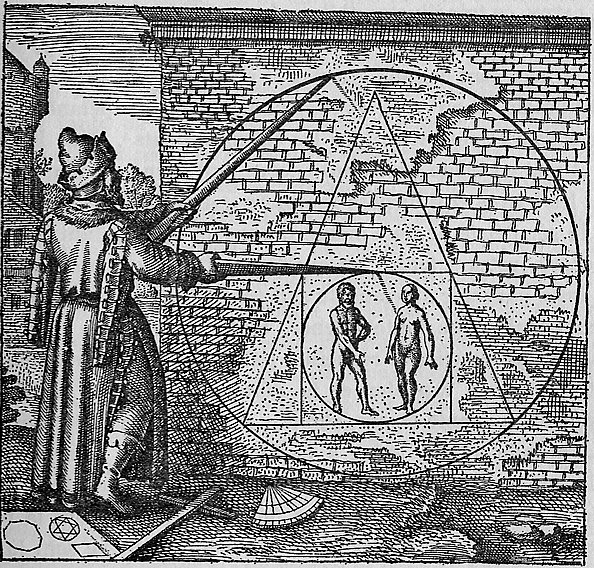
Emblem 21: The philosophical 'Squaring of the Circle'—a geometric map of the soul's completion.
The Multimedia Alchemist: Introduction to Michael Maier
In the early 17th century, the court of Holy Roman Emperor Rudolf II in Prague was a fever dream of occult speculation, alchemical laboratories, and artistic genius. At the center of this "Invisible College" stood Michael Maier (1568–1622), a physician, counselor, and staunch defender of the Rosicrucian ideals. Maier was not merely a chemist; he was a pioneer of what we might today call "multimedia spirituality."
His magnum opus, Atalanta Fugiens (1617), is a breathtaking synthesis of image, poetry, and music. It consists of 50 emblems, each accompanied by an alchemical fugue. Maier understood that the Great Work could not be grasped by the intellect alone; it required the engagement of all the senses. He was the architect of a resonant reality, where the vibration of sound and the geometry of light combined to catalyze the transformation of the practitioner.
Emblem 21: The Geometry of the Great Work
The image provided above, Emblem 21, is perhaps the most iconic in the history of Western alchemy. Its epigram reads: "Make a circle out of the man and the woman, then a square, then a triangle; make a circle and you will have the Philosopher's Stone."
This is a technical manual for the Squaring of the Circle. Esoterically, the circle represents the Absolute, the Infinite, and the Divine. The square represents the material world, the four elements, and the limitations of 3D reality. To "square the circle" is to find the bridge between the finite and the infinite. It is the process of bringing the "Light of the Stars" (Neptune) into the "Structure of the Earth" (Saturn).
Mythoalchemy: The Flight of Mercury
Maier used the Greek myth of Atalanta—the swift-footed huntress who could only be won in a race—as an allegory for Mercury. In alchemy, Mercury is the "volatile spirit," the elusive spark of consciousness that is always fleeing from the seeker. Hippomenes, who pursues her with the golden apples of Aphrodite, represents Sulphur, the fixed principle that seeks to ground and "fix" the volatile.
In Maier's vision, the "apples" are not mere fruit; they are the fruits of the Tree of Life. They are the symbols of Salt or the physical matrix. The entire Atalanta Fugiens is a map of this pursuit—a chase through the forest of the unconscious to capture the lightning of the spirit and house it in the vessel of the soul.
The Rosicrucian Resonance
Maier’s work was deeply intertwined with the early Rosicrucian Manifestos. He saw alchemy as a means of social and spiritual reformation. For Maier, the purification of metals was a mirror for the purification of the state and the individual. In the "Prague Spring" of the occult, he believed that a humanity tuned to the harmonic proportions of the universe would naturally create a just and enlightened society.
As we look toward the shifts of the late 2020s, Maier reminds us that true progress is never purely technological. It is alchemical. It requires the integration of the male (action) and the female (reception), the triangle (spirit), and the square (matter) into the unified circle of the Self.
Conclusion: Singing the Stone
If you have the chance to listen to the musical canons of Atalanta Fugiens, do so while contemplating Emblem 21. You will find that Maier was attempting to "architect" a state of consciousness where the boundaries of the self dissolve. He was a Forgotten Master who knew that the universe is a symphony, and we are the instruments.
The circle is waiting to be drawn. Are you ready to pick up the compass?
Lux Esoterica.
2026.


Comentarios