Tantra: The Sacred Science of Union

Vajrayogini — the fierce tantric deity of transformation and liberation. In Buddhist Tantra, wisdom-energy takes form as the divine feminine in her most radical and liberating aspect.
Of all the words that travel between cultures and arrive disfigured beyond recognition, Tantra may be the greatest casualty. In the West, it has been almost entirely reduced to its most peripheral aspect — exotic sexuality — while its vast philosophical architecture, its rigorous meditative practices, its metaphysics of radical non-dualism, and its irreplaceable contribution to humanity's understanding of consciousness have been quietly ignored. This post is an attempt to restore the full picture.
Tantra is one of the most profound spiritual systems humanity has ever developed. It is also one of the most misunderstood. To encounter it honestly is to discover a path that does not flee from the world but embraces it completely — a path that insists that the sacred and the sensory are not opposites, that the body is not the enemy of liberation but its very vehicle, and that the universe itself is the living body of the divine.
What Tantra Actually Is
The word tantra comes from Sanskrit roots: tan (to expand, to weave) and tra (tool, instrument). A tantra is literally "a loom for weaving expanded consciousness." The Tantras are a body of texts — some Hindu, some Buddhist, some Jain — that began appearing in India roughly between the 5th and 10th centuries CE, though their roots reach back much further into Shaiva and Shakta traditions.
What distinguishes Tantra from earlier forms of Indian spirituality is a single, revolutionary shift in perspective: the world is not an obstacle to liberation. It is the means of liberation.
Classical Vedantic and early Buddhist teachings tended to frame the spiritual path as a process of subtraction — withdrawing from sensory experience, renouncing desire, transcending the body and its appetites. Tantra said: no. The energy that appears as desire, sensation, form, and embodiment is not something to be suppressed. It is Shakti — divine power itself — moving through you. The question is not how to escape it but how to transform it.
This is Tantra's central alchemical insight: the fires that burn most intensely in ordinary human experience — sexuality, anger, fear, grief, ecstasy — contain the most concentrated spiritual energy. The untrained person is consumed by these fires. The tantric practitioner learns to ride them.
Shiva and Shakti: The Cosmic Polarity
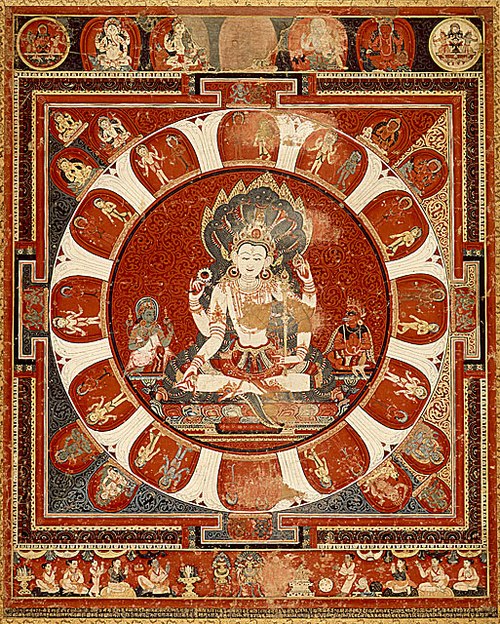
A Hindu mandala — the geometric expression of cosmic order and the union of opposites at the heart of tantric cosmology.
At the metaphysical core of Hindu Tantra lies the relationship between Shiva and Shakti — the two ultimate principles of reality.
Shiva is pure consciousness: absolute, still, luminous, beyond all quality and distinction. He is the nirguna (without attributes) ground of being — the silent witness, the pure awareness that is never born and never dies. Without Shakti, Shiva is described as shava — a corpse. Pure awareness without energy is inert.
Shakti is the dynamic power that animates all existence. She is the force that causes consciousness to vibrate into form. She is the universe in its entirety — every galaxy, every particle, every wave of emotion, every heartbeat. She is the Goddess in her infinite aspects: creative as Saraswati, sustaining as Lakshmi, dissolving as Kali and Durga.
The entire cosmos, in this view, is the sacred play (lila) of Shiva and Shakti — consciousness expressing itself through power, the absolute dancing with the relative. To practice Tantra is to align oneself with this play consciously rather than being an unwitting actor in it.
This polarity finds its human expression in the union of masculine and feminine — not just as literal sex, but as the marriage of stillness and movement, awareness and energy, the witness and the world. The tantric path seeks to realize this union within the individual practitioner's own body and consciousness.
The Subtle Body: Chakras, Nadis, and Kundalini
Tantra introduced to world spirituality one of its most influential maps of the human being: the subtle body (sukshma sharira). This is not the physical body visible to ordinary sight, but the energetic architecture that underlies and animates it.
The subtle body consists of nadis (channels of life-force energy) — tradition counts 72,000 of them — through which prana (vital force) circulates. Three of these nadis are paramount: Ida (lunar, feminine, cooling, on the left) and Pingala (solar, masculine, heating, on the right) spiral around the central channel, Sushumna, which runs along the spine from the base to the crown of the skull.
Along Sushumna lie the chakras (wheels of energy) — vortices where prana concentrates. The classical tantric system recognizes seven major chakras: Muladhara (base), Svadhisthana (sacral), Manipura (solar plexus), Anahata (heart), Vishuddha (throat), Ajna (third eye), and Sahasrara (crown). Each is associated with specific states of consciousness, elements, sounds, colors, and psychological patterns.
Kundalini Shakti — the coiled serpent-power — lies dormant at the base of the spine in the Muladhara chakra. Tantric practice, through mantra, pranayama, visualization, mudra, and — in some lineages — ritual sexual union, aims to awaken this dormant energy and guide it upward through each chakra to Sahasrara, where the individual consciousness merges with universal consciousness. This ascent is the heart of the tantric path to liberation — not an escape from the body but a complete awakening through it.
The Tools: Mantra, Yantra, and Mudra
Tantra is above all a practical system. It offers specific technologies for transforming consciousness, not merely philosophical positions.
Mantra is sacred sound. In Tantra, sound is not merely communication — it is a vibration that, when generated with proper intention and awareness, creates specific effects in consciousness. The most fundamental of all mantras is Om (or Aum) — understood as the primordial vibration from which the universe emerges. More specific mantras — like Om Namah Shivaya, Om Shreem Hreem, or the Vajrayana Om Mani Padme Hum — are understood as sonic vehicles for particular aspects of consciousness.
Yantra is the geometric counterpart of mantra — a visual symbol that concentrates specific divine energies. The Sri Yantra, composed of nine interlocking triangles (four pointing upward representing Shiva, five pointing downward representing Shakti), is the most celebrated yantra in the Hindu tradition. Gazing at a yantra during meditation is understood to tune the practitioner's consciousness to the reality the yantra embodies.

The Kali Yantra — the geometric body of Kali, deity of transformation and liberation. In Tantra, every deity has its yantra: a visual mantra for meditation.
Mudra (gesture or seal) completes the triad. Specific positions of the hands and body are understood to direct and seal prana in particular configurations. The classic lotus position of meditation is itself a mudra. In ritual Tantra, elaborate mudras accompany mantra recitation to create a complete multi-sensory invocation.
Together — mantra, yantra, and mudra — constitute the three dimensions of tantric practice: the sonic, the visual, and the physical. They are designed to engage the whole being simultaneously, so that no part of the practitioner remains outside the practice.
Buddhist Tantra: Vajrayana
Tantra is not exclusively Hindu. Vajrayana Buddhism — the "Diamond Vehicle" — is the tantric form of Buddhist practice that flourished in India before the 12th century and survives today most completely in Tibet, Nepal, Bhutan, and Japan (as Shingon).
Vajrayana takes the Mahayana ideal of the bodhisattva (one who delays their own nirvana to liberate all beings) and supercharges it with tantric methods. The goal — the liberation of all sentient beings from suffering — remains the same; but the path of Vajrayana claims to achieve in one lifetime what sutra-only practice might take many lifetimes to accomplish.
Central to Vajrayana is the practice of deity yoga: the practitioner visualizes a specific enlightened deity (such as Vajrayogini, Chakrasamvara, or Kalachakra), recites the deity's mantra, performs the deity's mudras, and — crucially — identifies with the deity. The practitioner does not worship the deity from a distance; they become the deity. The logic is profound: by practicing the recognition that one's own body, speech, and mind are already the body, speech, and mind of an enlightened being, one gradually makes this recognition actual.
Tibetan Buddhism preserved this system in extraordinary detail through centuries of transmission from Indian masters to Tibetan disciples. The Kalachakra Tantra — the "Wheel of Time" — is considered the most complete and complex of all tantric systems, encompassing cosmology, astrology, medicine, and the most advanced meditation practices of the tradition.
Kashmiri Shaivism and the Trika System
Among all the Hindu tantric schools, Kashmiri Shaivism (particularly the Trika tradition, founded in the 9th-10th centuries CE) produced perhaps the most philosophically sophisticated non-dualist metaphysics ever formulated.
Its principal teacher, Abhinavagupta (c. 950–1016 CE), wrote works — including the Tantraloka (Light of the Tantras) — that remain unsurpassed in their depth and scope. Abhinavagupta's central teaching is Pratyabhijna (Recognition): the divine is not something outside the practitioner to be reached, but the innermost nature of the practitioner's own consciousness — already present, already perfect, simply veiled by a contraction of awareness called anava mala (the impurity of limitation).
Liberation, in this system, is not an achievement but a recognition — the sudden and complete recognition of one's own nature as Shiva-Shakti: pure consciousness, infinite, free, and forever at play with itself in the form of the universe.
Left-Hand and Right-Hand Tantra
The tradition distinguishes between dakshinachara (right-hand path) and vamachara (left-hand path). The right-hand path performs all rituals symbolically — the "five M's" (pancha makara: madya/wine, mamsa/meat, matsya/fish, mudra/grain, maithuna/sexual union) are understood metaphorically and substituted with pure alternatives. The left-hand path engages with these elements literally, as sacramental substances in specific ritual contexts.
The left-hand path has been consistently sensationalized and misunderstood. Within its proper context, it represents not indulgence but the most demanding form of purification: the direct encounter with the forces most likely to enslave consciousness — intoxication, flesh, sexuality — transformed through ritual awareness into vehicles of liberation. The practitioner does not suppress these forces, nor give in to them blindly, but meets them with full awakened presence and thus transcends them.
It is this aspect of Tantra — the deliberate engagement with what other traditions call taboo — that has given Tantra its reputation. But to see only this, and to miss the philosophy of non-dual consciousness that frames it, is to understand nothing at all.
Tantra and Sacred Sexuality
Maithuna (ritual sexual union) is the most misunderstood element of Tantra. In the tradition's most advanced and restricted practices, the sexual act is understood as a direct enactment of the Shiva-Shakti union at the cosmic level. The goal is not pleasure in the ordinary sense but the prolongation of the pre-orgasmic state of expanded consciousness — a state described as ananda (bliss) in which the boundaries between self and other dissolve and the unity of all existence is directly experienced.
For most practitioners — and the tradition itself emphasizes this — these practices are not entry-level but the culmination of years of preparatory practice in ethics, pranayama, meditation, and devotion. Without this preparation, the practice collapses into mere indulgence. With it, the tradition claims, it can produce the most rapid awakening possible.
The Western appropriation of "tantric sex" as a technique for better orgasms has extracted this one element from its entire philosophical and practical context, creating something that bears almost no resemblance to the original teaching.
Tantra in the Modern World
Tantra reached the West primarily through three channels. The first was the scholarly work of Sir John Woodroffe (pen name: Arthur Avalon), whose translations of Sanskrit tantric texts in the early 20th century — especially The Serpent Power (1919) — introduced Western readers to the chakra system and kundalini. The second channel was Theosophy, which transmitted tantric concepts (karma, subtle bodies, energy centers) in a universalized form. The third was the human potential movement of the 1960s and 70s, where teachers like Bhagwan Shree Rajneesh (Osho) presented elements of Tantra to Western audiences hungry for a spirituality that did not ask them to suppress the body.
The result is a complex inheritance: alongside genuine practitioners and scholars, a vast commercial industry has grown up around "Tantra workshops" that have little connection to the tradition's actual depth. Discernment — viveka — is essential.
At its deepest, Tantra offers something genuinely rare: a spiritual path that does not split the human being into a higher spiritual part and a lower animal part, does not ask the practitioner to deny the world in order to reach the divine, and insists that every molecule of experience — joy and grief, pleasure and pain, desire and aversion — is already the face of the sacred.
The world is not a test to be passed. It is a sacrament to be received.
To encounter Tantra in its fullness is to be offered a complete vision of reality in which nothing is excluded, nothing is profane, and the path to liberation runs not away from life but deeper into its very center. This is its enduring power — and the reason why, despite centuries of misrepresentation and misappropriation, the tradition continues to draw sincere seekers who sense, in its teachings, something that ordinary spirituality has not dared to say: that the divine is not found beyond the world, but as the world, luminous and alive in every single thing.
— Lux Esoterica
Related Esoteric Inquiries:
- Tantra: The Sacred Union of Shiva and Shakti
- Raja Yoga: The Royal Path of the Mind and the Science of Consciousness
- Kundalini: The Serpent Power and the Awakening That Changes Everything
Lux Esoterica.
2026.


Comments