Kundalini: The Serpent Power and the Awakening

The Kundalini serpent rising through the energy centers of the yogin's body, from an Indian manuscript on Hatha Yoga practice
There is a force coiled at the base of the human spine. So say the Tantric and yogic traditions of India -- and they have been saying it, in careful, technical detail, for at least a thousand years. This force is not metaphorical. It is not merely a poetic way of describing spiritual aspiration. According to these traditions, it is a real energy -- subtle, not gross; experiential, not merely theoretical -- that under the right conditions can be awakened, can rise through the central channel of the subtle body, and in so doing can fundamentally transform the human being in whom it moves.
The Sanskrit name for this force is Kundalini -- from kundal, meaning "coiled" or "ring-shaped." It is described as a serpent of pure divine energy lying dormant at the Muladhara chakra, the root center at the base of the spine, until some combination of grace, practice, or circumstance causes it to stir. When it rises, it passes through each of the seven chakras in succession, dissolving the knots of unconscious conditioning that block the flow of life-force, until it reaches the crown center -- the Sahasrara -- where it unites with pure awareness, and the practitioner awakens.
This is the map. The territory, as anyone who has traversed it will tell you, is considerably more complex, more difficult, and more astonishing than any map can convey.
The Serpent Power: Kundalini in Hindu and Tantric Tradition
The foundations of Kundalini theory lie in the Tantric traditions of Hinduism, which flourished in Kashmir, Bengal, and southern India from roughly the seventh century CE onward, though they draw on earlier Vedic and Upanishadic sources. The most important systematic text is the Sat-Chakra-Nirupana ("Description of and Investigation into the Six Chakras"), written in 1577 by the Bengali scholar Purnananda and later translated into English by Arthur Avalon (Sir John Woodroffe) in his landmark work The Serpent Power (1919), which introduced Kundalini yoga to the Western world.
According to this tradition, the subtle body (the non-physical vehicle of consciousness) is organized around a central vertical channel called the Sushumna nadi, which runs from the base of the spine to the crown of the head. On either side of it run two helical channels -- the Ida (associated with the moon, the feminine, the left side) and the Pingala (associated with the sun, the masculine, the right side). These three channels intersect at each of the seven chakras.
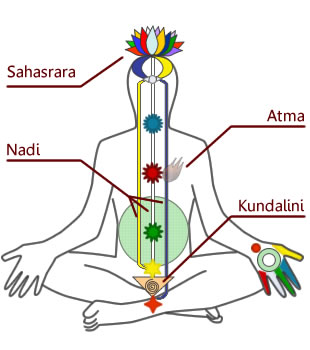
Diagram of the seven chakras and the Kundalini energy pathway through the subtle body, showing the Sushumna nadi and its relationship to the energy centers
The chakras are not organs in the physical body -- they are nodes of energy in the subtle body, each governing specific dimensions of human experience. Muladhara (root) governs survival and groundedness; Svadhisthana (sacral) governs desire and creativity; Manipura (solar plexus) governs will and power; Anahata (heart) governs love and compassion; Vishuddha (throat) governs expression and truth; Ajna (third eye) governs intuition and vision; Sahasrara (crown) is the seat of pure consciousness, identified with Shiva -- pure, formless awareness.
Kundalini itself is identified with Shakti -- the divine feminine principle, the power aspect of consciousness, the universe's own creative energy that has taken up residence in the human body. She sleeps coiled three and a half times around the Svayambhu linga (a symbolic form of Shiva) at the Muladhara, blocking the entrance to the Sushumna with her own body. When she awakens and rises, she passes through each chakra, absorbing its energies and dissolving its limitations, until she reaches the Sahasrara where she reunites with Shiva. That reunion -- the marriage of power and awareness, of movement and stillness, of the finite and the infinite -- is, in the Tantric understanding, the full realization of what a human being is.
Awakening: Grace, Practice, and Crisis
Kundalini can awaken spontaneously, without deliberate practice, often in circumstances that seem to have nothing to do with yoga: a near-death experience, a profound grief, a period of intense creativity, a moment of falling in love. When it does, the experience can be overwhelming -- a rush of heat or electricity through the spine, involuntary movements (kriyas), visions, states of bliss or terror, a sense of enormous energy that the physical body struggles to contain.
When it awakens through sustained yoga practice -- which the tradition regards as the safer path -- it typically unfolds more gradually. The Hatha Yoga Pradipika (15th century CE), one of the core texts of classical Hatha yoga, describes the whole system of asana, pranayama, mudra, and bandha as preparatory work for the rising of Kundalini -- a systematic purification and strengthening of the physical and subtle bodies so that they can withstand and integrate the energy without being overwhelmed.
The dangers of unguided Kundalini awakening are taken seriously in the tradition. Kundalini syndrome -- a cluster of physical, psychological, and spiritual symptoms that can accompany an unmanaged awakening -- includes extreme sensitivity to sound and light, uncontrollable physical movements, altered sleep, emotional volatility, perceptual shifts, and what can look from the outside, and sometimes from the inside, like psychosis. Traditional texts are explicit: Kundalini work requires a qualified teacher, ethical preparation, and a stable life foundation.
The tradition's insistence on preparation is not conservatism. It is engineering. You do not run maximum current through a wire that has not been insulated to bear it.
Gopi Krishna: The Pioneer of Modern Research
The most important first-person account of Kundalini awakening in the twentieth century belongs to Gopi Krishna (1903-1984), a civil servant from Kashmir who underwent a spontaneous awakening in December 1937 during his morning meditation practice.

Gopi Krishna (1903-1984), Kashmiri mystic and civil servant, whose 1937 spontaneous Kundalini awakening he documented in meticulous detail over decades of subsequent research
What followed was eleven years of intense and often terrifying crisis. The energy that had awakened refused to subside. It rose incorrectly at times -- through the Ida channel rather than the Sushumna -- producing physical symptoms so severe that Gopi Krishna believed he was dying. He described the experience with unusual precision: rivers of light rising and falling through his body, unbearable heat, extraordinary visions, and an altered sense of his own consciousness that made ordinary life almost impossible to maintain.
He survived, eventually stabilized, and spent the remaining decades of his life writing about the experience and its implications. His memoir Kundalini: The Evolutionary Energy in Man (1967) -- published with a commentary by the neuropsychiatrist James Hillman -- remains the most detailed first-person account of Kundalini awakening in Western literature.
Gopi Krishna's central thesis was as bold as it was controversial: Kundalini is a biological energy, a real physiological force involving the nervous system and the brain, and its awakening represents an acceleration of the evolutionary process by which the human species is slowly developing higher states of consciousness. He saw genius, mystical experience, and artistic inspiration as different degrees of Kundalini activity -- a view that, while speculative, points toward genuinely open questions about the relationship between neurological function and states of illumination.
Carl Jung and the Western Encounter with Kundalini
In October 1932, the Swiss psychologist Carl Jung delivered a seminar on Kundalini yoga to the Psychological Club of Zurich. The seminars -- later published as The Psychology of Kundalini Yoga (1996) -- represent one of the most serious early Western attempts to understand the Tantric system using the tools of depth psychology.
Jung's interpretation was characteristically both illuminating and cautionary. He read the lower chakras -- Muladhara through Manipura -- as the territory of the unconscious: the realm of instinct, shadow, and the elemental psychic forces that ordinary Western consciousness has suppressed and denied. Anahata, the heart, he associated with the emergence of a reflective, individuated self. The upper chakras he approached with respect and caution, noting that the Western tendency to leap straight to transcendence -- to skip the uncomfortable lower floors of the psyche in the rush to reach the divine -- was precisely what made the tradition dangerous in the wrong hands.
"In our typical Western way," Jung wrote, "we want to get to the top at once, to jump over the shadow and the inferior functions." The Kundalini map, in his reading, was a curriculum of individuation -- not a ladder to escape the human condition but a path of becoming fully human, which requires descending before ascending, integrating what is dark before claiming what is luminous.
This tension -- between the genuinely transformative potential of Kundalini practice and the danger of premature spiritual ambition -- is not merely a Western problem. The Tantric tradition itself embeds it in the form of a warning: Kundalini is called the Maha Shakti, the Great Power, and power without wisdom is simply destruction at a higher voltage.
Practices: The Paths of Awakening
Classical Tantra and Hatha yoga offer several approaches to working with Kundalini energy, all of which require the foundational work of ethical discipline (Yama and Niyama), physical purification (asana), and breath control (pranayama) before any direct Kundalini techniques are approached.
Pranayama -- yogic breath work -- is the most accessible preparatory practice. Techniques like Nadi Shodhana (alternate nostril breathing) work directly on the Ida and Pingala channels, balancing solar and lunar energies and preparing the Sushumna to receive the rising force. More advanced practices like Kapalabhati (skull-shining breath) and Bhastrika (bellows breath) generate heat (tapas) in the body and stimulate the energy centers.
Bandhas (energy locks) -- Mula Bandha at the perineum, Uddiyana Bandha at the abdomen, Jalandhara Bandha at the throat -- are used to contain and direct the Kundalini energy once it begins to move, preventing it from dispersing before it can complete its journey.
Shaktipat -- the direct transmission of Kundalini energy from teacher to student through touch, gaze, word, or intent -- is described in Tantric texts as the fastest but also the most demanding path. A genuine shaktipat transmission can trigger awakening instantaneously in a prepared student. In an unprepared one, the results can be destabilizing.
Modern teachers who work with Kundalini -- from Swami Muktananda (whose Siddha Yoga lineage centered on shaktipat) to the Kundalini yoga of Yogi Bhajan (now practiced worldwide) to the somatic approaches of contemporary body-centered therapists -- all acknowledge the same basic truth: this energy is real, it is powerful, and it demands respect.
The Inner Meaning: The Marriage of Shiva and Shakti
The Tantric image of Kundalini's ascent and its union with Shiva at the crown is, at one level, a description of a process. But at another level it is a teaching about the nature of reality itself.
Shiva is pure consciousness: the unmoving witness, the sky that contains all weather, the awareness in which all experience arises without being touched by any of it. Shakti is the power of that consciousness made dynamic: the universe itself, creation and dissolution, the dance of phenomena that arises from and returns to the stillness of Shiva.
In ordinary human consciousness, Shakti is asleep at the base -- unconscious, driven by instinct and habit, moving in the channels of the conditioned personality. The work of Kundalini yoga is not to add something new to the human being but to wake up what was always already there: to allow the energy that built the universe to recognize itself in the small instrument of one human body and mind.
When Kundalini reaches the crown, the tradition does not say the practitioner disappears into the absolute and leaves the world behind. The realized being descends -- back through the chakras, back into embodied life -- but now transparent to both Shiva and Shakti simultaneously. The ordinary world has not changed. The one who inhabits it has.
The serpent does not escape the body. She transfigures it. That is her whole purpose: not to take you out of your life but to make you, at last, fully alive within it.
- Lux Esoterica
Related Esoteric Inquiries:
- Kundalini Awakening: The Serpent Power, the Spine, and the Fire That Changes Everything
- Tantra: The Sacred Science of Union and the Path That Embraces the Whole World
- Kundalini Awakening: Igniting the Serpent Fire Within
Lux Esoterica.
2026.


Comments