Atalanta Fugiens, Emblem 25: The Dragon Dies Only by Brother and Sister
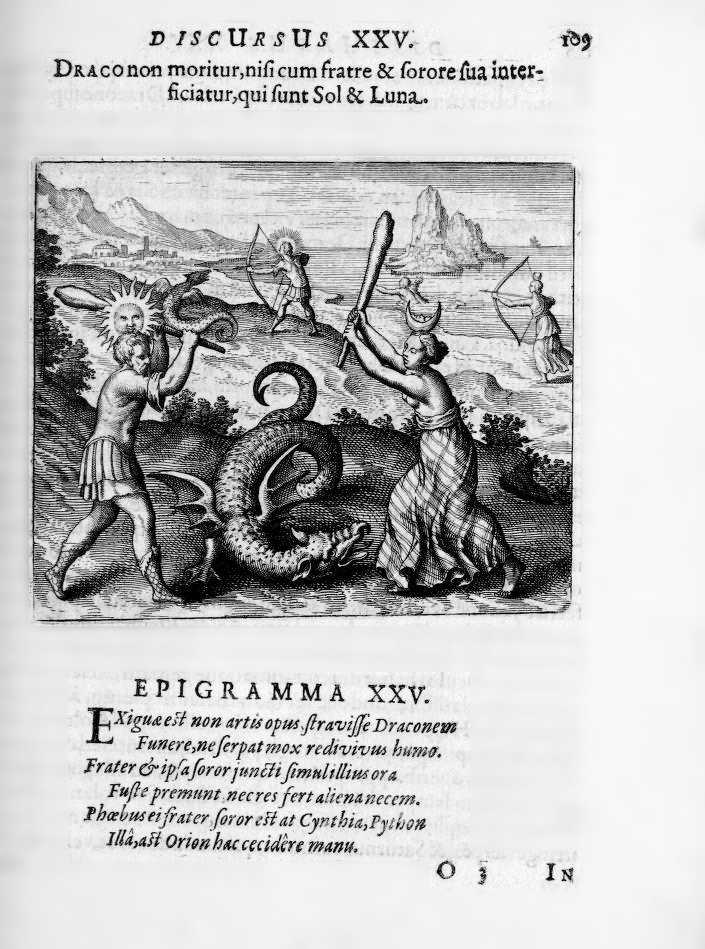
A young man in a short tunic and a woman in a checked gown swing heavy clubs at a winged dragon that lies coiled on a hillside between them. The man holds a sun with a human face up beside his head, and the woman wears a crescent moon on her brow.
Behind them, on a rise, a radiant archer bends his bow, and farther along the shore a second archer draws on a distant target. A bare crag stands in the sea. This is the twenty-fifth emblem of Michael Maier's Atalanta Fugiens, and its motto says: the Dragon does not die unless it is killed by its brother and sister, who are Sun and Moon.
The book was printed in 1617 at Oppenheim. It has fifty emblems, and each one joins an engraving, a Latin verse, a prose discourse and a fugue for three voices. The engravings are attributed to the workshop of Matthäus Merian. Maier, a physician at the court of Emperor Rudolf II, set many of his scenes at the meeting of two opposites.
The Motto
The Latin line gives a rule about killing a dragon. One hero cannot do it alone. Two must do it together, and they must be a brother and a sister. The text names them: the Sun and the Moon.
The engraving shows the rule at work. The man and the woman strike from either side, and the dragon is pinned between them.
The Dragon and the Golden Fleece
The discourse begins with Jason. To win the Golden Fleece, Jason first had to kill the dragon that guarded it. Many had tried before him, it says, and the dragon's poison destroyed them. They were not armed against his venom and did not know how he could be killed.
Jason, called the physician by Maier, took remedies from Medea, whom the text calls the counsel of his mind. Among them were the images of the Sun and the Moon. By their proper use, he gained the Fleece. The point is that the dragon dies only to a pair.
Brother and Sister
The old book called the Rosary of the Philosophers, quoted in the discourse, repeats the saying and gives it to Hermes: the dragon does not die unless it is killed by a brother and a sister, not by one alone but by both together. The sun stands for gold, and the moon for silver.
In the picture, the Sun-man is dressed as a Roman soldier, and the Moon-woman is draped in a checked gown. They are the same age, face to face, and wield the same weapon. The old authors saw in them the two pure metals, and in the dragon the quicksilver that must be fixed by them.
Phoebus, Cynthia and the Archers
The epigram adds two names. Phoebus, the bright one, is the brother, and Cynthia, the moon-goddess, is the sister. By Phoebus, it says, fell the serpent Python, and by Cynthia, Orion. The two archers in the background are Apollo and Diana, and they are the gods behind the two clubs.
In Greek myth, Apollo killed the serpent Python at Delphi with his arrows. Diana is said in some accounts to have killed the hunter Orion. Maier folds these two kills into one emblem, and the twins hunt together.
A Reading for Today
The emblem is about combining. A threat that overwhelms one kind of strength may fall to two different kinds. The sun and the moon do not do the same job. One is steady and bright, the other changing and quiet. The emblem tells us to look for the person or the virtue that is unlike us.
The Engraving
The dragon fills the lower half of the picture. He has bat wings, a curling tail and a horned head turned toward the viewer, and his body is scaled like armor. On the left, the sun-face is drawn with a ring of flames, and the man's club is lifted over his shoulder.
On the right, the woman raises her club in both hands and her gown is drawn with checks and folds. In the distance, a walled town and a bay stretch to the horizon.
The Fugue
Each emblem has its own fugue for three voices, and each voice follows the one before it. The name of the book recalls Atalanta, the swift huntress of Greek myth who stopped to pick up golden apples. Recordings of the fugues are available, and they pair well with this picture.
Contemplating the Emblem
For those who wish to work with this image:
- Look at the two clubs and the dragon between them.
- Ask what trouble you have tried to face alone.
- Think of a person whose strength is the opposite of yours.
- Imagine the two of you working side by side.
A Word of Care
The picture shows violence against a monster, and the emblem does not advise violence against anyone. If a fear or a conflict feels too large to face alone, ask someone you trust or a professional for help. The tradition's claims about the Sun, the Moon and the dragon cannot be confirmed.
Closing
A brother, a sister, a dragon between their clubs. Maier took a saying from the old books and wrote it as a picture. For the seeker, the teaching is warm: what one cannot overcome alone, a pair may.
Related Esoteric Inquiries
- Atalanta Fugiens, Emblem 43: The Vulture on the Mountain
- Atalanta Fugiens, Emblem 32: The Alchemical Coral
- Atalanta Fugiens, Emblem 26: The Tree of Life, Fruit of Human Wisdom
Lux Esoterica.
2026.


Comments