Atalanta Fugiens, Emblem 32: The Alchemical Coral
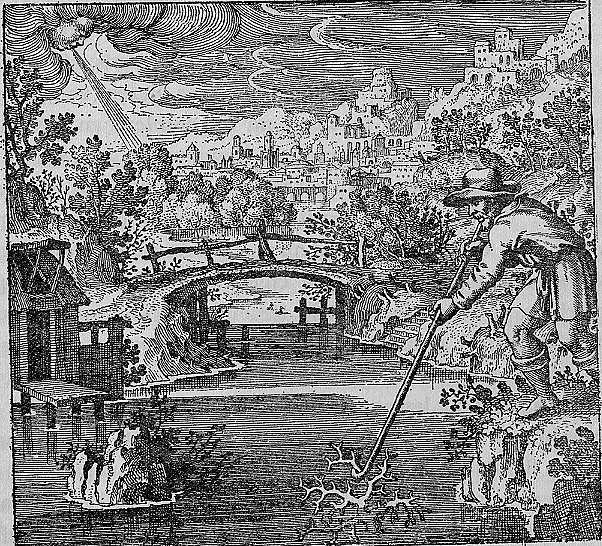
A man in a wide hat leans over a quiet pond, holding a long pole. At the end of the pole, a branched growth is being lifted out of the water. Below the surface lie more of these branches, spreading like small trees.
Behind him, a wooden footbridge crosses the stream, a hut stands on stilts, and a town rises among hills under a sky with a single ray of sun. This is the thirty-second emblem of Michael Maier's Atalanta Fugiens, and its motto says: as coral grows under water and hardens in the air, so does the Stone.
The book was printed in 1617 at Oppenheim. It has fifty emblems, and each one joins an engraving, a Latin verse, a prose discourse and a fugue for three voices. The engravings are attributed to the workshop of Matthäus Merian. Maier, a physician at the court of Emperor Rudolf II, took many of his images from nature.
The Motto
The Latin line is a comparison. Coral and the Stone grow in the same way. Both are soft under water, and both harden when they meet the air.
The old belief behind it is simple. A thing that grows in the dark of the deep may become firm only when it is lifted into light.
Coral in the Old World
The Roman writer Pliny the Elder recorded that coral is soft while it lives under the sea and hardens when it is taken out into the air. In his day, many people believed this. Coral was also thought to guard against lightning, storms and the evil eye, and children wore it as an amulet.
We now know that coral is built by small animals, and that the hardness is not caused by air. The old idea was an honest observation, and it gave poets a good image.
The Blood of Medusa
A Greek myth gave coral a stranger origin. In Ovid's Metamorphoses, the hero Perseus lays the head of Medusa on a bed of seaweed. The plants touch the blood and turn to stone, and the sea nymphs scatter the seeds, so coral grows in the water.
The tale joins death and beauty. From a dangerous head comes a lovely red branch. Maier knew the story, and a reader of his time would have thought of it as soon as coral came up.
The Stone That Hardens
In the alchemical tradition, the Stone begins as something fluid and formless. It grows in the dark, in a closed vessel, and passes through a long time of softness. At a certain point it fixes and becomes firm.
The emblem uses coral to describe the change. The tradition does not claim that a physical Stone can be made. It uses the image of a delicate form that gains strength when it meets a clear, open space.
A Reading for Today
Many ideas and talents begin in hiding. They are soft, uncertain and easily harmed. The emblem says that they must grow where they are until they are ready.
It also says that a moment of exposure is needed. A thing that never meets the air never hardens. Showing the work, speaking the plan, and offering the poem to a reader are all ways of lifting the branch out of the pond.
The Engraving
The picture is full of quiet detail. The man at the right stands on a rock and holds the pole with both hands. The coral he has caught drips water as it rises. Below the surface, two other branches stretch toward the bottom.
The footbridge in the middle is made of rough planks on posts, and the hut on the left leans over the water. In the sky, a single ray falls from a cloud, as if the sun were looking at the work.
The Fugue
Music is part of the design. Atalanta Fugiens joins an engraving, a verse and a discourse with a fugue for three voices, and the three voices circle one another like runners. The name of the book recalls Atalanta, the swift huntress of Greek myth, who lost a race when Hippomenes dropped golden apples and she stopped to pick them up.
Maier read the story as a picture of the volatile and the fixed. Recordings of the fugues are available, and they pair well with this picture.
Contemplating the Emblem
For those who wish to work with this image:
- Look at the branch rising from the water and the ones still below.
- Ask what in your life is still soft and growing in the dark.
- Think of one thing you could show to the air, even in a rough form.
- Notice how it feels to be seen after a long time unseen.
Closing
A fisher of coral, a pond, a ray of sun. Maier took an old belief about the sea and made it a lesson about growth. For the seeker, the teaching is gentle: let the branch grow in the water, then lift it into the light.
Related Esoteric Inquiries
- Atalanta Fugiens, Emblem 23: The Rain of Gold and the Birth of Pallas
- Atalanta Fugiens, Emblem 26: The Tree of Life, Fruit of Human Wisdom
- Atalanta Fugiens, Emblem 25: The Bird and the Serpent
Lux Esoterica.
2026.


Comments