Atalanta Fugiens, Emblem 26: The Tree of Life, Fruit of Human Wisdom
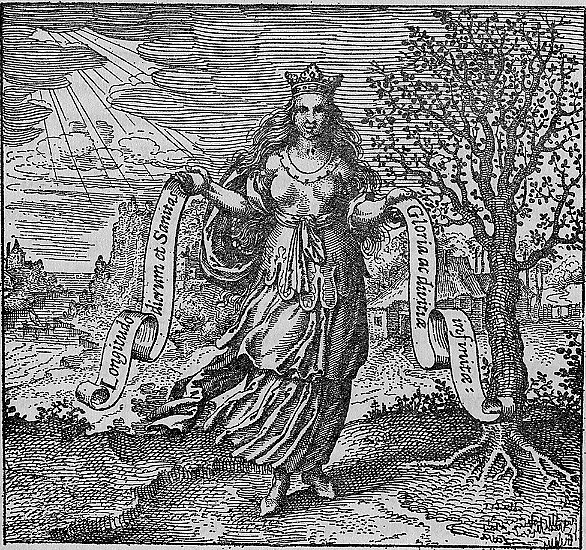
A crowned woman walks through an open landscape. In each hand she holds the end of a long banner that curls around her, carrying words in Latin. Rays of light break through the clouds on one side, and on the other a tree stands with spreading roots.
This is the twenty-sixth emblem of Michael Maier's Atalanta Fugiens, and its motto says: the fruit of human wisdom is the tree of life.
The book was printed in 1617 at Oppenheim. It has fifty emblems, and each one joins an engraving, a Latin verse, a prose discourse and a fugue for three voices. The engravings are attributed to the workshop of Matthäus Merian. Maier, a physician at the court of Emperor Rudolf II, built the book to be seen, read and sung.
The Motto
The Latin line is a single sentence with a double meaning. Wisdom has a fruit, and the fruit is the tree of life. The sentence turns the usual picture around. A tree gives fruit, but here the fruit gives rise to the tree.
The crowned woman is easy to read as Wisdom herself. The banners at her sides carry words about long life, glory and riches.
Wisdom in Proverbs
The emblem draws on a famous passage in the Book of Proverbs. It says of wisdom that length of days is in her right hand, and in her left hand riches and honor. It continues that she is a tree of life to those who lay hold of her.
Maier's picture follows the verse closely. A woman with a crown, offering life with one hand and honor with the other, stands next to a tree. A reader of his time would have recognized the text at once.
The Tree of Life
The tree of life stands in the garden of Eden, in the first chapters of Genesis. It appears again in the last chapter of Revelation. Between the two it becomes an image of everything that gives life and renewal.
Alchemists took up the image. For them, the Stone was the fruit of the tree of life, the Elixir that heals and renews. Maier, who admired the Rosicrucian ideals, would have seen no gap between spiritual wisdom and the Work.
Wisdom and the Work
The emblem links two ideas that are usually kept apart: knowledge and life. A person who knows many things but does not live well has not reached the fruit. A person who lives well without understanding has not either.
In the tradition, the Work was meant to join both. The scholar, the physician and the seeker all aimed at a knowledge that would also be a way of living.
A Reading for Today
The picture invites us to ask what wisdom is for. It is not a store of facts. It is whatever makes a life fuller, steadier and kinder.
The tree in the picture has bare branches but strong roots. That may be a hint: wisdom does not always look rich, but it holds firm.
The Engraving
The engraving gives the woman a calm, upright pose. Her crown marks her as a figure of rank, and her long hair is loose in the wind. The sun's rays on one side and the leafless tree on the other make a quiet contrast between light above and root below.
The banners, which curl around her like ribbons, give the Latin words a place in the picture. It is an image meant to be read slowly, line by line.
The Fugue
The fugue that goes with this emblem is written for three voices. The voices enter one after another and repeat the same line, as if each chased the one before. That is the sense of the title. In the myth, Atalanta was a swift runner, and Hippomenes won her by dropping golden apples to make her stop. Maier turned that chase into music and into a series of images. Modern recordings let us hear it today.
Contemplating the Emblem
For those who wish to work with this image:
- Look at the crowned woman and the words on her banners.
- Ask what wisdom means to you, apart from knowing facts.
- Think of a person whose way of living shows it.
- Ask what would make your own life grow like a tree with deep roots.
A Word of Care
The tradition speaks of an Elixir that grants long life. No such substance exists, and offers of one should be treated with suspicion. The claims of the tradition cannot be confirmed. The emblem is better read as a reflection on what a good life needs.
Closing
A crowned woman, two banners, a tree with deep roots. Maier compressed a famous verse and an old symbol into one picture. For the seeker, the teaching is simple and lasting: the fruit of wisdom is not knowledge for its own sake, but a life that grows like a living tree.
Related Esoteric Inquiries
- Atalanta Fugiens, Emblem 31: The King in the Alchemical Sea
- Atalanta Fugiens, Emblem 32: The Alchemical Coral
- Atalanta Fugiens, Emblem 28: The King in the Bath
Lux Esoterica.
2026.


Comments