Atalanta Fugiens, Emblem 14: The Dragon Devouring Its Tail
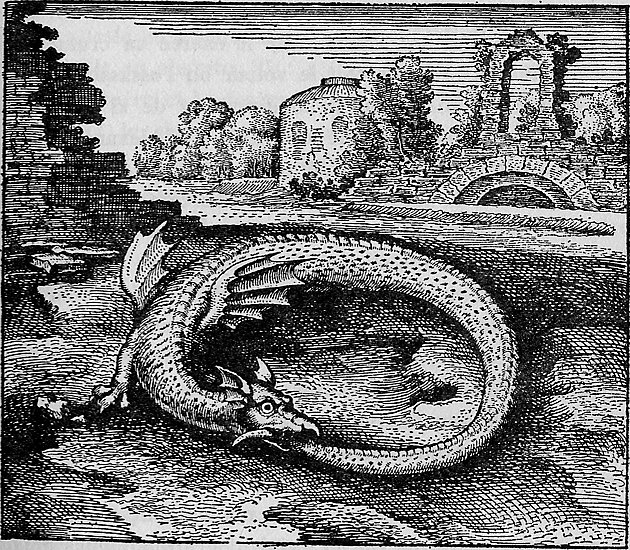
A winged dragon lies in a ring on bare ground, its head bent back to bite its own tail. Behind it stand a round tower, a broken arch, a low bridge and a few trees. This is the fourteenth emblem of Michael Maier's Atalanta Fugiens, and its motto says it plainly: here is the dragon devouring its tail.
The book was printed in 1617 at Oppenheim. It has fifty emblems, and each one joins an engraving, a Latin verse, a prose discourse and a fugue for three voices. The engravings are attributed to the workshop of Matthäus Merian. Maier, a physician at the court of Emperor Rudolf II, borrowed this picture from a tradition already very old.
The Motto
The line is short and needs no decoding. A dragon eats itself. The animal is both the one who devours and the one who is devoured.
The old name for the figure is the ouroboros, a Greek word that means tail-eater. It is among the best known symbols in the history of the art.
An Ancient Serpent
The image is older than alchemy. A serpent biting its tail appears in Egyptian funerary art, on the shrines placed around the burial of Tutankhamun in the fourteenth century before our era, where it surrounds the figures of the sun god. Later Greek writers, such as Horapollo, described it as a sign of time and of the year.
In the alchemical writings of Alexandria, the symbol took on a new life. A famous page attributed to Cleopatra the Alchemist, from the early centuries of our era, shows an ouroboros with the words "the all is one" inside its ring. The tradition has repeated it ever since.
The Dragon That Feeds on Itself
For alchemists, the dragon was a name for crude, poisonous matter, the stuff at the beginning of the Work. It is a creature of earth, with wings that cannot lift it. The picture of it eating its own tail described a closed cycle: the matter dissolves, rises as vapor, falls back and dissolves again.
The sealed vessel, heated gently, was meant to reproduce this cycle. Nothing was added, and nothing was removed. The matter fed on itself until it changed. That is the meaning the emblem gives the image.
Ruins in the Background
The setting is a ruined place. The arch is broken, the tower stands empty, and the bridge crosses a dry stream. The dragon lies in the foreground like a guardian of what remains.
Some readers see in this a comment on endings. Every cycle begins with something that has fallen apart. The ruin is not a failure but the raw ground from which the next form will grow.
A Reading for Today
Most people know the feeling of a pattern that repeats. An old habit returns, an old quarrel begins again, and the creature seems to eat itself. The emblem does not say to flee. It says the pattern carries a whole in itself, and that the circle can be turned into a vessel.
The dragon also shows that destruction and renewal are the same motion. What is swallowed is also what is fed. A life can be understood as a ring, not only a line.
The Engraving
The artist drew the dragon with great care. Its body is covered in small scales, a row of spines runs along its back, and two bat-like wings fold against its sides. Its eye is round and watchful, and the mouth seizes the very tip of the tail.
The loop is nearly complete and fills the width of the picture. Behind it, the round tower and the arch are lightly drawn, as if they belong to another age.
The Fugue
Each emblem in the book has its own music. The fugue is written for three voices, and each voice follows the one before it, which is where the name comes from: fuga means flight or pursuit. The title recalls Atalanta, who raced her suitors until Hippomenes dropped golden apples in her path.
Maier used the old tale as a frame for fifty riddles. Modern singers have recorded the pieces, so anyone can hear them while looking at the engraving.
Contemplating the Emblem
For those who wish to work with this image:
- Look at the ring formed by the dragon's body and find the point where head meets tail.
- Name one cycle in your life that repeats and ask what feeds it.
- Ask what the cycle would look like if it were a closed vessel and not a trap.
- Consider what in your life has fallen into ruin and what it might grow into.
Closing
A dragon in a ring, a ruin behind it. Maier took the oldest picture of the art and made it the fourteenth step. For the seeker, the teaching is steady: what feeds on itself in the right vessel does not vanish, but is made new.
Related Esoteric Inquiries
- Atalanta Fugiens, Emblem 41: The Death of Adonis
- Atalanta Fugiens, Emblem 28: The King in the Bath
- Atalanta Fugiens, Emblem 5: The Toad at the Woman's Breast
Lux Esoterica.
2026.


Comments