Hercules' Fourth Labor: The Erymanthian Boar
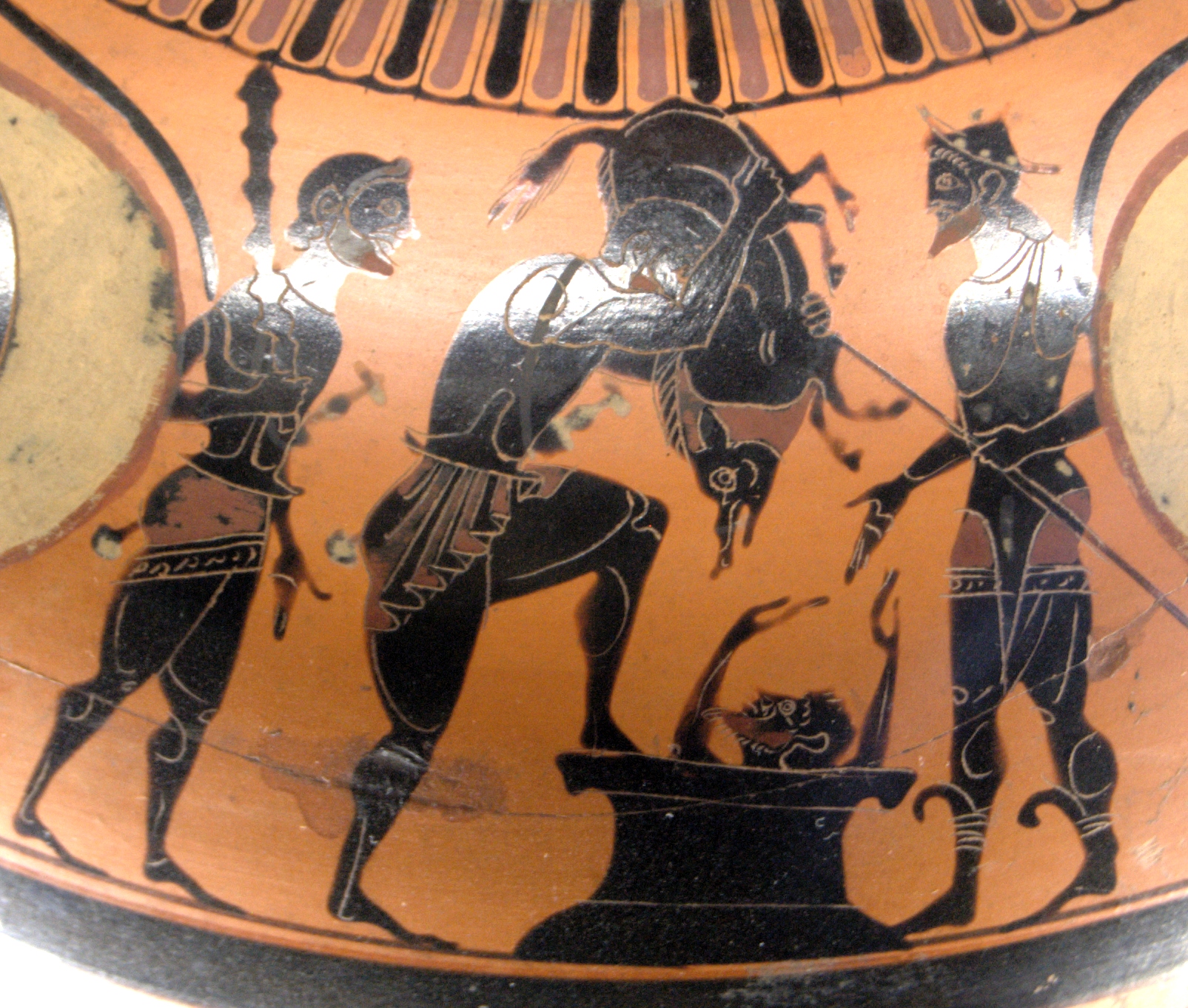
For his fourth labor, Hercules was sent to capture the Erymanthian Boar, a huge and ferocious wild pig that came down from Mount Erymanthos, in Arcadia, to destroy crops and terrify the countryside. King Eurystheus demanded that the hero bring it back alive.
The previous labor had asked Hercules to capture the swift Ceryneian Hind, a creature of grace and lightness. The boar was its opposite: heavy, brutal and blindly destructive. In esoteric readings, it stands for the raw power of our most basic appetites, which must be mastered rather than destroyed.
The Myth
On his way to the mountain, Hercules stopped to visit his friend Pholus, a wise and gentle centaur. Pholus offered him food and, at the hero's request, opened a jar of wine that belonged to all the centaurs. The scent of the wine drew the other centaurs, who arrived in a wild fury. Hercules drove them off with his arrows, poisoned with the blood of the Hydra.
The battle ended in tragedy. One arrow struck the noble centaur Chiron, the teacher of heroes, causing him an incurable wound. Pholus, curious about the arrows, accidentally dropped one on his foot and died. Hercules buried his friend and continued his journey with a heavy heart.
The Hunt in the Snow
Hercules knew he could not easily overpower the boar in its own thicket. Instead, he shouted loudly to drive it out of hiding. Then he chased it higher and higher up the mountain, into deep snow. There the exhausted beast became trapped, unable to move freely, and Hercules bound it and carried it on his shoulders back to Mycenae.
When he arrived, Eurystheus was so frightened that he hid in a large bronze jar. Ancient Greek vase painters loved this comic scene, showing the king peeking out of his jar as Hercules held the boar above him.
The Beast of Appetite
In symbolic terms, the boar represents the heavy, earthbound part of human nature: hunger, lust, anger and the urge to consume without limit. When these forces run wild, they trample the fields of our lives, destroying in a moment what took months or years to grow.
Yet the myth insists that the boar must be captured alive. Our basic drives are not evil in themselves. They give us energy, vitality and the will to live. The task is not to kill them, but to bring them under the guidance of a wiser self.
Strategy Over Force
The way Hercules captures the boar is instructive. He does not wrestle it in the dense undergrowth, where the beast has every advantage. He changes the field. By driving it up the mountain into the snow, he puts it in a place where its strength no longer helps it.
This offers a practical lesson. When strong impulses arise, fighting them head-on in the heat of the moment often fails. It can be wiser to step back, change the setting or create conditions where the impulse loses its power.
The Cold of Detachment
Snow and mountain heights are rich symbols. Height suggests a higher perspective, a calm point of view from which our impulses can be seen clearly. Cold suggests cooling down, the pause that allows the heat of passion to fade.
Many traditions teach similar practices: counting before reacting, taking a walk, breathing slowly or waiting a day before a decision. These simple acts are the snows of Erymanthos, where the wild boar becomes still enough to be bound.
The Cost of Excess
The episode with the centaurs adds a warning. The opening of the wine jar, a symbol of indulgence, leads to chaos and to the death of good friends. Even the hero's actions, taken in defense, cause unintended harm.
The myth suggests that when appetite is released carelessly, its consequences can reach far beyond what we intend.
A Practice for Today
The fourth labor invites reflection:
- Which appetite or impulse tends to trample my efforts?
- In what settings is it strongest?
- How could I change the field, as Hercules did, to weaken its hold?
- What pause or cooling practice can help me in the moment?
Closing
The Erymanthian Boar is the heavy beast of appetite that descends from the mountain to ravage our fields. Hercules does not kill it, but drives it into the snow, where it can be bound and carried. For the seeker, the lesson is clear: our vital drives are powerful and necessary, but they must be guided with strategy, patience and the cool clarity of a higher view.
Related Esoteric Inquiries
- Hercules' Twelfth Labor: Cerberus and the Underworld
- Hercules' Eleventh Labor: The Apples of the Hesperides
- Hercules' Tenth Labor: The Cattle of Geryon
Lux Esoterica.
2026.


Comments