The Minotaur: The Beast in the Labyrinth, Guardian of the Shadow Self

Theseus and the Minotaur in the Labyrinth — tile design by Edward Burne-Jones, 1861. Victoria and Albert Museum, London.
Beneath the palace of Knossos, in a structure so deviously constructed that even its architect feared he could never escape it, there lived a creature with the body of a man and the head of a bull. His name, given to him by myth, was the Minotaur — Minotauros in Greek, meaning "Bull of Minos." But his true name, the one whispered in some older versions of the tale, was Asterion: the Starry One.
That secret name changes everything. A monster is a thing to be destroyed. But a starry one — a being of light hidden in darkness, of divinity sealed within a labyrinth — is something far more disturbing, and far more sacred. The Minotaur is one of the most enduring figures in Western mythology precisely because he refuses to be only a monster. He is the shadow: the hidden, rejected, and terrifying aspect of the self that civilization builds its walls to contain.
The Cretan Myth: Born from Shame and Divine Punishment
The story begins not with the Minotaur but with a broken promise. King Minos of Crete had asked Poseidon, god of the sea, to send him a magnificent bull as a sign of divine favor — proof that he, and not his brothers, was the rightful heir to the Cretan throne. Poseidon obliged: a dazzling white bull emerged from the waves, and Minos was confirmed as king. But the bull was so magnificent that Minos could not bring himself to sacrifice it as promised. He substituted an inferior animal, hoping the god would not notice.
Gods always notice.
Poseidon's revenge was devious and intimate. He caused Pasiphae, Minos's queen, to fall into an obsessive, unnatural desire for the white bull. Pasiphae — herself a daughter of Helios, the sun — had no power to resist the divine curse. She appealed to Daedalus, the master craftsman of Athens who lived at the Cretan court, and he built for her a hollow wooden cow covered in real hide, so convincing that the bull was deceived. From this terrible union was born the Minotaur: half-man, half-bull, entirely impossible, entirely real.

Pasiphae nursing the infant Minotauros — Settecamini Painter, red-figure calyx-krater, 4th century BCE. Bibliothèque nationale de France, Paris.
The myth carries the weight of a curse that operates through three generations: Poseidon punishes Minos through Pasiphae; Pasiphae's shame produces the Minotaur; the Minotaur becomes a source of shame for Minos that must be hidden, which produces the labyrinth, which produces more shame when Athens is forced to feed it. Shame is the engine of the entire story, as it so often is in human psychological life.
What Minos cannot integrate — the consequence of his broken promise, the monstrous child in his household — must be concealed. And concealment, the myth insists, only makes things worse.
Daedalus and the Labyrinth: The Architecture of Repression
Minos commissioned Daedalus to build the Labyrinth (Labyrinthos): not merely a maze but an architectural masterpiece of disorientation, a structure so complex that its creator called it the "dancing floor" (choros), perhaps because to navigate it was to be caught in a dance with confusion itself.
The word labyrinth most likely derives from labrys — the double-headed axe that was the sacred symbol of Minoan Crete, found carved into the walls at Knossos in great numbers. The labyrinth, then, is the house of the double axe, the dwelling of the sacred. And its inhabitant is not simply a monster but the embodiment of a divine curse, something Minos has called down upon himself and cannot look at directly.

Daedalus depicted in a Roman mosaic — Zeugma Mosaic Museum, Gaziantep, Turkey. The master craftsman who built both the wooden cow and the labyrinth.
Daedalus is one of the great ambiguous figures of Greek myth: a genius who enables monstrosity (the wooden cow) and then contains it (the labyrinth), who serves the powerful and suffers for it. He will eventually be imprisoned in his own creation by Minos, and escape only by inventing wings of feathers and wax — the same wings that kill his son Icarus, who flies too close to the sun.
The labyrinth is not merely a building. It is a model of repression: the psychic structure humanity erects to keep its most unbearable truths out of sight, while still feeding them — because the Minotaur does not starve. Every nine years (some versions say every year), Athens was required to send a tribute of seven young men and seven young women to Crete, to be sent into the labyrinth and devoured. The monster must be fed. Repression has its costs, and they are paid by the young.
Theseus and Ariadne's Thread: The Descent into the Unconscious
Into this system arrives Theseus, prince of Athens, who volunteers as one of the tributes in order to slay the Minotaur. He is the hero of the rational order — brave, strategic, politically motivated. But he cannot accomplish the feat alone.
Ariadne, daughter of Minos and half-sister to the Minotaur, falls in love with Theseus and gives him two gifts: a sword and a ball of thread. The sword kills the monster. But the thread — the famous clew, from which we get our modern word "clue" — allows Theseus to find his way back out. Without it, slaying the Minotaur means dying in the dark.

Theseus slaying the Minotaur — bronze statuette, National Museum of Athens. The classical iconography of the hero confronting the beast.
The thread of Ariadne has been a symbol of guidance through complexity for three millennia. In esoteric reading, Ariadne represents consciousness itself — specifically, the capacity of the intuitive mind to hold a thread of awareness through the darkest and most bewildering passages of inner experience. She does not go into the labyrinth. She stands at the threshold and lets out the line. Her knowledge is intimate — this is her house, her half-brother's dwelling — and her gift is not courage but orientation.
The hero's journey into the labyrinth is a descent into the unconscious. Campbell's monomyth would recognize it immediately: the call to adventure, the crossing of the threshold, the descent into the belly of the beast. But what gives the Cretan myth its peculiar depth is that the monster at the center has a name — Asterion — and a mother who nursed him. He is not an abstract evil. He is a being with a history of shame.
Asterion: The Starry One, Hidden Nobility in the Dark
The name Asterion appears in several ancient sources as the Minotaur's personal name. Astēr in Greek means "star." The one who lives at the center of the labyrinth, in absolute darkness, is named for stars — for the light that exists in and beyond the abyss.
Jorge Luis Borges, the Argentine master of labyrinths and mirrors, seized upon this in his 1947 short story "The House of Asterion" (La casa de Asterión). In Borges's version, we hear the story from the Minotaur's own perspective. He does not experience the labyrinth as a prison but as his house, its infinite corridors as the extension of his mind. He waits not with hunger but with a kind of mystic patience for his "redeemer" — the one who will come and free him. When Theseus arrives and kills him, Asterion is almost relieved.
Borges's Asterion is a being of pure interiority, condemned to solitude not by a jailer but by his own nature. His story is a meditation on the inner life of the rejected — the part of us that has been locked away, that waits in the dark of the psyche, that interprets its prison as cosmos. The monster becomes a philosopher. The labyrinth becomes consciousness.

Tondo depicting the Minotaur — red-figure cup, 5th century BCE. National Museum of Athens. A rare image of the Minotaur alone, without hero or combat.
The Minotaur in Art: From Attic Pottery to Picasso
No figure in Greek mythology generated more visual art than the Minotaur and his encounter with Theseus. On thousands of surviving Attic vases — kylixes, amphorae, kraters — the combat scene is endlessly repeated, each time slightly different: Theseus young or mature, the Minotaur upright or fallen, witnesses watching with hands raised in horror or wonder.
The image shifts in the Renaissance, when Dante's Inferno adds a new chapter. In Canto XII, Dante and Virgil find the Minotaur (il Minotauro) guarding the seventh circle of Hell — the circle of violence — where he rages like a bull who has received a mortal wound. William Blake illustrated this scene with the Minotaur massive and glowering at the edge of a cliff, a figure of raw, untransformed violence. Here the Minotaur has lost his name Asterion and become pure obstruction.

William Blake — The Minotaur, illustration for Dante's Inferno, Canto XII, c. 1824–1827. Tate Britain, London.
But the most psychologically complex engagement with the Minotaur in modern art belongs to Pablo Picasso. Between 1933 and 1936, the Minotaur became Picasso's obsessive self-image — appearing in scores of prints, drawings, and paintings. In the great etching Minotauromachy (1935), the Minotaur advances through a scene of violence and dream: a wounded horse, a young woman holding a candle, a Christ-like figure climbing a ladder. The Minotaur shields his eyes from the small candle-flame — he, the creature of darkness, cannot bear the light of a child's truth.
Picasso's Minotaur is at once predator and sufferer, masculine aggression and mythic wound. In the years leading to the Spanish Civil War, he became a figure of political and personal darkness that could not be rationalized away. He was, in the deepest sense, the shadow: the part of the self that Jung would recognize immediately.
The Jungian Shadow: Confronting the Beast Within
Carl Gustav Jung understood the shadow as the repository of everything the conscious ego refuses to acknowledge: the desires deemed unacceptable, the capacities deemed dangerous, the aspects of the self that civilization trains us to hide. The shadow is not evil; it is unlived. But when it is denied long enough, it becomes monstrous — not because its contents are inherently destructive, but because the force of their repression makes them explosive when they finally erupt.
The Minotaur myth maps onto this dynamic with startling precision. Minos's denied promise (his broken contract with the divine) returns as the monster in his household. The monster, unfaced, demands increasing tribute — more and more of the young are sacrificed to maintain the pretense that the labyrinth is simply the way things are. And the only solution is not to build a better wall, but to go into the labyrinth and face what lives there.
This is what shadow work means in Jungian practice: not the destruction of the shadow (Theseus kills the Minotaur, but the labyrinth remains, and Ariadne is eventually abandoned) but the conscious encounter with the rejected self. The thread of Ariadne — the slender continuity of consciousness that allows us to enter the dark and return — is the essential tool. Without it, the descent into the unconscious is simply madness. With it, it becomes individuation.
Crucially, Jung noted that the shadow is not purely personal. The collective shadow — the mass of what a culture refuses to face — is far more dangerous than any individual's inner beast. The Minotaur who devours the young of Athens is, in this light, a figure of collective repression: the tribute paid to systems of violence and shame that no individual challenges because the labyrinth is presented as simply real, as simply the price of civilization.
The Labyrinth as Sacred Path: From Knossos to Chartres
The labyrinth is not only a symbol of confusion and entrapment. It has a second, entirely distinct tradition: the unicursal labyrinth, in which there is only one path, which winds to the center and back out again without any branching choice. This is not a maze but a walking meditation.
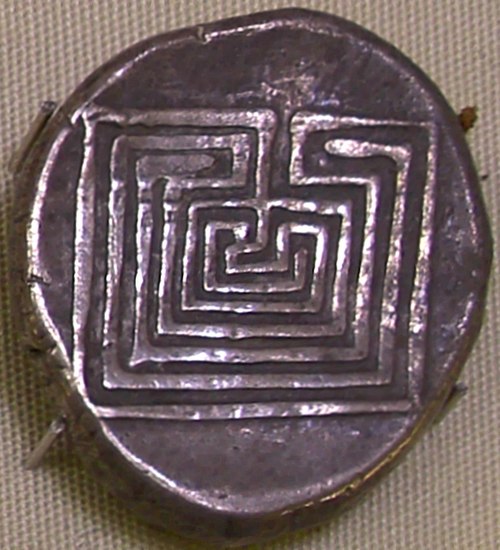
Knossos silver coin, c. 400 BCE, depicting the labyrinth pattern — one of the earliest representations of the labyrinth as a symbol in its own right.
The most famous surviving example is the labyrinth of Chartres Cathedral, laid into the nave floor in the early 13th century. Medieval pilgrims who could not travel to Jerusalem walked the Chartres labyrinth on their knees as a penitential substitute — the labyrinth as compressed pilgrimage, the winding path as spiritual preparation for encounter with the sacred center. In this context, the labyrinth is not a prison but a process: it holds you, turns you, disorients you in order to bring you to a place you could not reach by walking straight.
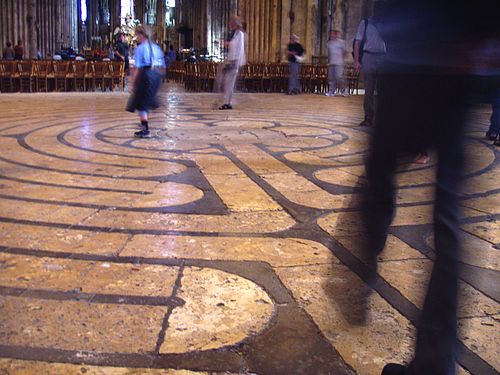
The labyrinth inlaid in the nave floor of Chartres Cathedral, France, c. 1205–1215. A unicursal path of pilgrimage and spiritual transformation.
The two traditions — labyrinth as trap and labyrinth as path — are not contradictory. They describe the same structure from different starting positions: fear or trust. To those who have not yet found the thread of Ariadne, the labyrinth is a prison. To those who hold the thread, it is a process — confusing, yes, but ultimately moving toward the center, and from there back out into the world.
Bull Symbolism: The Sacred Power Beneath the Monster
The bull that contributed half of the Minotaur's nature was itself a sacred animal across the ancient Mediterranean and beyond. In Minoan Crete, the bull was the central sacred animal — the great bull-leaping frescoes at Knossos show young men and women performing acrobatic feats over charging bulls in rituals whose exact meaning remains debated but whose religious significance is unmistakable. To face the bull was an act of devotion, not merely sport.
In Egypt, the Apis bull was the earthly manifestation of Ptah, the creator god — a living animal of sacred power that was worshiped, housed in temples, and mourned with elaborate funerary rites when it died. In Mesopotamia, the lamassu — the winged bull with a human head — guarded the gates of palaces and cities, turning terror into protection. In India, Nandi, the white bull of Shiva, is the guardian of Kailash and the gatekeeper between the human and the divine. The bull's power — sexual, generative, unstoppable — is universally recognized as something that must be approached with care, something that cannot simply be eliminated.
The Minotaur is not an aberration from this tradition. He is its extreme form: the sacred power of the bull, combined with human consciousness and human shame, sealed inside a human-built structure of denial. He is what happens when civilizational repression meets divine force.
The Minotaur's Esoteric Legacy
The story of the Minotaur is, at its deepest register, a story about what we refuse to see. Minos refuses to honor his promise to Poseidon and pays for it with something monstrous in his household. His queen Pasiphae cannot refuse the divine curse and produces the monster. Daedalus cannot refuse the king and builds the labyrinth. Athens cannot refuse the tribute and sends its young. Every character in the myth is caught in a structure of obligation and shame, and the monster at the center is the truth of that structure made flesh.
The esoteric tradition reads the labyrinth as the world — the world of appearances, of confusion, of wandering — and Ariadne's thread as the higher self, the slender but unbreakable connection to consciousness that guides us through the complexity of experience. The Minotaur at the center is not an obstacle to be destroyed but a confrontation to be survived: the meeting with what one most fears, which turns out to be something that has a name, a history, and a longing to be released.
That is why Borges's Asterion waits not with rage but with patience. He knows the redeemer will come. The labyrinth is vast, but it has a center, and at the center is not an ending but a meeting.
The thread leads in, and the thread leads out. What you find in the middle changes you. That is the esoteric promise of the labyrinth: not that it has no monster, but that the monster, named and faced, becomes a threshold — and beyond the threshold, the light of Ariadne's candle, and the open air.
— Lux Esoterica
Related Esoteric Inquiries:
- The Myth of Theseus and the Minotaur: The Thread of Ariadne, the Labyrinth of Crete, and the Victory of the Spirit
- The Minotaur: The Syntax of the Labyrinth and the Dissolution of the Ego
- The Myth of Theseus: The Labyrinth and the Thread of Gnosis
Lux Esoterica.
2026.


Comments