The Myling: The Restless Child Ghosts of Scandinavian Folklore
The heaviest ghost in the world's folklore is also the smallest. Scandinavian tradition calls it the myling—in Norway also the utburd, "that which was carried out"—and both names are case files. The myling is the ghost of a child killed and hidden: the newborn of desperation, born in secret to a servant girl or a starving household, killed or left to die, and disposed of outside every rite—buried under floorboards, sunk in the bog, left on the winter hill. Denied baptism, name, and churchyard, the child does not leave. It stays where it was put, and it cries: travelers on lonely roads at night heard the thin wailing from marsh or scree where no living infant could be; and the boldest of the old stories begin when someone, hearing it, does not hurry on. For the myling wants one thing, and the whole tradition hangs on it: to be carried to consecrated ground. It will leap upon the back of the night-walker—and then, as he carries it toward the churchyard, it grows heavier: heavier with every step, heavy as a grown man, heavy as a stone, heavy as the whole weight of what was done to it, until the carrier staggers, sinks to the knees in the earth of the road—and learns whether his strength, or his mercy, is great enough to reach the gate.
The Weight and the Name
The carrying-tales are told with the economy of ballads, and their clauses never vary in what matters. A man walking at night hears the cry and answers it—answering is the fatal courtesy; the unanswered myling cannot board—and the small thing is on his shoulders, cold as bog-water, light as a cat. He walks. It grows: at the first field's end, the weight of a child; at the second, of a man; near the churchyard wall, the bearer's boots are breaking through frozen ground as though the road were thawed mud, and the small voice at his ear is asking—the tradition preserves the terrible politeness of it—whether he can go on. Those who drop the burden are found mad or dead; those who carry it through the lychgate feel the weight dissolve at the boundary of the blessed ground, and hear, in the best tellings, one word out of the dark: rest, or thanks, or—in the deepest stratum of the tradition—a name at last received. For a strand of the lore holds that the nameless dead child can be laid by naming: the Norwegian utburd-tales tell of the haunted mother or the passing stranger who cries out to the wailing thing a baptismal formula and a name for either sex—if you are a girl, be called...; if a boy, be called...—and the crying stops forever. What was carried out is carried in; what was never entered in any register is registered; and the smallest, heaviest ghost in the world lies down.
The darker branch of the tales gives the myling its other office: accusation. The child's ghost does not always beg; sometimes it prosecutes. Ballads and legal legend alike tell of the murdered infant's voice rising at the wedding of its mother years later, or of the myling naming its killer from under the floorboards of the christening-feast—the crime the parish never discovered announced by the only witness, in the only court left open. In Sweden and Norway both, the folklore and the criminal archives shadow each other here with terrible fidelity: infanticide of the hidden kind was the crime the old rural world produced in numbers and prosecuted in dread, and the myling is that entire buried history given a voice—the community's own knowledge, which it could not or would not act on, crying from the bog where everyone privately guessed it lay. The ghost, as so often, is the conscience of the parish wearing the victim's size.
The Doctrine of the Unregistered
The myling belongs to a great and unhappy family we have met at every border of the old world's map: the unbaptized dead—the souls that died outside the register, claimed by neither heaven nor churchyard, and therefore attached to the world's margins: they fill the winter processions of the Wild Hunt, trail the Alpine goddesses through the Twelve Nights, people the strange traffic between the hills and the harvest fields recorded in the legend of the Green Children of Woolpit, and staff, as we have seen, half the uncanny institutions of Europe—the hidden folk themselves, by the Norwegian genesis-legend, being Eve's own unwashed and hidden children. The myling is the family's rawest case, because in it the theological category and the human crime coincide: the child is outside the register because someone put it there, and the folklore never lets the theology launder the deed. Its Scandinavian specificity is the weight: no other tradition made the unregistered dead heavy. The Gaelic and Slavic margins gave their unquiet ones voices, lights, shapes; the North, with its instinct for physics, gave the hidden child mass—as though what is excluded from the books of the living does not thereby become nothing, but becomes dense: all the unlived years compacted into the small body, growing heavier the nearer it comes to the ground that should have received it.
The Esoteric Reading: Carrying the Hidden Thing to the Gate
For the esoteric tradition, the myling is the most exact parable ever told about the disposal of what a life cannot afford to acknowledge. Every household, every family line, every soul has its carried-out things: the shames and casualties of desperate years, born of us and unownable by us, killed quietly and buried outside every rite—under the floorboards of the story we tell, in the bog at the edge of the family's memory. The tradition's findings on such disposals are three, and they have lost nothing in translation. First: the hidden thing does not leave. It stays exactly where it was put, and it cries—at night, at the margins, in the wordless registers: the unexplained dread on certain roads of a life, the wailing in certain seasons that has no visible infant. Second: it boards the one who answers. Healing begins with the fatal courtesy—turning aside toward the cry—and everyone who has ever done the real work knows what the tales know: the acknowledged burden gets heavier, and heavier still the closer it comes to consecration; the worst weight of a buried grief arrives not at its discovery but within sight of the gate, where the bearer's boots break through the road and the small voice asks, politely, whether he can go on. The tradition's whole counsel is for that furlong: do not drop it there. Dropped at the wall, it returns to the bog angrier, and the bearer is marked; carried through, it becomes weightless at the boundary—the burden was never the child, but the distance from the blessed ground. Third: what finally lays it is the name. Not the carrying alone, but the christening-cry into the dark—the formal, spoken admission of the hidden thing into the family register: you happened; you were ours; be called thus. Name and gate together, the lore insists, and the crying stops forever; and the archives of every school of the soul's healing since have merely footnoted the formula.
The Norwegian utburd-lore added its own harder edges. The exposed child's ghost, in the northern valleys, could be malignant as well as pleading: it pursued travelers over the snow crying mother, mother, grew huge in the pursuit—for the utburd too obeys the law of the growing weight—and could be stopped, said the old people, only by crossing running water, or by the desperate formula thrown back over the shoulder that deferred it to a later meeting. And the sites of such hauntings were mapped with grim precision: not the churchyard, never the churchyard, but the between-places—the scree, the shore below the tide-line, the boundary bog—exactly the unregistered ground to which the unregistered dead had been committed. The geography is the doctrine: what is buried outside the community's map haunts the map's edges, and enlarges there.
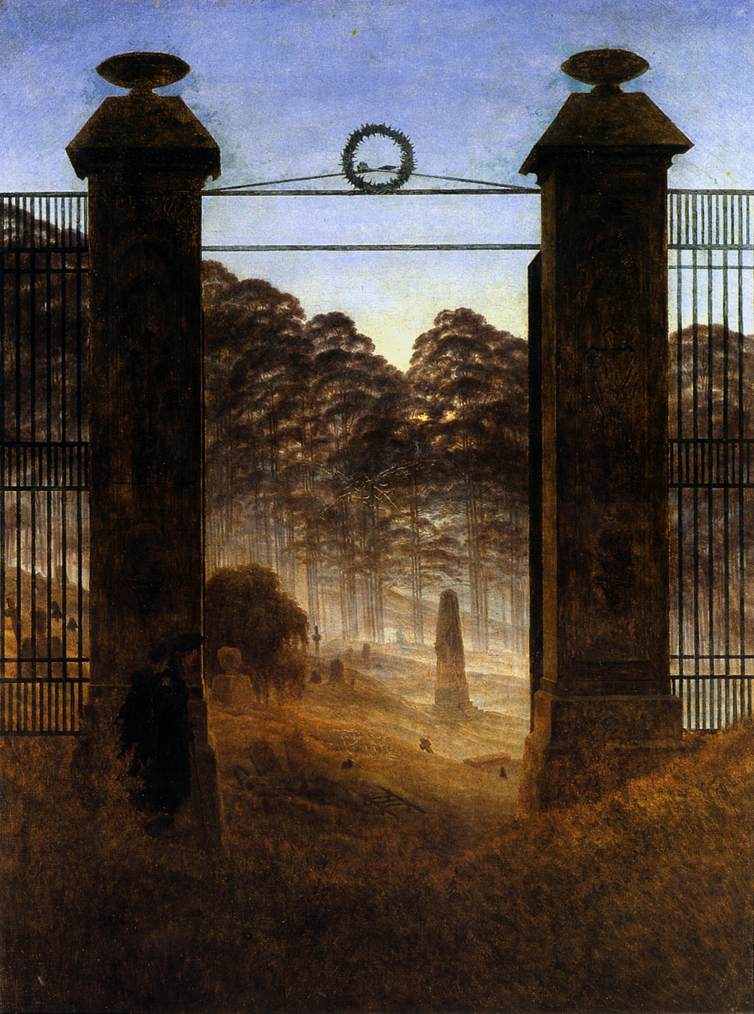
The bogs of the North still now and then give up their small archaeology, and the parish records their old silences; the utburd's crying, the folklorists noted, was last reported from valleys where everyone could still say whose it had been. Friedrich's painting of the churchyard gate—two living figures pausing at the threshold of the ground where all the registered dead lie easy—shows the destination the whole tradition walks toward: the gate is the point; everything in the lore is a map to it. Its instruction survives every change of theology and needs no belief to work: listen, on the night roads of your own history, for the crying that has no child; answer it, knowing what answering costs; let it ride, and walk toward holy ground while the weight doubles and the road softens under you; and at the wall, when you cannot take another step, do the one thing the smallest ghost in the world has waited all this time for someone to do—say what it was, and give it its name, and carry it in through the gate.
Lux Esoterica.
2026.


Comments