Tibetan Ritual Objects: Sound, Symbol, and the Sacred in Buddhist Practice
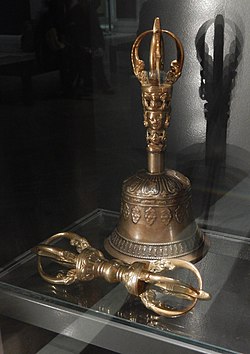
Tibetan Buddhist ritual objects are not decorative accessories to spiritual practice — they are the practice itself, made tangible. The vajra (thunderbolt-scepter) held in the right hand and the bell (ghanta) held in the left are the body and speech of the practitioner unified in physical form: the vajra represents the indestructible compassionate method, the bell the wisdom that realizes emptiness; together they enact the union of skillful means and wisdom that is the essence of the bodhisattva path. The singing bowl (rin gong), which produces a tone when struck or rubbed, is not merely a musical instrument — it is a tool for aligning the practitioner's attention with a specific frequency, for using sound to dissolve the ordinary mental noise that prevents recognition of the mind's natural clarity. Each object in the Tibetan ritual arsenal has been refined over centuries of practice, each detail of its construction encoding a specific intention, each use in ceremony a repetition of an act whose meaning has been transmitted in an unbroken lineage from teacher to student.
 [Unavailable: ❌ https://upload.wikimedia.org/wikipedia/commons/thumb/c/c4/British_Museum_Tibetan_Bell_and_Vajra_B.jpg/250px-British_Museum_Tibetan_Bell_and_Vajra_B.jpg ❌]
Vajra and Bell (ghanta), British Museum — the inseparable ritual pair of Tibetan Buddhist practice; the vajra (right hand, method, skillful means, compassion) and bell (left hand, wisdom, emptiness) are held together in all tantric rituals; their sound and form together express the non-dual nature of reality that the practice aims to recognize
 [Unavailable: ❌ https://upload.wikimedia.org/wikipedia/commons/thumb/c/c8/Vajrasattva_Tibet.jpg/250px-Vajrasattva_Tibet.jpg ❌]
Vajrasattva with ritual implements — the Bodhisattva of purification, holding the vajra to his heart and the bell at his hip; Vajrasattva practice (the 100-syllable mantra repeated 100,000 times) is the foundational purification practice of the Vajrayana path; the image of the deity holding the ritual objects is itself the instruction in their use
 [Unavailable: ❌ https://upload.wikimedia.org/wikipedia/commons/thumb/c/c9/Itsukushima_Jinsha_Bronze_Vadjras_and_Bell_%28477%29.jpg/250px-Itsukushima_Jinsha_Bronze_Vadjras_and_Bell_%28477%29.jpg ❌]
Bronze vajras and bells, Itsukushima Shrine collection — the vajra tradition spread from India through Tibet to Japan, where it entered the Shingon and Tendai schools of esoteric Buddhism; the Japanese dorje (vajra) and kei (bell) are visually and functionally identical to their Tibetan counterparts, demonstrating the fidelity with which tantric transmission preserved its physical as well as textual content
 [Unavailable: ❌ https://upload.wikimedia.org/wikipedia/commons/thumb/b/b1/Klangschale.jpg/250px-Klangschale.jpg ❌]
Tibetan singing bowl — a metal bowl (typically bronze, sometimes containing seven metals corresponding to the seven planets) struck or rubbed with a wooden mallet to produce a sustained tone; the tone can be sustained indefinitely by rubbing, creating a continuous harmonic field that some practitioners use to induce meditative states
 [Unavailable: ❌ https://upload.wikimedia.org/wikipedia/commons/thumb/4/40/WasserKlangschale_2013-09.jpg/250px-WasserKlangschale_2013-09.jpg ❌]
Singing bowl with water — when a singing bowl is partially filled with water and activated by rubbing, the sound waves create visible patterns in the water surface; the geometric patterns formed by standing waves in the water mirror the sacred geometric patterns of tantric iconography; the bowl makes the relationship between sound and form literally visible
 [Unavailable: ❌ https://upload.wikimedia.org/wikipedia/commons/thumb/7/74/Rin_gong_at_Kiyomizu-dera%2C_Kyoto.JPG/250px-Rin_gong_at_Kiyomizu-dera%2C_Kyoto.JPG ❌]
Rin gong (bell), Kiyomizu-dera Temple, Kyoto — the Japanese equivalent of the Tibetan singing bowl, used to mark transitions in temple practice; in Buddhist ritual, the sound of the bell is understood as a teaching: it arises, sustains, and fades in the same way that all phenomena arise, sustain, and fade; to listen to the bell carefully is to hear impermanence
 [Unavailable: ❌ https://upload.wikimedia.org/wikipedia/commons/thumb/e/e8/VanLinhKhanhC.jpg/250px-VanLinhKhanhC.jpg ❌]
Van Linh Khanh temple bells, Vietnam — the bell tradition spread throughout Buddhist Asia, each culture adapting the form while preserving the function; from the enormous bronze bells of Japanese temples (whose resonance is felt as much as heard) to the small hand bells of Tibetan ritual to the wind bells of Southeast Asian pagodas, the same principle operates: sound as a bridge between the ordinary and the sacred
 [Unavailable: ❌ https://upload.wikimedia.org/wikipedia/commons/thumb/7/72/Healing_with_Tibetan_Singing_Bowls_on_Arambol_Beach.jpg/250px-Healing_with_Tibetan_Singing_Bowls_on_Arambol_Beach.jpg ❌]
Tibetan singing bowl sound healing session — the contemporary use of singing bowls in therapeutic contexts extends their traditional application; while their use in formal Tibetan ritual is specific and structured, the bowls' capacity to produce resonant, harmonically rich tones that promote relaxation and focused attention is accessible outside the ritual context
Related Esoteric Inquiries:
- Thangka: Sacred Paintings of the Tibetan Buddhist World
- Esoteric Acoustics: The Architecture of Sound and the Sacred Echo in 2026
- Buddhist Thangkas: Sacred Painting from the Heart of Tibet
Lux Esoterica.
2026.


Comments