Astrolabes and Medieval Astronomy: Instruments of the Heavens
For nearly a thousand years — from the early Islamic astronomers of the 8th century through the Renaissance — the astrolabe was the most sophisticated scientific instrument available to humanity. Part astronomical clock, part navigation device, part calculator, part model of the universe, the astrolabe could determine the time of day from the sun's position, find the altitude of stars, predict the positions of the planets, calculate the times of sunrise and sunset, and locate the direction of Mecca for prayer. But it was also something more than a tool: it was a physical embodiment of the medieval understanding of the cosmos as an ordered, hierarchical, beautiful structure — a machine in the Aristotelian sense, a mechanism whose every part participated in the divine order of the spheres. The astrolabes that survive from medieval Islam, al-Andalus, and Christendom are among the most beautiful scientific instruments ever made, their engraved celestial maps combining mathematical precision with an aesthetic devotion to the order they describe.
 [Unavailable: ❌ https://upload.wikimedia.org/wikipedia/commons/thumb/d/d5/Khalili_Collection_Islamic_Art_sci_0430_back.jpg/330px-Khalili_Collection_Islamic_Art_sci_0430_back.jpg ❌]
9th-century North African astrolabe, Khalili Collection — one of the oldest surviving astrolabes; the rete (the rotating star map showing the positions of the brightest stars) is engraved with extraordinary precision; the Arabic astronomers who developed the astrolabe were simultaneously preserving Greek astronomical knowledge and extending it far beyond what the ancients had achieved
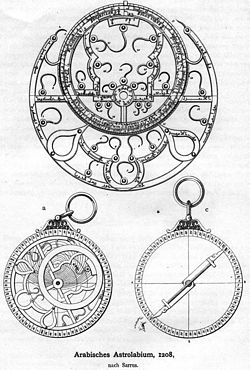 [Unavailable: ❌ https://upload.wikimedia.org/wikipedia/commons/thumb/c/cc/Astrolabium.jpg/250px-Astrolabium.jpg ❌]
Arab astrolabe (1208 CE) — the Ayyubid period in the Middle East produced some of the finest astronomical instruments in history; the geometric precision of the latitude plates (each one recalculated for a specific latitude) and the elegance of the star-pointer rete demonstrate a mathematical sophistication matched by a craftsman's devotion to beauty
 [Unavailable: ❌ https://upload.wikimedia.org/wikipedia/commons/thumb/c/c7/Iranian_Astrolabe_14.jpg/250px-Iranian_Astrolabe_14.jpg ❌]
Iranian astrolabe — the Persian tradition of astronomical instrument-making extended from the early Islamic period through the Safavid era; Iranian astrolabes are characterized by elaborate surface engraving that transforms the instrument into a work of art without compromising its scientific function; beauty and accuracy were understood as complementary, not competing
 [Unavailable: ❌ https://upload.wikimedia.org/wikipedia/commons/thumb/7/7d/Yantraraja_Folio_3.jpg/330px-Yantraraja_Folio_3.jpg ❌]
Yantraraja Sanskrit Manuscript (1382 CE) — the 'King of Instruments,' a Sanskrit treatise on the astrolabe composed by Mahendra Suri at the court of the Gujarat Sultanate; the transmission of the astrolabe from Arabic to Sanskrit demonstrates how astronomical instruments traveled along trade and intellectual routes across the medieval world
 [Unavailable: ❌ https://upload.wikimedia.org/wikipedia/commons/thumb/9/94/Euclid_and_Herman_-_Ashmole_MS_304%2C_fol_2.jpg/250px-Euclid_and_Herman_-_Ashmole_MS_304%2C_fol_2.jpg ❌]
Euclid and Hermann of Reichenau, Ashmole MS 304 (13th century) — Hermann of Reichenau (1013-1054) was one of the first Western scholars to write about the astrolabe, translating and adapting Arabic treatises; this illuminated manuscript shows the transmission of ancient mathematical knowledge through the medieval monasteries that preserved and transmitted it
 [Unavailable: ❌ https://upload.wikimedia.org/wikipedia/commons/thumb/1/17/Tusi_manus.jpg/250px-Tusi_manus.jpg ❌]
Nasir al-Din al-Tusi's astronomical manuscript — al-Tusi (1201-1274) was the greatest astronomer of the medieval Islamic world, whose 'Tusi couple' (a mathematical device for converting circular motion into linear motion) anticipated Copernican planetary theory by three centuries; his manuscripts circulated from Persia to Byzantium to Renaissance Italy
 [Unavailable: ❌ https://upload.wikimedia.org/wikipedia/commons/thumb/b/bd/Richard_of_Wallingford.jpg/250px-Richard_of_Wallingford.jpg ❌]
Richard of Wallingford (c. 1292-1336) measuring an equatorium — the Abbot of St. Albans and the greatest mathematical astronomer of medieval England, who designed an extraordinary mechanical clock for his monastery that modeled the motions of the sun, moon, and planets; he is depicted here with the astronomical instruments that defined the medieval natural philosopher's vocation
 [Unavailable: ❌ https://upload.wikimedia.org/wikipedia/commons/thumb/1/11/Chartres2006_080_detail.jpg/250px-Chartres2006_080_detail.jpg ❌]
Zodiac signs and Labours of the Months, Royal Portal of Chartres Cathedral (c. 1145) — the integration of astronomical and agricultural calendars into sacred architecture; the same portal that depicts the divine hierarchy in its tympana shows the months and zodiac signs in its archivolts, teaching the congregation that sacred time and celestial order are aspects of the same divine reality
Related Esoteric Inquiries:
- Ramon Llull and the Ars Magna: The Medieval Combinatorial Art That Tried to Prove God with a Rotating Machine
- Medieval Marginalia: The Hidden World in Manuscript Borders
- Medieval Alchemical Manuscripts: Art from the Great Work
Lux Esoterica.
2026.


Comments