Medieval Marginalia: The Hidden World in Manuscript Borders
In the margins of medieval manuscripts — alongside the sacred text, in the white space between the holy words and the edge of the vellum — a completely different world exists. Knights fight giant snails. Rabbits hunt men. Monkeys perform surgery. A fox preaches to a congregation of geese. Women joust on the backs of deer. These images, produced by the same craftsmen who painted the exquisitely reverent sacred miniatures on the page's interior, have puzzled scholars for centuries. Were they satirical commentary? Decorative space-filling? The private jokes of scribes weary of copying holy text? Invocations of popular folklore? All of these explanations have been proposed and none entirely satisfies. What is certain is that the medieval mind that produced these images inhabited a world in which the sacred and the absurd were not opposites — in which the space around the holy could be filled with the unholy, and the juxtaposition was not considered blasphemous but somehow appropriate. The margin was the place where the imagination could play.

Geoffrey Luttrell mounted, Luttrell Psalter (c. 1320-1340 CE) — the wealthy Lincolnshire knight Sir Geoffrey Luttrell is depicted being armed for a tournament by his wife and daughter-in-law; the Luttrell Psalter is the richest source of medieval English marginalia, commissioned by Luttrell to demonstrate his piety and status; the full-page illustration exists alongside pages where grotesques and hybrid creatures fill every available margin

Dining scene, Luttrell Psalter — the household of Sir Geoffrey at table, servants bringing food and drink; the Luttrell Psalter is unusual in depicting the actual daily life of a 14th-century English aristocratic household alongside its religious content; the margins of these scenes often contain hybrid creatures whose relationship to the depicted reality is deliberately ambiguous

Grotesque figure, Luttrell Psalter — the hybrid creature that is the most characteristic product of medieval marginal imagination; part human, part animal, part architectural ornament, the grotesque embodies the medieval understanding that the boundary between categories is permeable; in the margin, the categories that the sacred text establishes can be playfully dissolved

Taborer playing pipe and drum, Luttrell Psalter — the musician in the margin of a sacred text; music occupies an ambiguous position in medieval theology: sacred music was devotional, secular music was suspect; the presence of a folk musician in the margin of a psalter may be a visual joke about the competition between sacred and secular entertainment, or simply a record of a world the scribe knew and loved

Marginalia from the Roman de la Rose (13th-14th century) — the most widely copied secular poem of the medieval period generated its own marginalia tradition; the poem's allegorical love narrative attracted illustrations and marginal commentary that ranged from devotional to bawdy; the manuscript tradition allowed readers to literally write their responses in the margins, creating a visual conversation between text and image
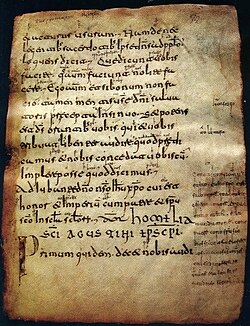
Glosas Emilianenses (c. 10th-11th century CE) — the manuscript containing the oldest surviving phrases in Castilian (Old Spanish) and Basque, written as glosses (explanatory notes) in the margins of a Latin liturgical text; the gloss tradition is marginalia in its most functional form — the scribe translating difficult Latin words into the vernacular for readers who needed help; the margin becomes a translation zone
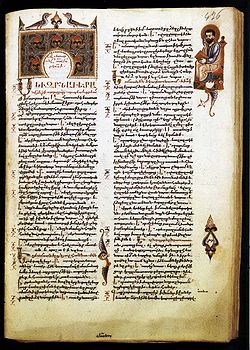
Armenian illuminated manuscript by Sargis Pitsak (14th century CE) — the Armenian manuscript tradition developed a distinctive marginalia style combining Byzantine formal elements with indigenous decorative motifs; birds, flowers, and interlace patterns fill the margins of Armenian Gospel books with the same devotional energy that fills their text; marginalia is not marginal — it is the text's sacred surround


Comentarios